
Lívia e a "institucionalização" da mulher romana
DOI:
https://doi.org/10.34024/herodoto.2022.v7.15475Palavras-chave:
Mulheres romanas, Moedas, Deusas, Patriarcado, Público/privado, Dominância masculinaResumo
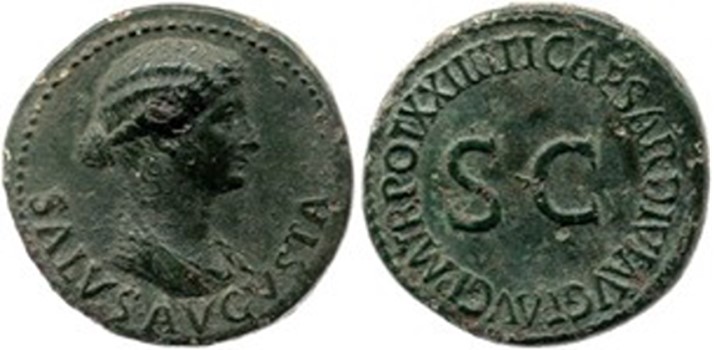
Para este trabalho, é fundamental atentar para o que já foi comentado até hoje sobre o patriarcado, averiguando-o no passado romano. Nesse sentido, este artigo tem como intuito realizar um convite ao pensamento e à reflexão acerca da posição da mulher na sociedade antiga, averiguando o caso de Lívia e a hipótese de como ela foi “institucionalizada”. Ela foi esposa de Augusto, mas anteriormente tinha sido casada com Tibério Claudio Nero, com o qual teve Tibério e Druso como filhos. Otávio arranjou o divórcio para ela se casar com ele, o qual estava casado com Escribônia. Ele soube unir uma linha da necessidade de Lívia se mostrar com dotes tradicionais e poder dentro da domus, com seu papel ligado às coisas do Estado. Sua posição acabava por ser dúbia, pois era alguém que tinha um papel público, mas não tinha uma posição pública. A presença e a atuação de Lívia poderiam estar atreladas às questões religiosas, as quais serão reportadas neste estudo através de fontes textuais, de autores como Tácito, Dião Cássio e Suetônio, e de fontes materiais, como as moedas.
Métricas
Downloads
Referências
Autores antigos
CASSIUS DIO. Roman History. Edited by E. Cary, London, G. B. Putman, 1925.
SUETONIUS. The Twelve Caesars. translation by Robert Graves, Penguin Books, Harmondsworth, 1957.
TACITUS, P. C. The Annals and The Histories. Tradução: Church, A. J. & Brodribb, W. J. Great Britain: Penguin Classics, 1952.
Documentação numismática
Coleção Numismática do Classical Numismatic Group, disponível em: https://www.cngcoins.com/, último acesso: 25/04/2022.
Coleção Numismática do Heritage Action: the world’s largest Numismatic Auctioneer, disponível em: https://www.ha.com/, último acesso: 25/04/2022.
Coleção Numismática do Museu Britânico, disponível em: https://www.britishmuseum.org/collection, último acesso: 25/04/2022.
Referências bibliográficas
ALVAREZ, Sonia E.; DAGNINO, Evelina; ESCOBAR, Arturo. (eds). Cultures of Politics of Cultures. Re-visioning Latin American Social Movements. Boulder, Colorado: Westview Press, 1998.
BARRETT, Anthony. A. Livia: first lady of Imperial Rome. New Haven: Yale University Press, 2002.
BOATWRIGHT, Mary, T. Woman and gender in the forum romanum. Transactions of the American Philological Association, 141, 2011, p. 105–141.
BOURDIEU, P. Novas reflexões sobre a dominação masculina. In: LOPES, M. J. M.; MEYER, D. E.; WALDON, V. R. (orgs.). Gênero & Saúde. Porto Alegre: Artes Médicas, 1996.
______. A dominação masculina. Rio de Janeiro: Bertrand Brasil, 1998.
CHARTIER, R. Diferença entre os sexos e a dominância simbólica (nota crítica). Cadernos Pagu, (4), 1995, p. 37–47.
CID LÓPEZ, Rosa M. La matrona y las mujeres de la Roma antigua. Um estereotipo feminino a través de las imágenes religiosas y las normas legales. In: Mujeres em la Historia, el arte y el cine: discursos de género, variantes de contenidos y soportes: de la palavra al audiovisual. Salamanca: Ediciones Universidad de Salamanca, 2011, p. 55–70.
FLORY, Marleen B. The meaning of Augusta in Julio-Claudian period. American Journal of Acient History, 132, 1998, p. 113–138.
GODDARD, Victoria, A. Introduction. In: GODDARD, V. A. (ed.). Gender, agency and change: Anthropological perspectives. Londres e Nova York: Routledge: Taylor and Francis Group, 2000.
GRETHER, Gertrude. Livia and the Roman Imperial Cult. The American Journal of Philology, v. 67, n. 3, 1946, p. 222–252.
HALLETT, Judith P. Fathers and daughters in Roman society: women and the elite family. Princeton, New Jersey: Princeton University Press, 1984.
HARVEY, Tracene. Julia Augusta: images of Rome’s first empress on the coins of the Roman empire. London; New York: Routledge; Tayor & Francis Group, 2020.
HEMELRIJK, Emily A. Matrona docta: educated women in the Roman elite from Cornelia to Julia Domna. London; New York: Routledge; Taylor & Francis Group, 1999.
KIMMEL, Michael S. Masculinidade como homofobia, medo, vergonha e silêncio na construção de identidade de gênero. Tradução: Sandra M. Takakura. Equatorial. v. 3, n. 4, 2016, p. 97–124.
MARTINS, Paulo. Imagem e poder: considerações sobre a representação de Otávio Augusto. São Paulo: Edusp, 2011.
PERKOUNING, C. M. Livia Drusilla-Iulia Augusta. Vienna, 1995.
PISCITELLI, Adriana. Re-criando a (categoria) mulher? In: Algranti, L. M. (org.). A prática feminista e o conceito de gênero. 2002, p. 7–42.
SCOTT, J. W.; KAPLAN, C.; KEATES, D. (eds). Transitions, Environments, Translations. Feminisms in International Politics. London and New York: Routledge, 1997.
SPAETH, Barbette S. The Roman goddess Ceres. Austin: University of Texas Press, 1996.
TAKÁCS, Sarolta A. Vestal Virgins, Sibyls, and matrons: women in roman religion. Austin: University of Texas Press, 2008.
TEMPORINI, H. Die Fruen am Hofe Trajans. Ein Beitrag zur Stellung der Augustae im Principat. Berlin; New York, 1978.
WOOD, Susan. E. Memoriae Agrippinae: Agrippina the Elder in Julio-Claudian Art and Propaganda. AJA, 92, 1988, p. 409–26.
______. Imperial women: a study in public images, 40 BC - AD 68. Leiden, Boston, Koln: Brill’s Scholars’ List, 1999.
WINKLER, Lorenz. Salus: Vom Staatskult zur politischen idee, eine, Archäologische Untersuchung. Heidelberg: Verlag Archäologie und Geschichte, 1995.
ZAGER, Ilona. The political role of women of the Roman elite, with particular attention to the autonomy and influence of the Julio-Claudian women (44 BCE to CE 68). Submitted in accordance with the requirements for the degree of Master of Arts, in the subject of Classical Studies, at the University of South Africa, Pretoria, 2014.
Downloads
Publicado
Edição
Seção
Licença
Copyright (c) 2023 Heródoto: Revista do Grupo de Estudos e Pesquisas sobre a Antiguidade Clássica e suas Conexões Afro-asiáticas

Este trabalho está licenciado sob uma licença Creative Commons Attribution-NonCommercial-NoDerivatives 4.0 International License.
Autores que publicam nesta revista concordam com os seguintes termos:
- Autores mantém os direitos autorais e concedem à revista o direito de primeira publicação, com o trabalho simultaneamente licenciado sob aLicença Creative Commons Attribution que permite o compartilhamento do trabalho com reconhecimento da autoria e publicação inicial nesta revista.
- Autores têm autorização para assumir contratos adicionais separadamente, para distribuição não-exclusiva da versão do trabalho publicada nesta revista (ex.: publicar em repositório institucional ou como capítulo de livro), com reconhecimento de autoria e publicação inicial nesta revista.
- Autores têm permissão e são estimulados a publicar e distribuir seu trabalho online (ex.: em repositórios institucionais ou na sua página pessoal) a qualquer ponto antes ou durante o processo editorial, já que isso pode gerar alterações produtivas, bem como aumentar o impacto e a citação do trabalho publicado (Veja O Efeito do Acesso Livre).