
A magister navigandi chosen in the middle of the tempest
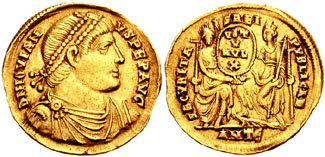
Jovian and entropy (363 – 364)
DOI:
https://doi.org/10.34024/herodoto.2021.v6.13919Keywords:
Entropy, Jovian, Fourth Century, Late AntiquityAbstract
This article explores the Roman imperial context between 363 and 364. It aims to present an interpretative key that allows the analysis of the scarcely studied period of Emperor Jovian’s government. For this purpose, the authors propose the use of the concept of entropy, found in Political Science, and carved out by means of the information found in various ancient sources which narrate the development of Jovian’s actions, such as the ones written by Ammianus Marcellinus, Zosimus, Libanius, and Paulus Orosius. Following this itinerary, the authors search for the particularity of the political and military process which took place in the second half of the fourth century and propose a concept that can be useful for future studies on the Late Antiquity.
Metrics
Downloads
References
APIANO. Guerras Civiles. Trad. Antonio Sancho Royo. Madri: Gredos, 1985.
AMIANO MARCELINO. The History. Trad. John C. Rolfe. Londres:William Heinemann LTD, 1982. 3v. (The Loeb Classical Library).
ANÔNIMO. Sobre Asuntos Militares. Trad. Álvaro Sánchez-Ostiz. Pamplona: Ediciones Universidade de Navarra, 2004.
CARVALHO, Margarida Maria de; OMENA, Luciane Munhoz. Considerações sobre memória e morte do Imperador Juliano nos testemunhos de Libânio e Amiano Marcelino (século IV d.C.). História. São Paulo, v. 35, e. 84, 2016, p. 01-15.
EUNÁPIO. Fragments. Trad. R. C. Blockley. Liverpol: Francis Cairns, 1983.
FRIGHETTO, Renan. A antiguidade tardia: Roma e as monarquias romano-bárbaras. Curitiba: Juruá, 2012.
GONÇALVES, Ana Teresa Marques; TAVARES, Wendryll José Bento. Como fazer um tratado com os persas? Uma análise do processo de negociação da paz entre romanos e persas em 363 d.C. Romanitas – Revista de Estudos Grecolatinos, Vitória, n. 14, p. 33-46, jul.-dez., 2019.
GOLDSWORTHY, Adrian. Em Nome de Roma. São Paulo : Planeta do Brasil, 2016.
HEATHER, Peter. Ammianus on Jovian : History and literature. In: DRIJVERS, J. W.; HUNT, D. The Late Roman World and its Historian: Interpreting Ammianus Marcellinus. Londres: Routledge, 2005. p. 93-103.
___; MONCUR, David. Politics, Philosophy, and Empire in the Fourth Century: Selected Orations of Themistius. Liverpool: Liverpool University Press, 2001.
HUNT, David. The sucessors of Constantine. In: CAMERON, A.; GARNSEY, P. The Cambridge Ancient History: The Late Empire, A.D. 337-425 (Volume XIII). Cambridge: Cambridge University Press, 1998., v. 13, p. 01-43.
JOÃO CRISÓSTOMO. Homilies on Phillipians. Trad. Pauline Allen. Atlanta: Society of Biblical Literature, 2013.
JONES, A. H. M. The Later Roman Empire (284-602). Oxford: Basil Blackwell, 1964. 3v.
KULIKOWSKI, Michael. Imperial Tragedy: from Constantine’s Empire to the Destruction of Roman Italy (AD 363-568). Londres: Profile Books, 2019.
LESSA, Renato. A Invenção Republicana: Campos Sales, as bases e a decadência da Primeira República brasileira. Rio de Janeiro : Topbooks, 2015.
LIBÂNIO. Discursos. Trad. Ángel González Gálvez. Madri: Gredos, 2001.
PAULO ORÓSIO. History Against the Pagans. Trad. A. T. Fear. Liverpool: Liverpool Press University, 2010.
SOCRATES. The Ecclesiastical History. Rev. A. C. Zenos. Edimburgo: T & T Clark, 1993.
SOZOMENO. The Ecclesiastical History. Trad. Chester D. Hartranft. Nova York: Christian Literatura Publishing Co., 1890.
TEMÍSTIO. Politics, Philosophy, and Empire in the Fourth Century: Selected Orations of Themistius. Trad. Peter Heather e David Moncur. Liverpool: Liverpool University Press, 2001.
TROMBLEY, Frank. Ammianus Marcellinus and fourth-century warfare: a protector’s approach to historical narrative. In: DRIJVERS, J. W.; HUNT, D. The Late Roman World and its Historian: Interpreting Ammianus Marcellinus. Londres : Routledge, 2005. p. 16-26.
VEGÉCIO. Compêndio da Arte Militar. Trad. J.G. MONTEIRO e J. E. BRAGA. Coimbra: Imprensa da Universidade de Coimbra, 2009.
Downloads
Published
Issue
Section
License
Copyright (c) 2022 Heródoto: Revista do Grupo de Estudos e Pesquisas sobre a Antiguidade Clássica e suas Conexões Afro-asiáticas

This work is licensed under a Creative Commons Attribution-NonCommercial-NoDerivatives 4.0 International License.
Autores que publicam nesta revista concordam com os seguintes termos:
- Autores mantém os direitos autorais e concedem à revista o direito de primeira publicação, com o trabalho simultaneamente licenciado sob aLicença Creative Commons Attribution que permite o compartilhamento do trabalho com reconhecimento da autoria e publicação inicial nesta revista.
- Autores têm autorização para assumir contratos adicionais separadamente, para distribuição não-exclusiva da versão do trabalho publicada nesta revista (ex.: publicar em repositório institucional ou como capítulo de livro), com reconhecimento de autoria e publicação inicial nesta revista.
- Autores têm permissão e são estimulados a publicar e distribuir seu trabalho online (ex.: em repositórios institucionais ou na sua página pessoal) a qualquer ponto antes ou durante o processo editorial, já que isso pode gerar alterações produtivas, bem como aumentar o impacto e a citação do trabalho publicado (Veja O Efeito do Acesso Livre).