
The Archaeology of Ethnicity and Race in the Roman World
The Jewish Black Moses Case
DOI:
https://doi.org/10.34024/herodoto.2025.v10.22731Keywords:
Archaeology, Classics and Race, Dura Europos, Cultural WhitewashingAbstract
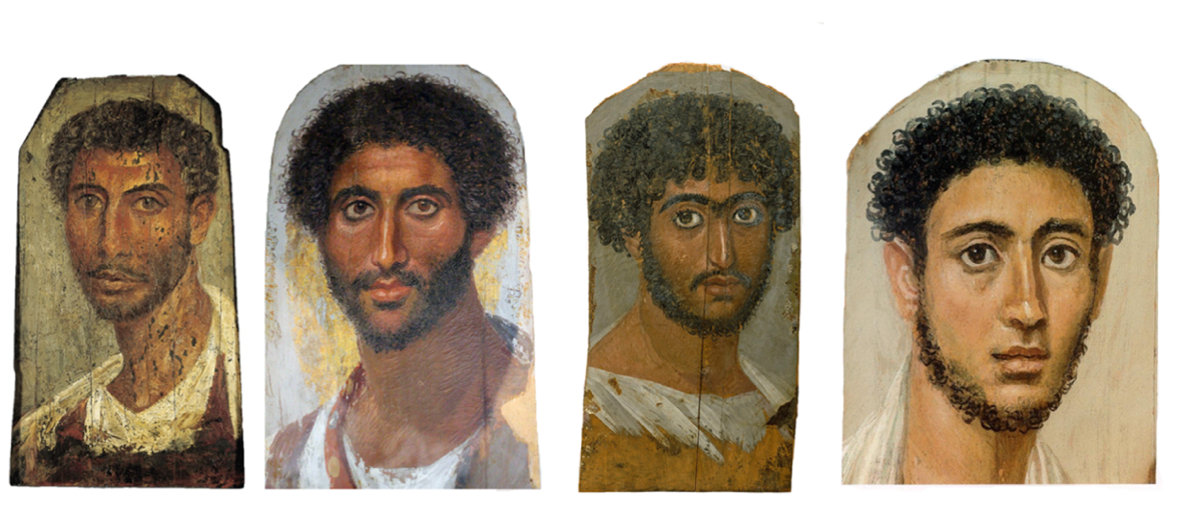
In this article, we examine archaeological interpretations of ethnicity and race in the Roman world, with a special focus on the representation of Moses in the Middle East, particularly in Syria. We argue that ethnicity is a dynamic and instrumental phenomenon expressed through materiality and social practices. Our paper highlights how representations of Moses in the Dura Europos synagogue (244-245 CE) clearly depict a dark-skinned man, contradicting the later appropriation that whitewashed his image in Greco-Roman art. We demonstrate that the whitewashing process was intentional, propagating a false notion of aesthetics for centuries. We also explore how concepts of race and blackness were distorted to legitimize racism, particularly through the appropriation of the Ham myth. We conclude that archaeology provides crucial evidence for understanding ethnic and racial diversity in antiquity, challenging hegemonic narratives that have erased the presence and importance of marginalized peoples (especially Black and Jewish people) in the ancient world.
Downloads
References
AGBE-DAVIES, Anna S. Archaeology and Race. Oxford: Oxford University Press, 2020. doi: 10.1093/OBO/9780199766567-0239.
ARNOLD, Bettina. Justifying genocide: Archaeology and the construction of difference. In: HINTON, A. L.; ROTH, K. (eds). Annihilating difference: The anthropology of genocide. Berkeley: Univ. of California Press, 2002, pp. 95–116.
BATCHELOR, David. Chromophobia. Reaktion Books, 2000.
CARMI, Shai; HUI, K.Y.; KOCHAV, E.; LIU, X.; XUE, J.; GRADY, J.; GUHA, S.; UPADHYAY, K.; BEN-AVRAHAM, B.; MUKHERJEE, S.; BOWEN, B. M.; THOMAS, T.; VIJAI, J.; GRUTS, M.; FROYEN, G.; LAMBRECHTS, D.; PLAISANCE, S.; VAN BROECKHOVEN, C.; VAN DAMME, P.; VAN MARCK, H.; BARZILAI, N.; DARVASI, A.; OFFIT, K.; BRESSMAN, S.; PE’ER, I. Sequencing an Ashkenazi reference panel supports population-targeted personal genomics and illuminates Jewish and European origins. Nat Commun 5, 4835, 2014. https://doi.org/10.1038/ncomms5835
CLARKE, John R. ‘Just Like Us’ Cultural Constructions of Sexuality and Race in Roman Art. In: PINDER, Kymberly (ed.) Race-ing Art History: Critical Readings in Race and Art History, 2002.
COLLAR, A. Re-thinking Jewish ethnicity through social network analysis. In: KNAPPETT, C., (ed.). Network Analysis in Archaeology. New Approaches to Regional Interaction. Oxford: Oxford University Press, 2013.
DE BUFFON, Georges Louis Leclerc. Barr’s Buffon. Buffon’s Natural History, Containing a Theory of the Earth, a General History of Man etc.. Translated by J. S. Barr. London: Barr, vol. 4, 1792.
DEE, James H. Black Odysseus, White Caesar: When Did “White People” Become “White”? The Classical Journal, v. 99, n. 2 (Dec., 2003 - Jan., 2004), 2004, p. 157-167.
DENCH, Emma. Romulus’ Asylum: Roman Identities from the Age of Alexander to the Age of Hadrian. Oxford University Press, 2005.
DERBEW, Sarah. Untangling Blackness in Greek Antiquity. Cambridge: Cambridge University Press, 2022
DIETLER, M. Anthropological Reflections on the Koine Concept: Linguistic Analogies and Material World. In: HANDBERG, S.; GADOLOU, A. (eds.). Material Koinai in the Greek Early Iron Age and Archaic Period. Acts of an International Conference at the Danish Institute at Athens 30 January–1 February 2015, Monographs of the Danish Institute at Athens 22 (Aarhus 2017). 2017, p. 17–39.
EFRON, John M. Defenders of the Race, Jewish Doctors and Race Science in Fin-De-Siècle Europe. New Haven and London: Yale University Press, 1994.
EL-KODSI, Mourad. The Karaite Jews of Egypt, 1882-1986. Virginia: Wilprint, 1987.
FANTALKIN, Alexander; TAL, Oren. The Canonization of the Pentateuch: When and Why? Zeitschrift für die Alttestamentliche Wissenschaft 124/1 (Part I): 1–18; 124/2 (Part II): 201–212. 2012.
FINKELSTEIN, Israel. The Archaeology of the United Monarchy: An Alternative View. Levant 28, 1996, p. 177-187.
FINKELSTEIN, Israel; SILBERMAN, N.A.. The Bible Unearthed, Archaeology’s New Vision of Ancient Israel and the Origin of its Sacred Texts. New York, 2001, p. 72-96.
FINKELSTEIN, Israel. City States and States: Polity Dynamics in the 10th-9th Centuries B.C.E. DEVER, W.G.; GITIN, S. (eds.). Symbiosis, Symbolism and the Power of the Past: Canaan, Ancient Israel, and their Neighbors. Winona Lake, 2003, p. 75-83.
FINKELSTEIN, Israel. Jerusalem in the Persian (and Early Hellenistic) Period and the Wall of Nehemiah. Journal for the Study of the Old Testament, 32, 2008, 501-520.
FINKELSTEIN, Israel. The Forgotten Kingdom: The Archaeology and History of Northern Israel. Atlanta, 2013, p. 37-61.
FORSDYKE, Sara. Slaves and Slavery in Ancient Greece. Cambridge: Cambridge University Press, 2021.
FUNARI, Pedro Paulo. Maroon, race and gender: Palmares material culture and social relations in a runaway settlement. In: FUNARI, P.P.A.; HALL, M.; JONES, S. (Org.). Historical Archaeology, Back from the edge. Londres: Routledge, 1999, p. 308-327.
GATES-FOSTER, Jennifer. Achaemenids, Royal Power, and Persian Ethnicity. In: MCINERNEY, J (ed). A Companion to Ethnicity in the Ancient Mediterranean. John Wiley & Sons Publishers, 2014, p. 175-193.
GILMAN, Sander L. The Jewish Nose: Are Jews White? Or, the History of the Nose Job. In: SILBERSTEIN, Laurence J.; COHN, Robert L (eds). The Other in Jewish Thought and History: Constructions of Jewish Culture and Identity. New York and London: New York University Press, 1994, pp. 364–401.
GOLDENBERG, David. The Development of the Idea of Race: Classical Paradigms and Medieval Elaborations. International Journal of the Classical Tradition, 5, 1999, p. 561-570.
GOLDENBERG, David. The Curse of Ham: Race and Slavery. In: Early Judaism, Christianity, and Islam. Princeton: Princeton University Press, 2003a.
GOLDENBERG, David M. Review Essay. Abraham Melamed, The Image of the Black in Jewish Culture: A History of the Other. London and New York: Routledge Curzon, 2003. p. 295. Jewish Quarterly Review, 93, 2003b, p. 1-18.
GOLDENBERG, David M. Racism, Color Symbolism, and Color Prejudice. In: ELIAV-FELDON, Miriam; ISAAC, Benjamin; ZIEGLER, Joseph (eds). The Origins of Racism in the West. Cambridge: Cambridge University Press, 2009, p. 88-108.
GOSDEN, Chris. Archaeology and Colonialism. Cambridge: Cambridge University Press, 2004.
GOSDEN, Chris. What Do Objects Want? Journal of Archaeological Method and Theory, 12, 3, 2005, p. 193-211.
GOSDEN, Chris. Race and racism in archaeology: Introduction. World Archaeology, 38, 1, 2006, p. 1–7.
GREEN, Toby. Beyond Culture Wars: Reconnecting African and Jewish Diasporas in the Past and the Present”. In: BHAMBRA, Gurminder K. et al (eds). African Athena: New Agendas. Oxford University Press, 2001, p. 138-155.
GRUEN, Erich. Did Ancient Identity Depend on Ethnicity? A Preliminary Probe. v. 67, n. 1/2 (Spring-Summer/printemps-été 2013), 2013, p. 1-22.
HA.C.OHEN, Ran. The “Jewish Blackness” Thesis Revisited. MDPI, Religions, 2018, 9, 222; doi:10.3390/rel9070222.
HALL, S. New Ethnicities. In: Black Film, British Cinema. ICA Documents 7. London: Institute of Contemporary Arts, 1989, p. 27-31.
HACHLILI, R. Ancient Jewish Art and Archaeology in the Diaspora. Handbook of Oriental Studies. The Near and Middle East 35. Leiden, 1998.
HACHLILI, R. Ancient Synagogues – Archaeology and Art: New Discoveries and Current Research. Handbook of Oriental Studies. The Near and Middle East 105. Leiden, 1989.
HARLAND, Philip. Climbing the Ethnic Ladder: Ethnic Hierarchies and Judean Responses. Journal of Biblical Literature, v. 13, n. 3, 2019, p. 665-686.
HEZSER, Catherine. From Lawgiver to Prophet: The Transformation of the Image of Moses in Late Antiquity. SOAS, University of London, 2021, p.1-24.
HITLER, Adolf. Mein Kampf. Translated by James Murphy. Stockholm: White Wolf, 2014.
HODDER, I.; ORTEN, C. Spatial Analysis in Archaeology. Cambridge: Cambridge University Press, p. 1976.
HODDER, I.. Pre-Roman and Romano-British tribal economies. In: BURNHAM, B. C.; JOHNSON (eds). Invasion and Response. Oxford: British Archaeological Reports British Series 73, 1979a, p. 189-196.
HODDER, I. Economic and social stress and material culture patterning. American Antiquity, 44, 1979b, p. 446–454.
HODDER, I. Symbols in action. Ethnoarchaeological studies of material culture. Cambridge: Cambridge University Press, 1982.
HODDER, I. Reading the Past: current approaches to interpretation in archaeology. Cambridge: Cambridge University Press, 1986.
HODDER, I. Entangled: An Archaeology of the Relationships between Humans and Things. Wiley-Blackwell: John Wiley and Sons Inc. 2012.
HOPKINS, Susan M. My Dura-Europos: the letters of Susan M. Hopkins, 1927-1935. Bernard Goldman, Norma Goldman. Detroit [Mich.]: Wayne State University Press, 2011.
ISAAC, B. The Invention of Racism in Classical Antiquity. New Jersey, Princeton University Press, 2004.
ISAAC, B. Proto-racism in Graeco-Roman Antiquity. World Archaeology, 38, 1, 2006, p. 32–48.
ISAAC, B. Racism: A Rationalization of Prejudice. In: ELIAV-FELDON, Miriam; ISAAC, Benjamin; ZIEGLER, Joseph (eds). The Origins of Racism in the West. Cambridge: Cambridge University Press, 2009, p. 32-56.
JOHNSON, Sylvester A. The Myth of Ham in Nineteenth-Century American Christianity: Race, Heathens, and the People of God. New York: Palgrave Macmillan, 2004.
JONES, Edward L. Blacks in Antiquity: Ethiopians in the Greco-Roman Experience, by Frank M. Snowden Jr., Cambridge, Mass.: Harvard University Press. Sausalito, CA, The Black Scholar, February, 1971, pp-56-59.
JONES, Siân. The Archaeology of Ethnicity. Constructing identities in the past and present. London: Routledge, 1997.
KAREGA, Munene; SCHMIDT, Peter. Postcolonial archaeologies in Africa: Breaking the silence. The African Archaeological Review, 27, 4, 2010, p. 323–337.
KNOX, Robert. The Races of Man. Philadelphia: Lea & Blanchard, 1850.
KIMES, T.; HASELGROVE, C.; HODDER, I. A method for the identification of the location of regional cultural boundaries. Journal of Anthropological Archaeology, 1, 1982, p. 113–131.
KRAELING, C. H. The Synagogue. The Excavations at Dura-Europos, Final Report VIII, Part I. New Haven, 1956.
LAWRENCE; BERMAN; FREED, RITA, E.; DOXEY, Denise. Arts of Ancient Egypt. Museum of Fine Arts Boston, 2003. ISBN 0-87846-661-4.
LEVINE, L. I. Visual Judaism in Late Antiquity. Historical Contexts in Jewish Art. New Haven, 2012.
LEIBNER, U.; HEZSER, C. (eds.). Jewish Art in Its Late Antique Context. TSAJ 163, Tübingen. 2016.
LIPSCHITS, Oded.; OEMING, M. (eds.). Judah and the Judeans in the Persian Period. Winona-Lake, 2006.
LIPSCHITS, Oded. Age of Empires: The History and Administration of Judah in the 8th–2nd Centuries BCE in Light of the Storage-Jar Stamp Impressions (Mosaics: Studies on Ancient Israel 2). Tel Aviv and University Park, PA, 2021.
MCCOSKEY, Denise. Race: Antiquity and its Legacy (Ancients and Moderns). Oxford University Press, 2012.
MCCOSKEY, D. M. Black Athena, White Power. Are We Paying the Price for Classics’ Response to Bernal?. Eidolon, nov. 15, 2018. https://eidolon.pub/black-athena-white-power-6bd1899a46f2
MCGUIRE, R.H. A Marxist Archaeology. London: Academic Press, 1992.
MILLER, Michael T. Black Judaism(s) and the Hebrew Israelites. Religion Compass, 13, e12346., 2019, p. 1-10. https://doi.org/10.1111/rec3.12346.
MELAMED, Abraham. The Image of the Black in Jewish Culture: A History of the Other. London and New York: Routledge Curzon, 2003.
MOORMANN, Eric M. The Murals of the Synagogue at Dura Europos as an Expression of Roman Koine. In: HAUG, Annette; LAURITSEN, Tayler M (eds). Principles of Decoration in the Roman World. Decor, De Gruyter, 2021, p.141-161.
NERLICH, Andreas G.; FISCHER, Lukas; PANZER, Stephanie; BICKER, Roxane; HELMBERGER, Thomas; SCHOSKE, Sylvia. The infant mummy’s face—Paleoradiological investigation and comparison between facial reconstruction and mummy portrait of a Roman-period Egyptian child. PLoS ONE, 15, 9, 2020, e0238427. https://doi.org/10.1371/journal.pone.0238427.
OAKES, Lorna; GAHLIN, Lucia. Ancient Egypt: An Illustrated Reference to the Myths, Religions, Pyramids and Temples of the Land of the Pharaohs. Hermes House, 2002. ISBN 1-84477-008-7.
OLSEN, B.; KOBYLINSKI, Z. Ethnicity in anthropological and archaeological research: a Norwegian—Polish perspective. Archaeologia Polona, 29, 1991, p. 5–27.
ORSER, Charles E., Jr. Race and practice in archaeological interpretation. Philadelphia: Univ. of Pennsylvania Press, 2004.
PRICHARD, James Cowles. The Natural History of Man. London: H.Baillière, 1843
RANKINE, Patrice. Black Apollo? Martin Bernal’s Black Athena: The Afroasiatic Roots of Classical Civilization, volume iii, and Why Race Still Matters. In: ORRELLS, Daniel; BHAMBRA, Gurminder K.; ROYNON, Tessa (eds). African Athena: New Agendas. New York: Oxford University Press, 2011, p. 40-55.
RENFREW, C. Space, time and polity. In: FRIEDMAN, J.; ROWLANDS, M. J. (eds). The Evolution of Social Systems. London: Duckworth, 1977, p. 89–112.
ROYMANS, Nico. Conquest, Mass Violence and Ethnic Stereotyping: Investigating Caesar’s Actions in the Germanic Frontier Zone. Journal of Roman Archaeology, v. 32, 2019, p. 439–58.
ROSTISLAVA, Todorova G. Sacred Space on Display: The place where God dwells and its visual representation. Acta Musei Tiberiopolitani, v. 3, Strumica: Издавач, 2020, p. 121-133.
ROTH, Ulrike. Thinking Tools: Agricultural Slavery between Evidence and Models. EDWARDS, Mike (ed). Bulletin of the Institute of Classical Studies Supplements. London: Institute of Classical Studies, 2007.
ROWLANDS, M. J. Processual archaeology as historical social science. In: RENFREW, C.; ROWLANDS, M. J.; SEAGRAVES, B. A. (eds). Theory and Explanation in Archaeology, London: Academic Press, 1982, p. 155–74.
SAMUELS, T. The riddle in the dark: re-thinking ‘blackness’ in Graeco-Roman racial discourse. Toronto: York Unversity, 2013.
SAMUELS, Tristan. Herodotus and the Black Body: A Critical Race Theory Analysis. Journal of Black Studies, v. 46, n. 7, 2015, p. 723-741.
SAND, Shlomo. The Invention of the Jewish People. Translated by Yael Lotan. London: Verso, 2009.
SCHORSCH, Jonathan. Black, Jews and the Racial Imagination in the Writings of Sephardim in the Long Seventeenth Century. Jewish History, v. 19, n. 1, 2005, p. 109-135.
SHETH, Falguni A. The Technology of Race and the Logics of Exclusion The Unruly, Naturalization, and Violence. In: SHETH, Falguni A. Toward a Political of Race. New York: State Univ of New York, 2004, p. 21-39.
SHENNAN, S. J. (ed.). Archaeological Approaches to Cultural Identity. London: Unwin & Hyman; Routledge, pbk 1994., 1989, p. 1-32.
SHEPHERD, Gillian. Archaeology and Ethnicity. Untangling Identities in Western Greec. Dans Dialogues D’Historire Ancienne, Supplement 10, 2014, p. 115-143.
STERN, Fritz. Gold and Iron: Bismarck, Bleichröder, and the Building of the German Empire. London: G. Allen & Unwin, 1977.
SKOVMØLLER, Amalie. Facing the Colours of Roman Portraiture: Exploring the Materiality of Ancient Polychrome Forms. De Gruyter Press, 2020.
SNOWDEN, Frank M. J. Blacks in Antiquity: Ethiopians in the Greco-Roman Experience. Cambridge, Massachusetts: Belknap Press, 1970, ISBN 0674076265.
SNOWDEN, F. M. J. Before Color Prejudice: The Ancient View of Blacks. Cambridge, Massachusetts: Harvard University Press, 1983, ISBN 0674063813.
TAL, Oren. Aspects of the Study of the Material Culture of Hellenistic Ptolemaic and Seleucid Palestine. Ph.D. Dissertation, Tel Aviv University, 2002.
TALBOT, M. O. A Deuteronomic Theme and Second Sophistic Rhetoric in the Dura-Europos Synagogue Paintings. In: HEYN, M. K.; STEINSAPIR, A. I. (eds.). Icon, Cult, and Context. Sacred Spaces and Objects in the Classical World. Los Angeles: UCLA Monograph 82, 2016, p. 91–102.
TALGAM, R. From Wall Paintings to Floor Mosaics: Jewish and Christian Attitudes to Figurative Art. In: LEIBNER, U.; HEZSER, C. (eds.). Jewish Art in Its Late Antique Context. Tübingen, TSAJ, 163, 2016, p. 97–120.
TEIXEIRA-BASTOS, M. Arqueología del Mundo Antiguo: Los Judíos en la Antigüedad Tardía y Modernidad. In: RODRÍGUEZ, Roberto R. (Org.). Sociedade Antiguas del Crescente Fértil - Territorios, Memorias e Identidades Culturales. 1ed. Buenos Aires: Remitente Patagonia, v. 3, 2021, p. 429-460.
THOMPSON. Lloyd A. Romans and Blacks. London: Routledge; Oklahoma University Press, 1989.
TROPE; B. T.; QUIRKE, S.; LACOVARA, L. Excavating Egypt: great discoveries from the Petrie Museum of Egyptian Archaeology, University College, London. Atlanta, Georgia: Michael C. Carlos Museum, 2005.
VERSLUYS, M. J. Review of Konrad, M, Emesa zwischen Klientelreich und Provinz. Identit.t und Identitätswandel einer lokalen Fürstendynastie im Spiegel der archäologischen Quellen, Orient-Archäologie 34. Rahden 2014. ZDPV, 135, 2019, p. 218–222.
WEITZMANN, K.; KESSLER, H. L. The Frescoes of the Dura Synagogue and Christian Art, DOS, 28, Washington, 1990.
Downloads
Published
Issue
Section
License
Copyright (c) 2026 Márcio Teixeira Bastos, Pedro Paulo Abreu Funari

This work is licensed under a Creative Commons Attribution 4.0 International License.
Authors retain copyright and grant the journal the right of first publication.
The works are licensed under the Creative Commons Attribution 4.0 International License (CC BY 4.0), which permits unrestricted use, distribution, and reproduction in any medium, including for commercial purposes, provided proper attribution is given.
Full license text: https://creativecommons.org/licenses/by/4.0/