
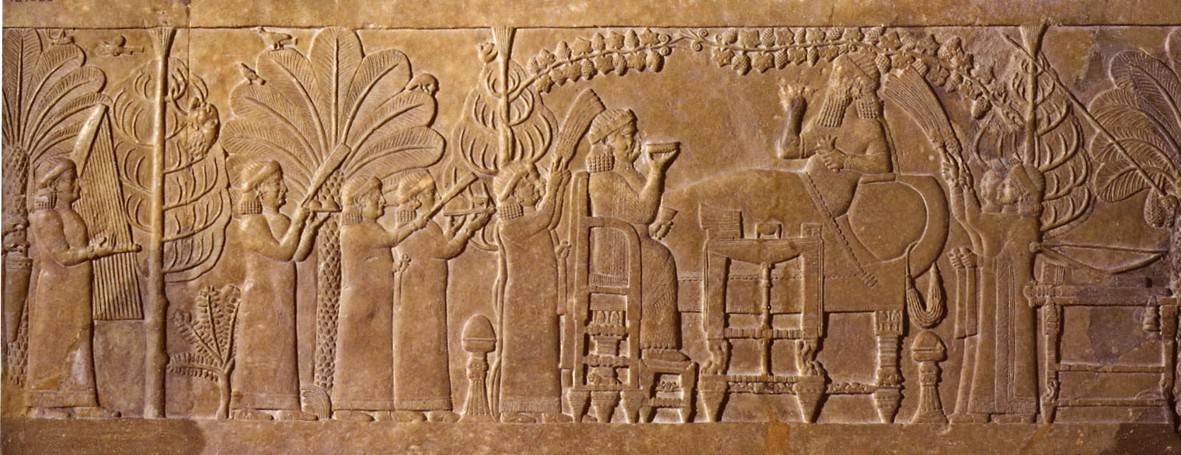
Assyrian Feast in the Garden
Narrative, Art, and Nature
DOI:
https://doi.org/10.34024/herodoto.2025.v10.22589Keywords:
History, Art, War, Mesopotamia, AssurbanipalAbstract
In the Mesopotamian world, stone relief was one of the most important artistic manifestations. The imposing amount of scenes and its own continuity indicate a largely documentary function. The cultural practice of creating these monumental reliefs is associated with the political moment of making great empires. In this article, we examine the relief of the banquet of Assurbanipal and Libbāli-šarrat since the perspective of art history and the foundations of iconology.
Downloads
References
ALVAREZ-MON, J. Ashurbanipal’s feast: a view from Elam. Iranica Antiqua, v. XLIV, p. 131-180, 2009. doi: 10.2143/IA.44.0.2034378.
BAHRANI, Z. Rituals of war: the body and violence in Mesopotamia. New York: Zone Books, 2008.
BARNETT, R. D. Sculptures from the north palace of Ashurbanipal at Nineveh (668–627 B.C.E.). London: The British Museum Publications, 1976.
BENOIT, A. Les civilisations du Proche-Orient ancien. Paris: École du Louvre, 2011.
BLACK, J.; GEORGE, A.; POSTGATE, N. A concise dictionary of akkadian. Wiesbaden: Harrassowitz Verlag, 2000.
BLACK, J.; GREEN, A. Gods, demons and symbols of ancient Mesopotamia. London: British Museum Press, 1998.
BONATZ, D. Ashurbanipal’s headhunt: an anthropological perspective. Iraq, v. 49, n. 1, p. 93-101, 2005.
BORDREUIL, P.; BRIQUEL-CHATONNET, F.; MICHEL, C. Les débuts de l’Histoire. Paris: Éditions de La Martinière, 2008.
BOTTÉRO, J.; KRAMER, S. Lorsque les dieux faisaient l’homme. Paris: Éditions Gallimard, 1993.
BRITISH MUSEUM. <https://www.britishmuseum.org/collection/image/237000001.>2021.
CURTIS, J. E.; READE, J.E. Art and empire: treasures form Assyria in the British Museum. New York: The Metropolitan Museum of Art, 1995.
FRANKFORT, H. The art and architecture of the Ancient Orient. New Haven; London: Yale Univesity Press, 1996.
GLASSNER, J.-J. Chroniques mésopotamiennes. Paris: Les Belles Lettres, 1993.
JARDINS D’ORIENT. De l’Alhambra au Taj Mahal. Paris; Gand: Institut du Monde Arabe; Snoeck, 2016.
LARSEN, M. T. La conquête de l’Assyrie 1840–1860. Paris: Hachette, 2001.
MARCUS, M. Art and ideology in ancient Western Asia. In: SASSON, J. M. (ed.). Civilization s of the ancient Near East. Peabody: Hendrickson Publishers, 2000, p. 2487-2505.
MINUNNO, G. La mutilation du corps de l’ennemi. In: ABRAHAMI, Ph.; BATTINI, L. Les armées du Proche-Orient (III–Ier mill. av. J.-C.). Oxford: British Archaelogical Reports, 2008, p. 247-256.
MOSCATI. S. Como reconhecer a arte mesopotâmica. São Paulo: Martins Fontes, 1985.
NYLANDER, C. Breaking the cup of the kingship an elamite coup in Nineveh? Iranica, v. XXXIV, p. 71-83, 1999.
PANOFSKY, E. Significados nas artes visuais. São Paulo: Perspectiva, 2007.
PARADISE. Wikipedia. <https://en.wikipedia.org/w/index.php?title=Paradise&oldid=1030557768.>2021.
POZZER, K. M. P. A Comemoração da vitória: o banquete triunfal assírio. Anais do XXVI Simpósio Nacional de História – ANPUH. São Paulo, julho 2011, p. 1-14.
READE, J. Assyrian sculpture. London: The British Museum Press, 2006.
RUSSELL, J. M. Sennacherib’s palace without rival revisited: excavations at Nineveh and the British Museum Archives. In: PARPOLA, S.; WHITING, R. Assyria 1995. Helsinki: The Neo-Assyrian Text Corpus Project, 1997.
WATANABE, C. The classification of methods of pictorial narrative in Assurbanipal’s reliefs. Studies in Ancient Oriental Civilization, n. 62, p. 321-331, 2008.
Downloads
Published
Issue
Section
License
Copyright (c) 2026 Katia Maria Paim Pozzer

This work is licensed under a Creative Commons Attribution 4.0 International License.
Authors retain copyright and grant the journal the right of first publication.
The works are licensed under the Creative Commons Attribution 4.0 International License (CC BY 4.0), which permits unrestricted use, distribution, and reproduction in any medium, including for commercial purposes, provided proper attribution is given.
Full license text: https://creativecommons.org/licenses/by/4.0/