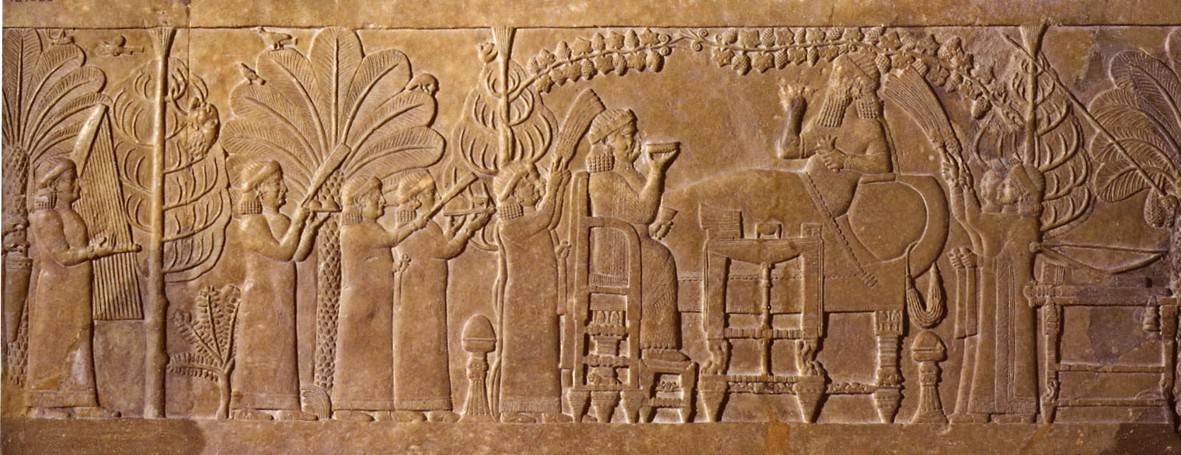
Banquete assírio no jardim
Narrativa, arte e natureza
DOI:
https://doi.org/10.34024/herodoto.2025.v10.22589Palavras-chave:
História, Arte, Guerra, Mesopotâmia, AssurbanipalResumo
No mundo mesopotâmico, o relevo sobre pedra foi uma das mais importantes manifestações artísticas. A imponente quantidade de cenas e a sua própria continuidade, indicam uma função amplamente documental. A prática cultural de criação destes relevos monumentais está associada ao momento político de construção de grandes impérios. Neste artigo examinamos o relevo do banquete de Assurbanipal e Libbāli-šarrat a partir da perspectiva da história da arte e dos fundamentos da iconologia.
Downloads
Referências
ALVAREZ-MON, J. Ashurbanipal’s feast: a view from Elam. Iranica Antiqua, v. XLIV, p. 131-180, 2009. doi: 10.2143/IA.44.0.2034378.
BAHRANI, Z. Rituals of war: the body and violence in Mesopotamia. New York: Zone Books, 2008.
BARNETT, R. D. Sculptures from the north palace of Ashurbanipal at Nineveh (668–627 B.C.E.). London: The British Museum Publications, 1976.
BENOIT, A. Les civilisations du Proche-Orient ancien. Paris: École du Louvre, 2011.
BLACK, J.; GEORGE, A.; POSTGATE, N. A concise dictionary of akkadian. Wiesbaden: Harrassowitz Verlag, 2000.
BLACK, J.; GREEN, A. Gods, demons and symbols of ancient Mesopotamia. London: British Museum Press, 1998.
BONATZ, D. Ashurbanipal’s headhunt: an anthropological perspective. Iraq, v. 49, n. 1, p. 93-101, 2005.
BORDREUIL, P.; BRIQUEL-CHATONNET, F.; MICHEL, C. Les débuts de l’Histoire. Paris: Éditions de La Martinière, 2008.
BOTTÉRO, J.; KRAMER, S. Lorsque les dieux faisaient l’homme. Paris: Éditions Gallimard, 1993.
BRITISH MUSEUM. <https://www.britishmuseum.org/collection/image/237000001.>2021.
CURTIS, J. E.; READE, J.E. Art and empire: treasures form Assyria in the British Museum. New York: The Metropolitan Museum of Art, 1995.
FRANKFORT, H. The art and architecture of the Ancient Orient. New Haven; London: Yale Univesity Press, 1996.
GLASSNER, J.-J. Chroniques mésopotamiennes. Paris: Les Belles Lettres, 1993.
JARDINS D’ORIENT. De l’Alhambra au Taj Mahal. Paris; Gand: Institut du Monde Arabe; Snoeck, 2016.
LARSEN, M. T. La conquête de l’Assyrie 1840–1860. Paris: Hachette, 2001.
MARCUS, M. Art and ideology in ancient Western Asia. In: SASSON, J. M. (ed.). Civilization s of the ancient Near East. Peabody: Hendrickson Publishers, 2000, p. 2487-2505.
MINUNNO, G. La mutilation du corps de l’ennemi. In: ABRAHAMI, Ph.; BATTINI, L. Les armées du Proche-Orient (III–Ier mill. av. J.-C.). Oxford: British Archaelogical Reports, 2008, p. 247-256.
MOSCATI. S. Como reconhecer a arte mesopotâmica. São Paulo: Martins Fontes, 1985.
NYLANDER, C. Breaking the cup of the kingship an elamite coup in Nineveh? Iranica, v. XXXIV, p. 71-83, 1999.
PANOFSKY, E. Significados nas artes visuais. São Paulo: Perspectiva, 2007.
PARADISE. Wikipedia. <https://en.wikipedia.org/w/index.php?title=Paradise&oldid=1030557768.>2021.
POZZER, K. M. P. A Comemoração da vitória: o banquete triunfal assírio. Anais do XXVI Simpósio Nacional de História – ANPUH. São Paulo, julho 2011, p. 1-14.
READE, J. Assyrian sculpture. London: The British Museum Press, 2006.
RUSSELL, J. M. Sennacherib’s palace without rival revisited: excavations at Nineveh and the British Museum Archives. In: PARPOLA, S.; WHITING, R. Assyria 1995. Helsinki: The Neo-Assyrian Text Corpus Project, 1997.
WATANABE, C. The classification of methods of pictorial narrative in Assurbanipal’s reliefs. Studies in Ancient Oriental Civilization, n. 62, p. 321-331, 2008.
Downloads
Publicado
Edição
Seção
Licença
Copyright (c) 2026 Katia Maria Paim Pozzer

Este trabalho está licenciado sob uma licença Creative Commons Attribution 4.0 International License.
Os autores mantêm os direitos autorais de seus trabalhos e concedem à revista o direito de primeira publicação.
Os trabalhos são publicados sob a licença Creative Commons Attribution 4.0 International License (CC BY 4.0), que permite o compartilhamento e adaptação do material para qualquer finalidade, inclusive comercial, desde que seja atribuído o devido crédito aos autores e à revista.
Texto completo da licença: https://creativecommons.org/licenses/by/4.0/