Estimulantes da moda: representações de café, chá e chocolate nas gravuras de moda francesas, inglesas e holandesas (1670-1705)
DOI:
https://doi.org/10.34024/fontes.2026.v13.20876Palavras-chave:
café, chá, chocolate, arte, gravuras de modaResumo
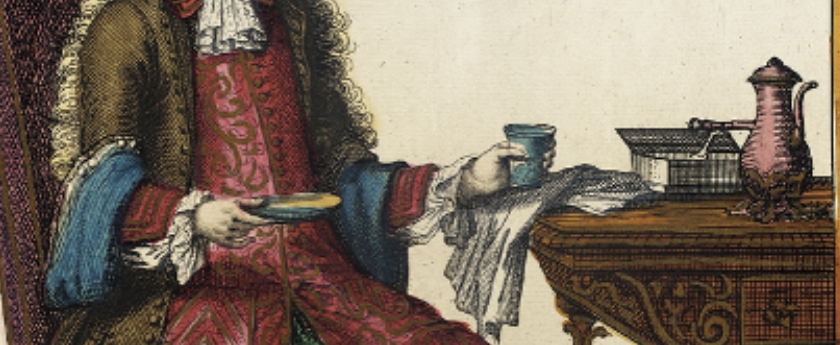
Este artigo examina as gravuras de moda produzidas na segunda metade do século XVII em que, figuraram café, chá ou chocolate. O objetivo será explorar como o exotismo associado às bebidas foi mobilizado na construção dos primeiros discursos visuais que posicionavam figuras europeias - e não mais otomanas, chinesas ou indígenas da América - como protagonistas do seu consumo. Tais imagens se encontram em um conjunto mais amplo de gravuras que construíam identidades da aristocracia por meio da ostentação do lazer ocioso e do acesso a itens exclusivos. É explorado seu papel na construção de um imaginário sobre as bebidas quentes que servia a um duplo propósito: qualificar seus consumidores iniciais e apresentar esses itens importados a um público novo. Mais especificamente, são comparadas as imagens francesas, inglesas e holandesas, revelando distinções nos modos de representar que revelavam especificidades na forma de cada espaço lidar com o consumo de novidades importadas. Nesse sentido, a visualidade operou, de forma autônoma para nos fornecer insumos para compreender os encontros culturais por trás do consumo alimentar junto da formação de identidades sociais próprias e de um padrão de representação dos estimulantes reiterado por outros artistas no século seguinte.
Downloads
Referências
BAXANDALL, Michael. Painting and Experience in Fifteenth Century Italy: A Primer in the Social History of Pictorial Style. Oxford: Oxford University Press, 1988.
BERG, Maxine; EGER, Elizabeth (eds.). Luxury in the Eighteenth Century: Debates, Desires and Delectable Goods. Basingstoke: Palgrave Macmillan, 2007.
BERRY, Christopher J. The Idea of Luxury: A Conceptual and Historical Investigation. Cambridge: Cambridge University Press, 1994.
BICKHAM, Troy. “Eating the Empire: Intersections of Food, Cookery and Imperialism in Eighteenth-Century Britain”. Past & Present, n. 198 (2008), pp. 71–109.
BLEGNY, Nicolas de. Le bon usage du thé, du caffé et du chocolat pour la préservation & pour la guérison des maladies. França: [s.n.], 1688. Biblioteca Digital Luso Brasileira.
Bourdieu, Pierre. Coisas ditas. São Paulo: Brasiliense, 2004.
CHAMBERLAYNE, John. The Natural History of Coffee, thee, chocolate, tobacco in four several sections. Londres, Printed for Christopher Wilkinson, 1682. Queen’s University Library.
CHAMBOULEYRON, Rafael e ARENZ, Karl Heinz. “Amazonian Atlantic: Cacao, Colonial Expansion and Indigenous Labour in the Portuguese Amazon Region (Seventeenth and Eighteenth Centuries).” Journal of Latin American Studies 53, no. 2 (2021): pp. 221–44.
CLARENCE-SMITH, William Gervaise. Cocoa and chocolate, 1765-1914. Londres: Routledge, 2000.
CLARENCE-SMITH, William Gervaise; TOPIK, Steven. The global coffee economy in Africa, Asia and Latin America, 1500-1989. Cambridge: Cambridge University Press, 2003.
COWAN, Brian William. The Social Life of Coffee: The Emergence of the British Coffeehouse. New Haven: Yale University Press, 2005.
COWAN, Brian. “What Was Masculine About the Public Sphere? Gender and the Coffeehouse Milieu in post-Restoration England”. History Workshop Journal, v. 51, n. 1 (2001), pp. 127–157.
DUFOUR, Philippe Sylvestre. Traitez nouveaux & curieux du cafe, du the et du chocolate: ouvrage également nécessaire aux médecins, & à tous ceux qui aiment leur santé. França: Chez Adrian Moetjens, Marchand Libraire prez la Cour, à la Libraire Françoise, 1688. BNF, 8-TTC24-11 (B).
ELIAS, Norbert. A sociedade de corte: investigação sobre a sociologia da realeza e da aristocracia de corte. Rio de Janeiro: Zahar, 2001.
ELLIS, Markman; COULTON, Richard; MAUGER, Matthew. Empire of Tea: The Asian Leaf That Conquered the World. Londres: Reaktion Books, 2015.
GALLAND, Antoine. De l'Origine et du progrès du café, opuscule du XVIIe siècle. Nouvelle édition augmentée par Cadet de Vaux. Caen: F. Poisson, 1836. BNF, S-27422.
HALL, Henry. The vertues of chocolate East-India drink. Oxford: Henry Hall, 1660. University of Michigan Library.
GOODMAN, Jordan.; LOVEJOY, Paul E.; SHERRATT, Andrew. (eds.). Consuming habits: global and historical perspectives on how cultures define drugs. London: Routledge, 2007.
HEYWOOD, Ian; SANDYWELL, Barry (ed.). Interpreting visual culture: explorations in the hermeneutics of the visual. Londres; Nova York: Routledge, 1999.
LANDWEBER, Julia. “This Marvelous Bean’: Adopting Coffee into Old Regime French Culture and Diet”. French Historical Studies, v. 38, n. 2 (2015), pp. 193–223.
McMICHAEL, Philip. “Incorporating Comparison within a World-Historical Perspective: An Alternative Comparative Method”. American Sociological Review, v. 55, n. 3 (1990), pp. 385–397.
MENESES, Ulpiano T. Bezerra de. “Fontes Visuais, Cultura Visual, História Visual. Balanço Provisório, Propostas Cautelares”. Revista Brasileira de História, v. 25, n. 45 (2003), pp. 11–36.
MINTZ, Sidney W. Sweetness and Power: The Place of Sugar in Modern History. Nova York: Penguin Books, 1986.
NORTON, Marcy. “Tasting Empire: Chocolate and the European Internalization of Mesoamerican Aesthetics”. The American Historical Review, v. 111, n. 3 (2006), pp. 660–91.
OVINGTON, John. An essay upon the nature and qualities of tea. London: Printed by and for R. Roberts, 1699. University of Michigan Library.
PEETERS, Alice. “Controverses sur les vertus du cacao et les manières de préparer le chocolat (XVIe-XVIIIe siècle)”. Journal d’agriculture traditionnelle et de botanique appliquée, v. 26, n. 3 (1979), pp. 201–216.
PEREIRA, Ana Marques. Mesa real dinastia de Bragança. Lisboa: A Esfera dos Livros, 2012.
RAPPAPORT, Erika Diane. A Thirst for Empire: How Tea Shaped the Modern World. Princeton: Princeton University Press, 2017.
ROCHE, Daniel. Histoire des choses banales: naissance de la consommation dans les sociétés traditionelles (XVIIe-XIXe siècle). Paris: Fayard, 1997.
ROQUE, Jean de la. Voyage de l’Arabie heureuse por l’Océan oriental. Paris : chez André Cailleau, sur le quay des Augustins, près la rue Pavée, à Saint André, 1716. BNF, 8-H-1231.
ROSEBAUM, Susan; NORBERG, Kathryn (eds). Fashion prints in the age of Louis XIV. Lubbock: Texas Tech University Press, 2014.
SANTIAGO JÚNIOR, Francisco Das Chagas Fernandes. “A Virada e a Imagem: História Teórica Do Pictorial/Iconic/Visual Turn e Suas Implicações Para as Humanidades”. Anais Do Museu Paulista: História e Cultura Material, 27 (2019).
SCHAMA, Simon. O Desconforto da riqueza a cultura holandesa na época de ouro: uma interpretação. São Paulo: Companhia das Letras, 1992.
SCHIVELBUSCH, Wolfgang. Tastes of Paradise: A Social History of Spices, Stimulants, and Intoxicants. Nova York: Vintage Books, 1993.
SCHOTLAND, Sara D. “Africans as Objects: Hogarth’s Complex Portrayal of Exploitation”, Journal of African American Studies 13-2 (2009), pp. 147–163.
SIMMEL, Georg. “Fashion”, American Journal of Sociology 62, no. 6 (1957), pp. 541–558.
SPARY, Emma C. Eating the Enlightenment: Food and the Sciences in Paris. Chicago: The University of Chicago Press, 2012.
TRENTMANN, Frank. Empire of Things: How We Became a World of Consumers, from the Fifteenth Century to the Twenty-First. Londres: Penguin Books, 2017.
TUCHSCHERER, Michel. “Trade and Port Cities in the Red Sea– Gulf of Aden Region in the Sixteenth and Seventeenth Century.” In: Leila Tarazi Fawaz & Christopher A. Bayly (ed.), Modernity and Culture. From the Mediterranean to the Indian Ocean. New York: Columbia University Press, 2002.
VAN DYK, Garritt. Commerce, Food, and Identity in Seventeenth-Century England and France: Across the Channel. Amsterdam University Press, 2022.
WHITE, Jonathan. “The ‘Slow but Sure Poyson’: The Representation of Gin and Its Drinkers, 1736–1751”. Journal of British Studies, v. 42, n. 1 (2003), p. 35–64.
WITHERS, George Withers. The touchstone, or, Trial of tobacco whether it be good for all constitutions. Londres: Printed and are to be sold by several booksellers, 1676. University of Michigan Library.
Downloads
Publicado
Edição
Seção
Licença
Copyright (c) 2026 Nicole Leite Bianchini

Este trabalho está licenciado sob uma licença Creative Commons Attribution 4.0 International License.

Revista de Fontes está licenciada com uma Licença Creative Commons Atribuição 4.0 Internacional.