El Culto y la destrucción de la escultura antigua en las sociedades arabo-islámicas contemporáneas
Histoiografía, identidad y patrimonio
DOI:
https://doi.org/10.34024/herodoto.2024.v9.20080Palabras clave:
Recepción, Islam, Iconoclasta, Medieval, Nacionalismo, Colonialismo, OrientalismoResumen
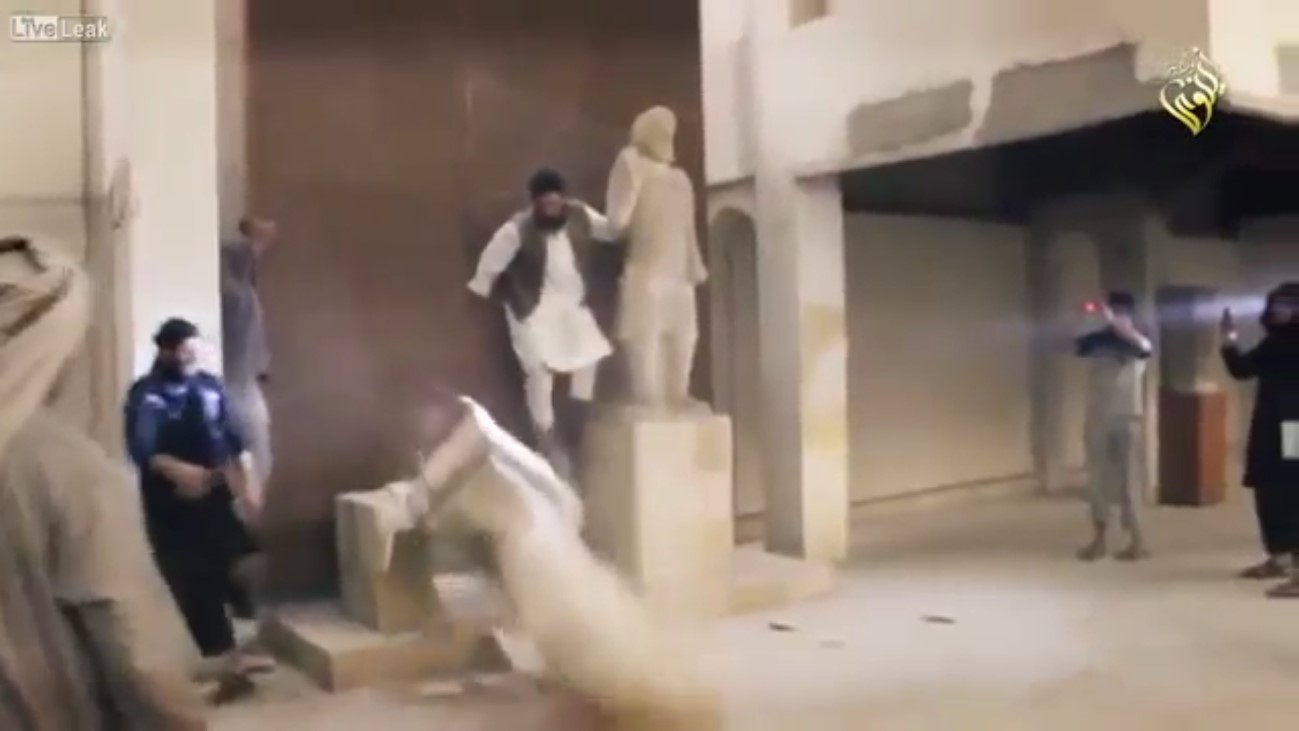
Este trabajo analiza la recepción de la escultura antigua en las sociedades arabo-islámicas considerando seis casos de estudio que evidencian su valor y vigencia desde época medieval hasta la actualidad: la erección de una estatua faraónica de Ramsés II en El Cairo durante el gobierno de Nasser y su reciente traslado entre masas al nuevo museo arqueológico; el hallazgo de una estatua de Darío en 1972 en Susa y su papel simbólico como pieza destacada del museo arqueológico de Teherán; la estatua moderna de Zenobia y exhibición en Damasco en 2015 en el contexto de la guerra civil en Siria; la erección de una estatua dedicada a Kahina en 2003 en la localidad argelina de Baghai, incendiada en 2016 como referente en conflictos políticos y religiosos entre comunidades (árabes y bereberes) y países (Argelia y Francia); el vídeo de destrucción del Museo Arqueológico de Mosul gravado por los militantes de DAESH en 2015; y la exhibición inaugural del Abu Dabi Louvre Museum en 2017 con una destaca presencia de escultura clásica. La escultura juega un papel determinante en la reafirmación identitaria de ciertos colectivos o regímenes políticos, su significado se construye a partir de discursos historiográficos anclados en el supuesto rechazo del Islam a la representación figurada y el conjunto de respuestas que suscita la escultura, ya sea venerada o destruida, forma parte de una ola iconoclasta actual que se hace eco de debates globales en torno al patrimonio, las identidades y su representatividad y la revisión de la historia.
Descargas
Referencias
ABDI, Kaymar. Nationalism, Politics, and the Development of Archaeology in Iran. American Journal of Archaeology 105 (1), 2001, p. 51-76.
AL-BAKRĪ, Description de l'Afrique Septentrionale par Abou-Obeïd-El-Bakri, trad., de Mac Guckin De Slane. París: Maisonneuve, 1965.
AL-BUSTĀNĪ, Salīm. Zanūbyā malikat Tadmur. Al-Jinān 1–24, 1870–1871.
ALI, Ali. How Raqqa, once the Syrian capital of Daesh’s caliphate, reclaimed its Arab cultural pride. Arab News. 15 de octubre de 2022. Disponible en: https://www.arabnews.com/node/2181736/amp
AL-MASʿŪDī, Murūǧ al-ḏahab, ed. Qāsim al-Samā῾ī al-Rufā῾ī. Beirut: Dār al-Qalam, 1989.
AL-ṬABARĪ, Taʼrīḥ al-rusul wa-l-mulūk, ed. M. J. de Goeje. Leiden: Brill, 1879-1901.
AMATO, Alain. Monuments en exil. Paris, Éditions de l'Atlanthrope, 1979.
ANÓNIMO. Zanūbyā. Al-ʿArab 14, Beirut: Dār al-ʿAwda, Series: Abta, 1975.
ANÓNIMO. Une statue à l’effigie d’Aksil à Ouzellaguen. 19 de enero de 2014. Disponible en: http://horizonsouzellaguen.centerblog.net/29.html
ANÓNIMO. Erasing the legacy of a ruined nation. Dabiq 8 2015, p. 22-24.
ANÓNIMO. Statue of ‘iconic Amazigh king’ Massinissa unveiled in Algiers. Amazigh World News. 1 de noviembre de 2019. Disponible en: https://amazighworldnews.com/statue-of-iconic-amazigh-king-massinissa-unveiled-in-algiers/
ANÓNIMO. Iran displays ancient clay tablets, returned by US, from empire that freed Jews. Time of Israel. 3 de octubre de 2019. Disponible em: https://www.timesofisrael.com/iran-displays-ancient-clay-tablets-returned-by-us-from-empire-that-freed-jews/
ANÓNIMO, Iconic Ferdowsi statue in Tehran to undergo meticulous restoration. Tehran Times. 11 septiembre de 2022. Disponible en: https://www.tehrantimes.com/news/476635/Iconic-Ferdowsi-statue-in-Tehran-to-undergo-meticulous-restoration
BAYOUMI’, Amr. Where did Ramses go?. 2019.
BECKER, Cynthia. The Kahina: The Female Face of Berber History. Mizan Project. 26 de octubre de 2015. Disponíble en: https://mizanproject.org/the-kahina-the-female-face-of-berber-history/#_ftn2
BECKER, Cynthia. “Visual Culture and the Amazigh Renaissance in North Africa and Its Diaspora.” In: VAN NIEUWKERK, Karin, LEVINE, Mark y STOKES, Martin, (eds.), Islam and Popular Culture. Austin: University of Texas Press, 2016, 100-121.
DE CORTE, Jan., Piercing the Cultural Diplomacy Veil: The Case of the Louvre Abu Dhabi, University of Antwerp. SSRN. 2019. Disponible en: https://ssrn.com/abstract=3733447
EL DALY, Okasha. Egyptology: The Missing Millennium Ancient Egypt in Medieval Arabic Writings. Londres: University College, 2005.
ELICES, Jorge. Respeto o barbarie: el islam ante la Antigüedad de al-Andalus a DAESH. Madrid: Marcial Pons, 2020a.
ELICES, Jorge. Caricaturas contra DAESH: construyendo y deconstruyendo Occidente, Oriente y el Islam, Roda da Fortuna. Revista Eletrônica sobre Antiguidade e Medievo 9 (2), 2020c, p. 75-94.
ELICES, Jorge. DA‘ESH’s Video in the Mosul Museum: Heritage Destruction or Heritage-Making?. In: CHRISTOFOLETTI R.; BOTELHO M.L. (eds) International Relations and Heritage. The Latin American Studies Book Series. Cham: Springer, 2021, p. 171-191.
ELSNER, Jas. Iconoclasm and the Preservation of Memory. In: NELSON, Robert y OLIN, Margaret, (eds) Monuments and memory, made and unmade. University of Chicago Press, Chicago, 2003, p. 209-232.
FLOOD, Fibarr. Between cult and culture: Bamiyan, Islamic iconoclasm, and the museum. Art Bulletin 84 (4), 2002, p. 641–659.
FLOOD, Fibarr. Idol breaking as image making in the islamic state. Religion and Society: Advances in Research 7, 2016, p. 116–138.
FRANTZMAN, Seth J. The Louvre Abu Dhabi: the best – and worst – of globalisation. The Spectator, 20 noviembre 2017. Disponible en: https://www.spectator.co.uk/article/the-louvre-abu-dhabi-the-best-and-worst-of-globalisation/
GASMI, Fouad. Les autorites locales de baghai doivent proteger et restaurer la statue. 2016. Disponible en: https://www.lematindz.net/news/21606-fouad-gasmi-les-autorites-locales-de-baghai-doivent-proteger-et-restaurer-la-statue-de-dihya.html
GONZÁLEZ, José Antonio y MUNAWAR, Nour. The unfallen statues of Hafez Al-Assad in Syria. City 24 (3-4), 2020, p. 642–655.
GREENHALGH, Michael. ‘Travelers’ Accounts of Roman statuary in the Near East and North Africa: From Limbo and Destruction to Museum Heaven. In: KRISTENSEN, Troels M. y STIRLING, Lea, (eds.), The Afterlife of Greek and Roman Sculpture: Late Antique Responses and Practices. Ann Arbor: University of Michigan Press, 2016, p. 330-348.
GRUBER, Christiane. The Image Debate: Figural Representation in Islam and Across the World. Berkeley, CA: Gingko Library, 2019.
HANNOUM, Abdelmajid. Historiography, Mythology and Memory in Modern North Africa: The Story of the Kahina. Studia Islamica 85, 1997, p. 85–130.
HANNOUM, Abdelmajid. Colonial Histories, Post-Colonial Memories: The Legend of the Kahina, A North African Heroine. Portsmouth, Heinemann, 2001.
HARMANSHAH, Ömür. DA‘ESH, heritage, and the spectacles of destruction in the global media. Near East Archaeol 78 (3), 2015, p. 170–177.
HENDRICKX, Benjamin. Al-Kahina: The Last Ally of the RomanByzantines in the Maghreb Against the Muslim Arab Conquest?. Journal of Early Christian History 3 (2), 2013, p. 47-61.
IMANPOUR, Mohammad-Taqi. Re-establishment of Achaemenid History and its Development in the Nineteenth and Twentieth Centuries, Iranian Studies 48 (4) 2015, p. 515-530.
JONES, Christopher. Understanding ISIS’s Destruction of Antiquities as a Rejection of Nationalism. Journal of Eastern Mediterranean Archaeology and Heritage Studies 6 (1-2), 2018, p. 32-58.
JONES, Christopher. Zenobia in Damascus: The Role of Classical Archaeology in Syrian Politics. 24 de julio de 2023. Disponible en: https://www.helsinki.fi/en/researchgroups/ancient-near-eastern-empires/news/zenobia-in-damascus-the-role-of-classical-archaeology-in-syrian-politics
KERVRAN, Monique. Une statue de Darius découverte à Suse. Le context archéologique. Journal asiatique 260, 1972, p. 235-239.
KINNEY, Dale. Spolia. Damnatio and renovatio memoriae. Memoirs of the American Academy in Rome 42, 1997, p. 117-148.
KOLRUD, Kristine y PRUSAC, Marina. Iconoclasm from antiquity to modernity. Ashgate, Burlington, 2014.
LAWLER, Andrew. Iran Reopens Its Past. Science 302 (5647), 2003, p. 970-973.
TIME. Iran. 20th-Century Darius. Time. 25 de abril de 1938. Disponible en: http://content.time.com/time/magazine/article/0,9171,931008,00.html
LERMAN, Eran. Abdel Fattah el-Sisi and the
Re-Pharaonization of Egypt. The Jerusalem Strategic Tribune. Mayo 2022. Disponible en: https://jstribune.com/lerman-re-pharaonization-of-egypt/
LOUNÈS, B. Les chaouis restaurent la statue de La kahina à Khenchela. Tamurt. 16 de Agosto de 2016. Disponible en: https://tamurt.info/les-chaouis-restaurent-la-statue-de-la-kahina-a-khenchela/
M.K. Edification d’une statue du roi berbère Sheshonq à Tizi Ouzou: la Libye réagit. Algerie Patriotique, 15 de enero de 2021. Disponible en: https://www.algeriepatriotique.com/2021/01/15/edification-dune-statue-du-roi-berbere-sheshonq-a-tizi-ouzou-la-libye-reagit/
MANAL. Statue of Palmyra queen Zenobia in Damascus for four days, Syrian Arab News Agency. 6 de septiembre de 2015. Disponible en: https://sana.sy/en/?p=53820
MARK, Joshua. Kahina: Early Medieval Berber Warrior-Queen Standing against Arab Invasion. 19 de febrero 2019. Disponible en: https://brewminate.com/kahina-early-medieval-berber-warrior-queen-standing-against-arab-invasion/
MARTINS, Ivo dos Santos. Iran in Assen… An “intentional” exhibition?. 11 de septiembre de 2018. Disponible en:
https://persiababylonia.org/2018/09/11/iran-in-assen-an-intentional-exhibition/
MASOUMI, Parvaneh. Killing History. Iran Wire. 10 de marzo de 2015. Disponible en: https://iranwire.com/en/society/60933/
MODÉRAN, Yves. Kusayla, l’Afrique et les Arabes. In: BRIAND-PONSART, Claude (ed.), Identités et cultures dans l’Algérie antique. Actes du colloque international (Rouen, mai 2003). Rouen-L. Havre: Presses Universitaires de Rouen et du Havre, 2005, p. 423-457.
MODÉRAN, Yves. Kahena, Encyclopédie berbère, 2005. Disponible en: http://journals.openedition.org/encyclopedieberbere/1306
MohandKBL. Contre la statue du Pharaon Chachnaq à Tizi Ouzou. 2021. Disponible en: https://www.mesopinions.com/petition/politique/contre-statue-pharaon-chachnaq-tizi-ouzou/122450
MONFERRER, Juan Pedro. La 'Caída de Palmira' o la 'Historia de Zenobia y Gadiīma'contada por la tradición norarábiga. Anaquel de Estudios Árabes 23, 2012, p.-83-108.
MULDER, Stephanie. Imagining Antiquity in Islamic Societies. Bristol/Chicago: Intellect Books, 2022.
MUSEUM OF THE JEWISH PEOPLE. Queen of the Desert: The Amazing Story of “Jewish Khaleesi”. 14 de octubre de 2018. Disponible en: https://www.anumuseum.org.il/blog/dihya-al-kahina/
OUAMER-ALI, Tarik. Sheshonq Ier, le pharaon de Tizi Ouzou. 11 de enero de 2024. Disponible en: https://www.founoune.com/sheshonq-ier-le-pharaon-de-tizi-ouzou/
PERROT, Jean, (ed.). The Palace of Darius at Susa: The Great Royal Residence of Achaemenid Persia. Nueva York: I.B.Tauris & Co Ltd, 2013.
PERROT, Jean. How the Statue of Darius broke. In: PERROT, Jean, (ed.), 2013, The Palace of Darius at Susa: The Great Royal Residence of Achaemenid Persia. Nueva York: I.B.Tauris & Co Ltd, 2013, p. 176-177.
POWERS, David S. Demonizing Zenobia: the legend of al-Zabbāʼ in Islamic sources. En: MARGARITAI, Roxani, SABRA, Adam y SIJPENSTEIN, Petra (eds.) Histories of the Middle East: Studies in Middle Eastern Society, Economy and Law in Honor of A.L. Udovitch. Leiden-Boston: Brill, 2011, p. 127-182.
RAZMJOU, Shahrokh. Assessing the Damage: Notes on the Life and Demise of the Statue of Darius from Susa. Ars Orientalis 34, 2002, p. 81-104.
REID, Daniel Malcolm. Whose Pharaohs? Archaeology, Museums, and Egyptian National Identity from Napoleon to World War I. California: University of California Press, 2002.
REID, Daniel Malcolm. Contesting Antiquity in Egypt: Archaeologies, Museums & the Struggle for Identities from World War I to Nasser. Cairo: American University in Cairo Press, 2015.
ROE, Thomas. Letters of Sir Thomas Roe, and his correspondents, relating to his embassy in Turkey. Londres: Samuel Richardson, 1740.
RUPTLY (2015) 'Warrior Queen' Zenobia Statue Erected in Syria in Defiance of Islamic State. Dailymotion. Disponible en: https://www.dailymotion.com/video/x35g5w2
SANADJIAN, Manuchehr. Islamic Rule and the Pre-Islamic Blessing, the ‘Homecoming’ of the Cyrus Cylinder. Dialectical Anthropology 35 (4), 2011, p. 459-474.
SHAW, Wendy. Destroy your idols. X-Tra Contemp Art Q 18 (1), 2015, p. 73-94.
SIWEL. La statue de la reine Dihya incendiée à Baghaï: Le MAC réagit. Siwel. 12 de agosto de 2016. Disponible en: https://www.siwel.info/la-statue-de-la-reine-dihya-incendiee-a-baghai-le-mac-reagit_8595.html
SIWEL. La statue du héros amazigh Aksel (Koceila) vandalisée à quelques jours de son inauguration. Siwel. 24 de marzo de 2021. Disponible en: https://siwel.info/la-statue-du-hero-aksel-koceila-vandalisee-a-quelques-jours-de-son-inauguration_63186.html
SMITH, Laurajane. Uses of heritage. Londres: Routledge, 2006.
SOHRABI, Narciss. Memorialization of War between conflicts of interest before and after the Islamic Revolution: Public Art and Public Space in Iran. ARTis ON 7, 2018, p 161-170.
TENORIO, Mauricio. La historia en ruinas. El culto a los monumentos y su destrucción. Madrid: Alianza Editorial, 2023.
TLASS, Mustafa. Zenobia: the Queen of Palmyra. Damasco: Tlass.
VICENTE, Álex. ¿Qué busca Francia al exportar sus museos?. El País, 15 de diciembre de 2019. Disponible en: https://elpais.com/elpais/2019/12/13/ideas/1576241625_837560.html
WAKEFIELD, S Cultural heritage, transnational narratives and museum franchising in Abu Dhabi. Oxford/New York: Routledge, 2021.
WOLTERING, Robert. Zenobia or al-Zabbā’: The Modern Arab Literary Reception of the Palmyran Protagonist. Middle Eastern Literatures 17 (1), 2014, p. 25-42.
YOUTUBE, The Pharaohs’ Golden Parade, 2021. Disponible en: https://www.youtube.com/watch?v=bnlXW7KZl0c
Descargas
Publicado
Número
Sección
Licencia
Derechos de autor 2025 Jorge Elices Ocón

Esta obra está bajo una licencia internacional Creative Commons Atribución 4.0.
Os autores mantêm os direitos autorais de seus trabalhos e concedem à revista o direito de primeira publicação.
Os trabalhos são publicados sob a licença Creative Commons Attribution 4.0 International License (CC BY 4.0), que permite o compartilhamento e adaptação do material para qualquer finalidade, inclusive comercial, desde que seja atribuído o devido crédito aos autores e à revista.
Texto completo da licença: https://creativecommons.org/licenses/by/4.0/