Escultura Clássica em Madīnat al-Zahrā’
Exemplum et spolia no contexto islâmico
DOI:
https://doi.org/10.34024/herodoto.2020.v5.12836Keywords:
Omíadas, al-Andalus, Spolia, Estátuas, Sarcófagos, Talismãs, VênusAbstract
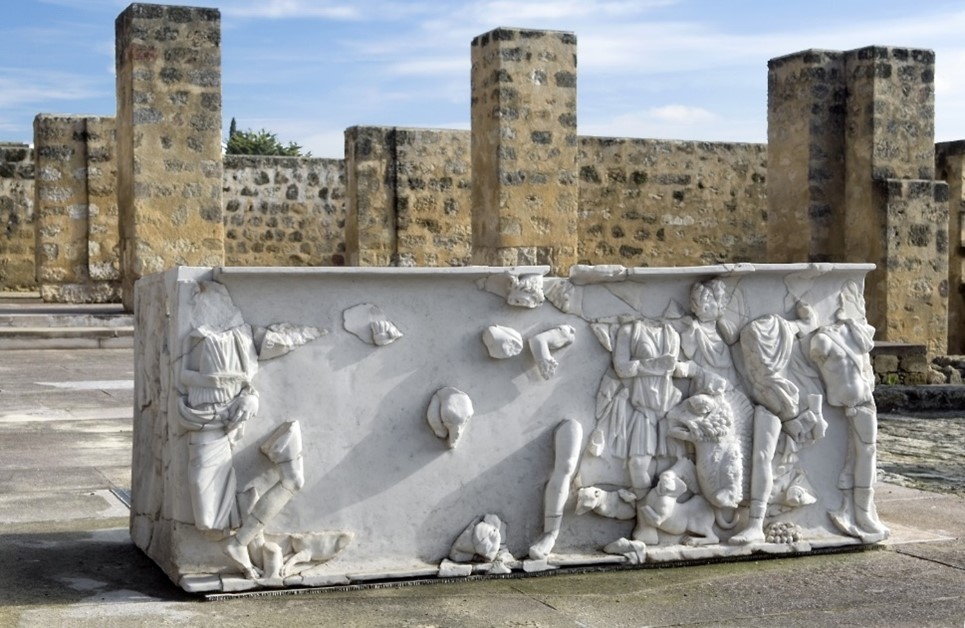
Meu objetivo com este artigo é destacar o caráter único da coleção de sarcófagos e estátuas romanos reutilizados em Madīnat al-Zahrā’, a cidade fundada pelo califa 'Abd al-Raḥmān III perto de Córdoba no ano 940 d.C., assim como esclarecer o significado e a finalidade que essas peças tinham no mundo islâmico e andaluz. Com base em fontes escritas e evidências arqueológicas disponíveis, este artigo aponta que esculturas antigas teriam sido consideradas "maravilhas" e "curiosidades", e ressignificadas de acordo com a tradição islâmica. Como exemplum e spolia, essas peças foram integradas na cidade palatina, transmitindo narrativas de poder, memória e identidade, e ocupando um lugar de destaque no projeto de legitimação política e religiosa dos omíadas em al-Andalus.
Downloads
References
Fontes
Akhbār maŷmū’a, Crónica anónima del siglo XI, ed. e trad. de E. Lafuente Alcántara. Madrid: 1867.
Al-Bakrī, Kitāb al-Masālik wa-l-mamālik, ed. de A. P Van Leeuwen e A. Ferré, (eds.). Túnez: 1992.
- Geografía de España (Kitāb al-Masālik wa-l-mamālik), trad. Eliseo Vidal Beltrán. Zaragoza: 1982.
Corpus Scriptorum Mozarabicorum, ed. J. Gil. Madrid: 1973.
Crónicas asturianas, ed. J. Gil, J. L. Moralejo e J. I. Ruiz de la Peña. Oviedo: 1986.
Crónica del moro Rasis, ed. de Catalán, D. e De Andrés, Mª. S. Madrid: 1975.
Crónica Mozárabe de 754, ed. e trad. J. E. López Pereira. Zaragoza: 1980 (reed. 2009).
Al-Ḥimyarī, Rawḍ al-mi’ṭār, ed. I., Abbas. Beirut: 1975.
- La Péninsule Ibérique au Moyen-Age d'apres le Kitāb al-Rawḍ al-mi’ṭār fī habar al-akṭār d’Ibn ‘Abd al-Mun’im al-Ḥimyarī, ed. e trad. Évariste Lévi-Provençal. Leiden: 1938.
Ibn al-Abbār, Al-Takmila li-kitāb al-sila, ed. ‘Abd al-Salam al-Harras, 4 vols. Casablanca: 1995.
Ibn ‘Abd Rabbihi, al-ʿIqd al-Farīd, ed. de Aḥmad Amīn, et al., Beirut: 1940-53.
- El collar único de Ibn ‘Abd Rabbihi, trad., parcial J. Veglison. Madrid: 2007.
Ibn Ḥayyān, Muqtabis V, ed. P. Chalmeta, F. Corriente e M. Ṣubḥ. Madrid: 1979.
Ibn Ḥayyān, El califato de Córdoba en el "muqtabis" de Ibn Ḥayyān. Anales palatinos del califa de Córdoba al-Hakam II, por ‘Īsà b. Aḥmad al-Rāzī 971-975, trad., E., García Gómez. Madrid: 1967.
Ibn ‘Iḏārī, Kitāb al-bayān al-mugrib fī ajbār al-Andalus wa l-Magrib, ed. G. S. Colin e E. Lévi-Provençal. Leiden: 1948-1951.
- Kitāb al-bayān, Los Almohades, trad., A., Huici Miranda. Tetuán: 1953.
- La caída del Califato de Córdoba y los Reyes de Taifas, trad., F., Maíllo. Salamanca: 1993.
Kitāb Hurūšiyūs: traducción árabe de las "Historiae adversus paganos" de Orosio, ed. M. Penelas. Madrid: 2001.
Libro de las Cruzes, ed., Ll. A. Kasten e L. B., Kiddle. Madrid-Madison: 1961.
Al-Maqqarī, Nafḥ al-ṭīb min gusn al-Andalus al-ratīb, ed. I. Abbas. Beirut: 1968.
Al-Maqrīzī, Kitāb al-mawā’iẓ wa’l-i’tibār fī dhikr al-khiṭaṭ wa’l-āthār (Al-Khiṭaṭ), ed. Gaston Wiet. Cairo: 1911.
Al-Masʿūdī, Murūŷ, ed. e trad. de Barbier De Meynard e Pavet De Courteille, 1861 (revisada por Ch. Pellat). Beirut/Paris: 1965-6.
Parastaseis. Constantinople in the Early Eight Century: the Parastaseis Syntomoi Chronikai, ed. A. Cameron e J. Herrin. Leiden: 1984.
Picatrix. The latin version of Ghayat al-Hakim, ed. David Pingree. Londres: 1986.
Referencias bibliográficas
ABUMALHAM, M. “Salomón y los genios”, Anaquel De Estudios Árabes, 3, 1992, 37-46.
ACIÉN ALMANSA, M. “Materiales e hipótesis para una interpretación del Salón de Abd al- Rahman al-Nasir”, em A. Vallejo, (coord.), Madinat al-Zahara: El Salón de Abd al-Rahman III. Córdoba: 1995, 177-195.
ARIZA ARMADA, A. “Signos y símbolos en la moneda medieval de la Península Ibérica”, Hesperia, monográfico: 2014
- “Los dinares bilingües de al-Andalus y el Magreb”, Revista Numismática Hécate, 3, 2016, 137-158.
BELTRÁN FORTES, J. “La colección arqueológica de época romana aparecida en Madinat al-Zahra”, Cuadernos de Madinat al-Zahra 2, 1988-90, 109-126.
- “Hermeraclae hispanos”, em Estudios dedicados a Alberto Balil. In memorian. Málaga: Universidad de Málaga, 1993, 163-174.
- Los sarcófagos romanos de la Bética con decoración de tema pagano. Málaga: Universidad de Málaga, 1999.
BELTRÁN FORTES, J. GARCÍA GARCÍA, M. A. E RODRÍGUEZ OLIVA, P. Los sarcófagos romanos de Andalucía. Corpus de esculturas del Imperio Romano. Murcia, 2006.
Borrut, A. “La Syrie de Salomon: l'appropriation du mythe salomonien dans les sources árabes”, Pallas 63, 2003, 107-120.
BOSCHUNG, D. “Fragmentierung und Persistenz. Antike Statuen im Mittelalter”, em Persistenz und Rezeption. Weiterverwendung, Wiederverwendung und Neuinterpretation antiker Werke im Mittelalter, ed. D. Boschung e S. Wittekind. Wiesbaden: 2008, 319-348.
BRUBAKER, L. “Making and Breaking: Images and Meaning in Byzantium and Early Islam”, em Striking Images, Iconoclasms Past and Present, ed. S. Boldrick, et al. Burlington: 2006, 14-24.
CALVO CAPILLA, S. “Madinat al-Zahra’ y la observación del tiempo: el renacer de la Antigüedad Clásica en la Córdoba del siglo X”, Anales de Historia del Arte, 22, Núm. Especial (II), 2012, 131-160.
- “Ciencia y adab en el islam. Los espacios palatinos dedicados al saber”, Anales de Historia del Arte 23, Núm. Especial (II), 2013, 51-78.
- “The Reuse of Classical Antiquity in the Palace of Madīnat al-Zahra and Its Role in the Construction of Caliphal Legitimacy”, Muqarnas 31, 1, 2014, 1-33.
CLARKE, N. The Muslim conquest of Iberia: medieval Arabic narratives. London: 2012.
CRESSIER, P. “El acarreo de obras antiguas en la Arquitectura islámica de primera época”, Cuadernos emeritenses 17, 2001, 309-334.
CRESWELL, K. A. C. “The lawfulness of Painting in Islam”, Ars Islamica, 11-12, 1946, 165-166.
CHRISTYS, A. “‘Made by the ancients’: Romanness in al-Andalus”, em Transformations of Romanness, ed. W. Pohl, et al. Berlin: 2018, 379-392.
DELGADO Y HERNÁNDEZ, A. Estudios de Numismática arábigohispana considerada como comprobante histórico de la dominación islámica de la Península. Madrid: 2001.
DUCÈNE, J. Ch. “Al-Bakrī et les Étymologies d'Isidore de Séville”, Journal asiatique, 297, 2, 2009, 379-397.
EL DALY, O. Egyptology: The Missing Millennium, Ancient Egypt in Medieval Arabic Writings. London: 2005.
ELICES OCÓN, J. Respeto o barbarie: el islam ante la Antigüedad. De al-Andalus a DAESH. Madrid: Marcial Pons.
ELICES OCÓN, J. e MANZANO MORENO, E. “Uses of the Past in Early Medieval Iberia (eighth-tenth centuries)”, Medieval Worlds 10, 2019, 87-106.
ESCALONA, J. “Family Memories. Inventing Alfonso I of Asturias”, em Building legitimacy. Political discourses and forms of legitimation in medieval societies, ed. I. Alfonso, H. Kennedy e J. Escalona. Leiden/Boston: 2004, 223-262.
FIERRO, M. “Madinat al-Zahara', el paraíso y los fatimíes”, Al-Qantara 25, 2, 2004, 299-328.
FLOOD. F. B. “Light in Stone. The commemoration of the Prophet in Umayyad Architecture”, em Bayt al-Maqdis. Jerusalen and Early Islam, ed. J. Johns. Oxford: 1999, 311-359.
- “Between Cult and Culture: Bamiyan, Islamic Iconoclasm, and the Museum”, The Art Bulletin 84, 4, 2002, 641-659.
- “Image against Nature: Spolia as Apotropaia in Byzantium and the Dar al-Islam”, The Medieval History Journal 9, 1, 2006, 143-166.
FREEDBERG, D. The Power of Images: Studies in the History and Theory of Response. Chicago: 1989.
FROCHOSO SÁNCHEZ, R. Las monedas califales de ceca al-Andalus y Madīnat al-Zahrā’ (316-403 H/928-1013 J.C.). Córdoba: 1995.
- “El símbolo de la estrella en las primeras acuñaciones andalusíes”, em Historia y representaciones. III Estudios sobre las fuentes de la conquista islámica, eds. L. A. García Moreno, E. Sánchez Medina e L. Fernández. Madrid: 2015, 215-231.
GARCÍA GARCÍA, M. A. “La reutilización y destrucción de los sarcófagos romanos de Baetica durante la edad media”, Romula 3, 2004, 239-256.
GIL, J. “Judíos y cristianos en Hispania (siglos VIII-IX)”, Hispania Sacra, 31, 1978-1979, 9-88.
GREENHALGH, M. Marble past, monumental present: building with antiquities in the medieval Mediterranean. Leiden: 2009.
- Constantinople to Córdoba. Dismantling Ancient Architecture in the East, North Africa and Islamic Spain. Leiden: 2012.
- “Travelers’ Accounts of Roman statuary in the Near East and North Africa: From Limbo and Destruction to Museum Heaven”, em The Afterlife of Greek and Roman Sculpture: Late Antique Responses and Practices, ed. T. M. Kristensen e L. Stirling. Ann Arbor: 2016, 330-348.
HERNÁNDEZ JUBERÍAS, J. La península imaginaria: mitos y leyendas sobre al-Andalus. Madrid: 1996.
JACOBS, I. “Old Habit Die Hard: A Group of Mythological Statuettes from Sagalassos and the Afterlife of sculpture in Asia Minor”, em The Afterlife of Greek and Roman Sculpture: Late Antique Responses and Practices, ed. T. M. Kristensen e L. Stirling. Ann Arbor: 2016, 93-117.
- “Old statues, new meanings. Literary, epigraphic and archaeological evidence for Christian reidentification of statuary”, Byzantinische Zeitschrift, 2020, 789–836
JACOBS, I. E STIRLING, L. “Re-using the gods. A 6th-c. statuary display at Sagalassos and a re-evaluation of pagan-mythological statuary in Early Byzantine civic space”, Journal of Roman Archaeology, 30, 2017, 197-226.
JAMES, L. “’Pray not to fall into temptation and be on your guard’: Antique Statues in Christian Constantinople”, Gesta 35, 1, 1996, 12-20.
KINNEY, D, “Rape or Restitution of the Past? Interpreting Spolia”, em The Art of Interpreting, Papers in Art History from the Pennsylvania State University, 9, ed. S. C. Scott. University Park, PA: 1995, 53–68.
- “Spolia. Damnatio and renovatio memoriae”, Memoirs of the American Academy in Rome, 42, 1997, 117–48.
- “The horse the king and the cuckoo medieval narrations of the statue of Marcus Aurelius in Rome”, Word & Image. A Journal of Verbal/Visual Enquiry, 18, 2002, 372-398.
KRISTENSEN, T. M. Making and Breaking the gods: Christian Responses to Pagan Sculpture in Late Antiquity. Aarhus: 2013a.
- “The Life Histories of Roman Statuary and Some Aspects of Sculptural Spoliation in Late Antiquity”, em Perspektiven der Spolienforschung 1 Perspectives on Spolia Research Spoliierung und Transposition, ed. S. Altekamp, C. Marcks-Jacobs e P. Seiler. Berlin, 2013a, 23-46.
KRISTENSEN, T. M. y STIRLING, L. The Afterlife of Greek and Roman Sculpture: Late Antique Responses and Practices. Ann Arbor: 2016.
KUNITZSCH, P. “Zur Namengebung Kairos (al-Qāhir-Mars?)”, Der Islam, 52,, 1975, 209-225.
LABARTA, A., BARCELÓ, C. e VEGLISON, J. València àrab en prosa i vers. Valencia: 2011.
LAVAN, L. A. “Political Talismans? Residual 'Pagan' Statues in Late Antique Public Space”, em The Archaeology of Late Antique 'Paganism'. Late Antique Archaeology, eds. L. Lavan e M. Mulryan. Leiden: 2011, 439-478.
MARCKS-JACOBS, C. “La recepción de estatuas romanas en al-Andalus”, em Actas de la VII Reunión de Escultura Romana en Hispania, eds. F. Acuña e R. Casal. Santiago de Compostela: 2012, 89-104.
MANZANO MORENO, E. Conquistadores, emires y califas. Los omeyas y la formación de al-Andalus. Barcelona: 2006.
- La corte del califa. Cuatro años en la Córdoba de los omeyas. Barcelona: 2019.
MARÍN, M. “Legends on Alexander the Great in Moslem Spain”, Graeco-Arabica 4, 1991, 71-89.
MOLINA, L. ”Sobre la procedencia de la Historia preislámica inserta en la Crónica del moro Rasis”, Awraq, 5-6, 1982-3, 133-139.
MORALEJO, S. “La reutilización e influencia de los sarcófagos antiguos en la España medieval”, em Colloquio sul reimpiego dei sarcofagi romani nel Medioevo, eds. B. Andreae S. Settis. Marburg/Lahn, 1982, 187-203.
MUNRO, B. “ Sculptural Deposition and Lime kilns at Roman Villas in Italy and Western Provinces in Late Antiquity”, em The Afterlife of Greek and Roman Sculpture: Late Antique Responses and Practices, ed. T. M. Kristensen e L. Stirling. Ann Arbor: 2016, 47-67.
OCAÑA, M. “Algo más sobre la ‘Bāb al-Ṣūra’ de Córdoba”, Al-Qantara, 3, 1982, 447-455.
PUERTA VÍLCHEZ, J. M. “Ensoñación y construcción del lugar en Madinat al Zahra”, en Paisaje y naturaleza en al-Andalus, ed. F. Roldán Castro. Sevilla: 2004, 313-338.
RAMÍREZ DEL RÍO, J. “Acerca del origen del topónimo al-Andalus (II). Hesperia, al-Andalus, Sefarad y Madīnat al-Zahrā”, eHumanista: Journal of Iberian Studies/IVITRA 14, 2018, 707-731.
RUBIERA MATA, Mª. J. La arquitectura en la literatura árabe. Madrid: 1981.
RUBIN, U. “Prophets and caliphs: the biblical foundations of the Umayyad authority”, em Method and Theory in the Study of Islamic Origins, ed. H. Berg. Leiden/Boston: 2003, 73-99.
RUGGLES, D. F. “Mothers of a Hybrid Dynasty: Race, Genealogy, and Acculturation in al-Andalus”, Journal of Medieval and Early Modern Studies 34, 1, 2004, 65-94.
SAHNER, Ch. “The first iconoclasm in Islam: a new history of the edict of Yazīd II (ah 104/ad 723)”, Der Islam, 94, 1, 2017, 5-56.
SCHNAPP, A. “Vestigios, monumentos y ruinas: Oriente frente a Occidente”, em El Gabinete de Maravillas, Cuadernos de la Fundación M. Botín 9, Observatorio de Analisis de tendencias. Santander, 2007, 21-52.
SCHNAPP, A. et al., World Antiquarianism: comparative perspectives. Los Angeles: 2013.
SHAW, W. Possessors and Possessed. Museums, Archaeology, and the Visualization of History in the Late Ottoman Empire. Berkeley/Los Angeles: 2003.
STIRLING, L. “The Opportunistic Collector: Sources of Statuary Décor and the Nature of Late Antique Collecting”, em Museum Archetypes and Collecting in the Ancient World, ed. M. Wellington Gahtan e D. Pegazzano: Brill: 2015, 137-145.
- “Shifting Use if a Genre: A Comparison of Statuary Décor in Homes and Baths of the Late Roman West”, em The Afterlife of Greek and Roman Sculpture: Late Antique Responses and Practices, ed. T. M. Kristensen e L. Stirling. Ann Arbor: 265-289.
TORAL-NIEHOFF, I. “The ‘Book of the Pearl on the Ruler’ in The Unique Necklace by Ibn ʻAbd Rabbih- Preliminary Remarks”: 2014. Disponible en: https://www.academia.edu/7399721, 134-51.
- “History in Adab Context: “The Book on Caliphal Histories” by Ibn ʿAbd Rabbih (246/860-328/940)”, Journal of Abbasid Studies, 2, 205, 61-85.
TRIGGER, B. A History of Archaeological Thought. Cambridge: 1989.
VALLEJO TRIANO, A. La ciudad califal de Madīnat al-Zahrā’: arqueología de su excavación. Córdoba: 2010.
VALLEJO TRIANO, A. MONTEJO CÓRDOBA, A. e GARCÍA CORTÉS, A. “Resultados preliminares de la intervención arqueológica en la "Casa de Yafar" y en el edificio de "Patio de los Pilares" de Madinat al-Zahra”, Cuadernos de Madinat al-Zahra’, 5, 2004, 199-239.
VALLEJO TRIANO, A. e FERNÁNDEZ BARBA, R. “Una aproximación a las canteras de piedra calcarenita de Madinat al-Zahra”, Cuadernos de Madinat al-Zahra’, 7, 2010, 405-419.
VALLVÉ, J. “Fuentes latinas de los geógrafos árabes”, al-Andalus, 32, 1967, 241-260.
WHELAN, Estelle J. The Public Figure: Political Iconography in Medieval Mesopotamia. Melisende: 2006 (org. 1979).
WIEGARTZ, V. Antike Bildwerke im Urteil mittelalterlicher Zeitgenossen. Weimar: 2004.
Downloads
Published
Issue
Section
License
Copyright (c) 2021 Jorge Elices Ocón

This work is licensed under a Creative Commons Attribution 4.0 International License.
Authors retain copyright and grant the journal the right of first publication.
The works are licensed under the Creative Commons Attribution 4.0 International License (CC BY 4.0), which permits unrestricted use, distribution, and reproduction in any medium, including for commercial purposes, provided proper attribution is given.
Full license text: https://creativecommons.org/licenses/by/4.0/