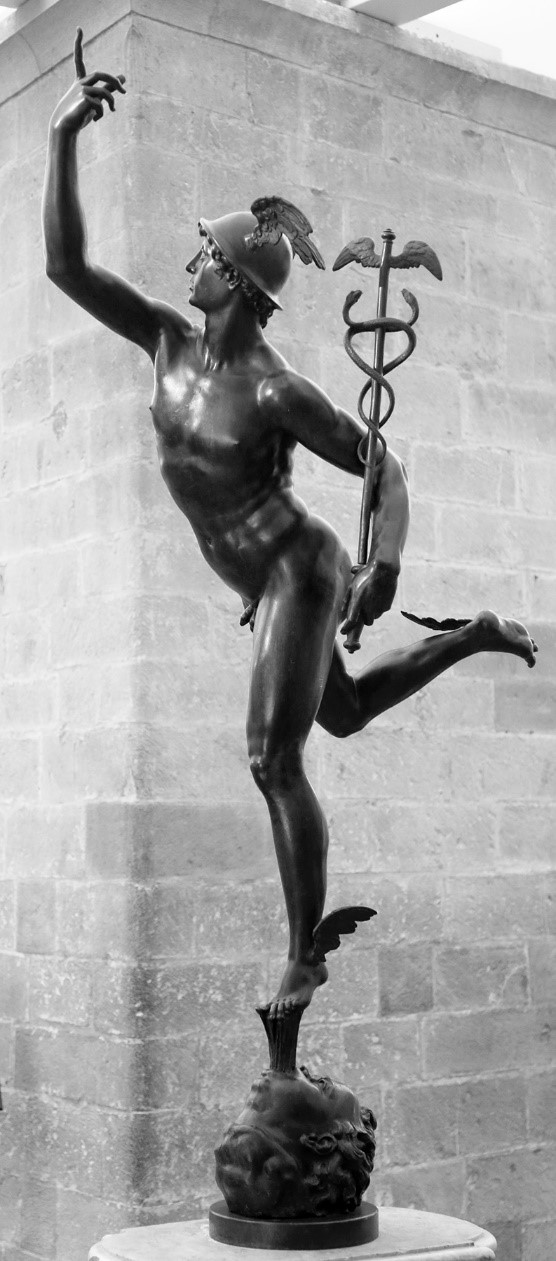
The “flying Mercury” statues in Pelotas and in Brasil
DOI:
https://doi.org/10.34024/herodoto.2019.v4.10973Keywords:
Sculpture, Mercury, Urban identity, PelotasAbstract
This article has as its central theme a symbol of the cultural heritage of Pelotas, which had been out of sight for a long time. And even while gone missing, it was present in the imagery of the city and was the object of heritage claims by some sectors of society. It is the metal sculpture which represents the Greco-Roman god Hermes/Mercury. It was fixed at the top of the tower of the Central Market probably in 1914, disappearing between the decades of 1950 and 1960 and reappearing a few years ago. The text, as it appreciates the context of the arrival of Mercury in Pelotas, approaches this fact as a phenomenon of Reception of Antiquity, connected to a process of construction of an urban identity, an idea of civilization. The text considers the statue as a product of a modern appropriation that occurred not only at a geographical scale, but also at a global one. This appropriation can be seen in some Brazilian cities that lived an analogous moment of economical and cultural prosperity like the one experienced by Pelotas.
Downloads
Downloads
Published
Issue
Section
License
Authors retain copyright and grant the journal the right of first publication.
The works are licensed under the Creative Commons Attribution 4.0 International License (CC BY 4.0), which permits unrestricted use, distribution, and reproduction in any medium, including for commercial purposes, provided proper attribution is given.
Full license text: https://creativecommons.org/licenses/by/4.0/