PROMETEICA - Revista de Filosofia y Ciencias. 2025, v. 32
Artículos
https://doi.org/10.34024/prometeica.2025.32.20909
PERCEPÇÃO DE PROFESSORES DA EDUCAÇÃO INFANTIL SOBRE SUA BASE DE CONHECIMENTO PARA FACILITAR O ENSINO DE CONCEITOS CIENTÍFICOS
PERCEPCIONES DE LOS MAESTROS DE EDUCACIÓN INFANTIL SOBRE SU BASE DE CONOCIMIENTOS PARA FACILITAR LA ENSEÑANZA DE CONCEPTOS CIENTÍFICOS
Mamontsuoe Lintle Maraisane
(University of the Free State, Sudáfrica)
Recibido: 02/08/2025
Aprobado: 22/10/2025
RESUMO
O conhecimento dos professores sobre o conteúdo é fundamental para moldar efetivamente sua capacidade de facilitar o aprendizado de conceitos científicos para jovens alunos. No entanto, a Educação Infantil enfrenta desafios singulares, e pesquisas que examinam como os professores percebem seu conhecimento para transmitir conceitos científicos nesse nível crítico permanecem limitadas. Este estudo investigou essas percepções, abordando a lacuna na compreensão da base de conhecimento percebida pelos professores e suas implicações para a educação científica na primeira infância. Uma abordagem quantitativa de pesquisa, sustentada por um estudo de caso, foi adotada. O referencial pedagógico de conhecimento de conteúdo orientou o estudo. Os dados foram coletados por meio de um questionário com 100 professores do Ensino Fundamental I para compreender suas percepções sobre sua base de conhecimento para facilitar o aprendizado de conceitos científicos. Os resultados indicam que, embora muitos professores expressem entusiasmo e reconheçam a importância da educação científica na primeira infância, eles relatam níveis variados de confiança em sua base de conhecimento, frequentemente citando a necessidade de desenvolvimento profissional adicional. Este estudo destaca a necessidade de programas de treinamento direcionados para apoiar professores do Ensino Fundamental I no ensino de ciências, com implicações para o desenvolvimento curricular e para as políticas educacionais, a fim de fortalecer a alfabetização científica na primeira infância. Por meio de uma melhor compreensão das percepções dos professores, esta pesquisa contribui para os esforços contínuos para aprimorar a qualidade da educação científica na primeira infância.
Palavras-chave: educação infantil. base de conhecimento. conhecimento pedagógico do conteúdo. percepções dos professores. conceitos científicos.
ABSTRACT
Teachers’ knowledge of subject matter is critical in effectively shaping their ability to facilitate science concepts to young learners. However, Early Childhood Education faces
unique challenges, and research examining how teachers perceive their knowledge to impart science concepts at this critical level remains limited. This study investigated these perceptions, addressing the gap in understanding teachers’ perceived knowledge base and its implications for early science education. A quantitative research approach underpinned by a case study design was followed. The pedagogical content knowledge framework guided the study. Data were collected through a survey with 100 Grade R teachers to understand their perceptions of their knowledge base for facilitating science concepts. The findings indicate that while many teachers express enthusiasm and recognise the importance of early science education, they report varying levels of confidence in their knowledge base, often citing a need for additional professional development. This study highlights the need for targeted training programmes to support Grade R teachers in science instruction, with implications for curriculum development and educational policy to strengthen early science literacy. Through a better understanding of teachers’ perceptions, this research contributes to ongoing efforts to enhance the quality of early childhood science education.
Keywords: early childhood education. knowledge base. pedagogical content knowledge. teachers’ perceptions. science concepts.
RESUMEN
O conhecimento dos professores sobre o conteúdo é fundamental para moldar efetivamente sua capacidade de facilitar o aprendizado de conceitos científicos para jovens alunos. No entanto, a Educação Infantil enfrenta desafios singulares, e pesquisas que examinam como os professores percebem seu conhecimento para transmitir conceitos científicos nesse nível crítico permanecem limitadas. Este estudo investigou essas percepções, abordando a lacuna na compreensão da base de conhecimento percebida pelos professores e suas implicações para a educação científica na primeira infância. Uma abordagem quantitativa de pesquisa, sustentada por um estudo de caso, foi adotada. O referencial pedagógico de conhecimento de conteúdo orientou o estudo. Os dados foram coletados por meio de um questionário com 100 professores do Ensino Fundamental I para compreender suas percepções sobre sua base de conhecimento para facilitar o aprendizado de conceitos científicos. Os resultados indicam que, embora muitos professores expressem entusiasmo e reconheçam a importância da educação científica na primeira infância, eles relatam níveis variados de confiança em sua base de conhecimento, frequentemente citando a necessidade de desenvolvimento profissional adicional. Este estudo destaca a necessidade de programas de treinamento direcionados para apoiar professores do Ensino Fundamental I no ensino de ciências, com implicações para o desenvolvimento curricular e para as políticas educacionais, a fim de fortalecer a alfabetização científica na primeira infância. Por meio de uma melhor compreensão das percepções dos professores, esta pesquisa contribui para os esforços contínuos para aprimorar a qualidade da educação científica na primeira infância.
Palabras clave: educação infantil. base de conhecimento. conhecimento pedagógico do conteúdo. percepções dos professores. conceitos científicos.
Early Childhood Education (ECE) serves as a preparatory stage within the primary education. It emphases the development of basic skills in literacy, numeracy, and life skills through engaging, play- based, and hands-on learning experiences (Ministry of Education and Training, 2021). Science education is taught at this level. Debates on early science education emphasise the important role of teachers in making learning accessible to learners (Larkin & Lowrie, 2023; Yiğit‐ Gençten et al., 2024). Hence, ECE teachers’ understanding of content and pedagogy significantly shapes young learners’ foundational skills, cognitive development, and enthusiasm for science learning
(Larimore, 2020). Teachers need to integrate their subject matter expertise with teaching strategies tailored to young learners’ developmental stages (Shulman, 1986).
Science education in early childhood is valuable, as it introduces young learners to initial science concepts and ways of thinking (Larimore, 2020). When teachers help the learners by engaging with basic science principles early, they develop an innate curiosity about their surroundings, spurring them to question, explore, and seek answers (Yiğit‐Gençten et al., 2024). Larkin and Lowrie (2023) emphasise that these experiences are more than an introduction to science; they are essential building blocks of scientific thinking. By the time teachers expose children to participating in hands-on activities, observational exercises, and interactive lessons, they begin to acquire critical cognitive skills, such as analytical reasoning, logical deduction, and effective problem-solving (Nhase et al., 2021).
The World Bank Group (2021) highlights that early childhood is a critical time for brain development. During this stage, when teachers introduce activities related to science, technology, engineering, arts, and mathematics (STEAM), they promote cognitive, social, and emotional growth, supporting well- rounded development (Larkin & Lowrie, 2023). Science education lays the foundation for developing critical thinking, creativity, problem-solving, and innovation skills, which are essential in today’s rapidly changing world (Murphy et al., 2021). Therefore, early exposure to STEAM subjects advances curiosity and a lifelong love for learning, helping children become comfortable with technology and science concepts from a young age (Alghamdi, 2023; DeJarnette, 2018). STEAM education helps close gender and socioeconomic gaps in later academic achievement by providing equitable learning opportunities from the start, aligning with global goals of inclusive and equitable education (Reimers, 2024).
Nonetheless, teaching science concepts in early childhood settings poses significant challenges due to the abstract nature of science concepts, teachers’ backgrounds, and lower priority on science curricula (Moomaw, 2024). Besides, the Foundation Phase curriculum often prioritises literacy and numeracy. For example, the Grade R (preparatory class before Grade 1, forms the setting of this study) curriculum places a strong emphasis on developing reading, writing, and mathematical skills (Ministry of Education and Training, 2021). This prioritisation creates gaps in addressing science concepts that prepare students for modern societal demands.
Literature indicates that young learners often struggle with abstract scientific concepts, and teachers may lack the pedagogical content knowledge (PCK) required to simplify and adapt these concepts for Early Childhood Education settings (Catalano et al., 2019). This difficulty is compounded by the multidisciplinary nature of science education, which requires teachers to be knowledgeable about teaching this subject in their classes. The complexity of balancing these domains can result in fragmented instruction, with teachers focusing more on traditional subjects at the expense of science integration (Nhase et al., 2021). It is, therefore, important to understand teachers’ knowledge base on facilitating science concepts. Their perceptions of their understanding, skills, and expertise in teaching science concepts contribute to the foundation of their knowledge base (Jita & Tsakeni, 2022). This includes their self-assessment of how well they understand scientific concepts, their confidence in applying pedagogical methods, and their assessment of how well they can support student learning in science (Şen et al., 2022).
Magnusson et al. (1999) argue that teachers’ perceptions are important as they directly impact their teaching practices. If teachers believe they have a strong knowledge base, they may be more likely to engage in effective teaching strategies. On the other hand, if they perceive gaps in their knowledge, it may limit their ability to teach science concepts effectively. Understanding these perceptions enables researchers to identify areas where teachers may require additional professional development or support to enhance their instructional practices in science education (Murphy et al., 2021; Raviv & Galili, 2024). Accordingly, this study aimed to address the following research question: What are the perceptions of early childhood teachers on their knowledge base in facilitating the teaching of science concepts?
Although the significance of early science education in nurturing curiosity and foundational science understanding is well recognised (Nhase et al., 2021), studies exploring how teachers perceive their science knowledge to teach science at the Grade R level are scarce. Specifically, there is a lack of research that examines Grade R teachers’ self-perceived knowledge base for facilitating science concepts effectively. This limited knowledge in the literature indicates an urgent need to investigate Grade R teachers’ perceptions of their knowledge of teaching science. The gap hinders progress toward achieving Sustainable Development Goal 4 (SDG 4) target, as foundational science skills are crucial for promoting lifelong learning and cognitive development (Reimers, 2024). Teaching science concepts in early childhood aligns with the broader objectives of SDG 4 to ensure inclusive and equitable education (World Bank Group, 2021). For teachers to provide high-quality science instruction at the fundamental level and fulfil SDG 4 objective 4.2 by 2030, it is imperative to comprehend how they perceive their level of knowledge.
Science education in early childhood is essential for enhancing curiosity, critical thinking, and problem- solving skills. Research highlights that young children are naturally inclined toward exploration and inquiry (Murphy et al., 2021). Therefore, early exposure to science lays a foundation for lifelong learning and can positively influence learners’ attitudes toward the subject in later years (Moomaw, 2024). However, achieving this requires teachers who are well-equipped with both content knowledge and effective teaching strategies.
Many scholars argue that the early introduction of science concepts nurtures cognitive development. For example, Nhase et al. (2021) emphasise that young children are naturally curious and learn through exploration, making early exposure to science a way to tap into their inherent desire to understand the world. Larimore (2020) asserts that early scientific inquiry improves learners’ capacity for critical thought, problem-solving abilities, and comprehension of cause-and-effect linkages. This hands-on learning experience helps shape their cognitive abilities. Scholars such as Kennedy and Sundberg (2020) and Prasetyo et al. (2024) add that early science education is key to fostering 21st century skills such as creativity, critical thinking, and collaboration. These skills are not only essential for personal development but also necessary to prepare young learners for future challenges in an increasingly technological and scientific world. The integration of STEAM subjects into Early Childhood Education is advocated as a holistic approach to preparing children for modern educational demands (Alghamdi, 2023). Some scholars caution against pushing science concepts too early, raising concerns about potential cognitive overload. Catalano et al. (2019) warn that forcing abstract concepts, such as those in science, too early may hinder children’s natural learning processes and instead lead to frustration. This is supported by Nhase et al. (2021), who advocate for a more developmentally appropriate approach where science concepts are introduced through play and inquiry-based learning rather than formal instruction.
Jurado de Los Santos et al. (2020) highlight the role of science education in promoting equity. Thus, introducing science early in life can help close the gap between children from different socioeconomic backgrounds. Reimers (2024) argues for equitable access to learning, including early science education, for the reduction of educational disparities. Without early science exposure, children from disadvantaged backgrounds may miss out on opportunities to develop essential skills for future academic success.
Teachers’ beliefs about their knowledge base have a profound impact on both their teaching methods and student outcomes (Nisperuza et al., 2019). Research suggests that when teachers perceive their knowledge base as solid, they tend to implement more innovative and student-centred teaching strategies, which can lead to more effective learning environments (Gul et al., 2021; Tondeur et al.,
2017). This confidence often allows teachers to be positive, take risks, experiment with different pedagogical approaches, and engage students in deeper learning experiences (Catalano et al., 2019). In contrast, teachers who feel uncertain about their knowledge may adopt more traditional and less engaging instructional strategies, limiting students’ exposure to critical and challenging content (Park et al., 2016).
Understanding how teachers perceive their knowledge base offers insights into their classroom practices, as these perceptions influence their decisions on how to apply their knowledge (Barendsen & Henze, 2017). Nonetheless, ongoing debates exist regarding the link between teachers’ perceptions and their teaching practices. For example, Yoshida and Sølberg (2024) indicate that teachers view curiosity and interest in science as key factors in influencing student learning.
Park et al. (2016), on the other hand, revealed that while teachers may hold positive views on innovative educational methods, such as STEAM education, they often face challenges in executing these methods effectively. Similarly, Jita and Tsakeni (2022) noted that teachers’ perceptions and attitudes toward their knowledge base can sometimes be a barrier to optimal use. The research context for the aforementioned studies is not in early childhood, which poses a gap in investigating teachers’ perceptions of their knowledge base in this area.
Further research highlights the need for professional development to enhance teachers’ knowledge base and belief systems. Professional learning opportunities can support teachers in developing a stronger sense of efficacy and help them bridge gaps between their perceived knowledge and actual classroom practices (Barendsen & Henze, 2017). This not only improves teachers’ confidence but also positively impacts student achievement, as teachers who feel knowledgeable and capable are more likely to promote critical scientific thinking and inquiry-based learning (Kovalchuck et al., 2024; Nisperuza et al., 2019).
The framework for this study is grounded in PCK, a concept introduced by Shulman (1986) as one of seven knowledge bases that teachers should possess. PCK refers to the knowledge that extends beyond the understanding of the subject matter and includes how to teach that content effectively (Shulman, 1987). This implies that teachers need both a strong grasp of the subject and the ability to make that content accessible to learners by organising and delivering it explicably (Mazibe et al., 2018).
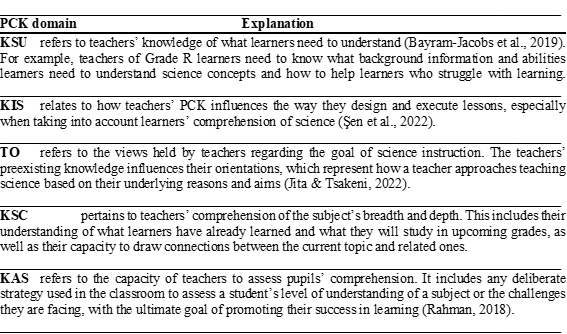
Several scholars have expanded on PCK research, with the model of Magnusson et al. (1999) being particularly relevant for science education. This model emphasizes key components, such as knowledge of the science curriculum (KSC), knowledge of student understanding (KSU), knowledge of instructional strategies (KIS), knowledge of assessment of strategies (KAS), and teacher orientation toward teaching science (TO). Fraser (2016) notes that this model provides a practical framework for evaluating, measuring, and supporting science teaching. Hlaela and Jita (2024) used the model to measure the domain-specific PCK of physics teachers quantitatively. This study used the same model to understand the perceptions of Grade R teachers on their knowledge base to facilitate science concepts. Table 1 below elaborates on the PCK domains of Magnusson et al. (1999).
This study used a quantitative research approach to investigate Grade R teachers’ perceptions of their knowledge base regarding teaching science concepts. A 5-point Likert scale questionnaire was created using the PCK domains of Magnusson et al. (1999). Questionnaires for this study were distributed to preschool teachers who had an Early Childhood Education certificate and studied science subjects. They ranked their perceived knowledge on a scale ranging from 1 to 5, with 1 being the lowest and 5 the highest. However, during data analysis, the 5-point Likert scale was collapsed to a 3-point scale so that the items can be ranked to disagree, neutral, and agree.
Through event sampling, a sample of 100 Grade R teachers from 10 districts was selected. The targeted event normally happens in September of every year, where preschool teachers meet for recreational purposes. The sampling technique was selected to guarantee that the respondents were representative of the teaching population in this case study. The majority of the respondents were female (n = 97), with only 3 being male. All the teachers selected had more than five years of experience, which is key in contributing craft knowledge to teachers (Rice & Kitchel, 2017). Ethical issues were followed as the research secured ethical clearance from the research ethics committee. Respondents completed the consent forms and were fully informed of their rights prior to participating in the study.
To evaluate the reliability of the questionnaire, a pilot study was conducted with four teachers from the Maseru district who were not part of the main study. They had the same qualifications as the main respondents. The quantitative data were imported into a spreadsheet, cleaned, and coded. Subsequently, the statistical analysis software Statistical Package for the Social Sciences (SPSS) was used to analyse the data. Frequencies were provided and they were descriptive. According to Cohen et al. (2018), descriptive statistics summarize and display data without concluding, making inferences, or predicting outcomes. Descriptive statistics for teachers were computed, and four items or questions were used to construct their demographic data. The others were recorded to serve as control variables, which were either dependent or independent.
Cronbach’s alpha coefficient was employed to evaluate the reliability of the questionnaire to assist in measuring the consistency of items within each group. Hair et al. (2006) proposed an acceptable reliability score of 0.5 to 0.6 as a minimum for exploratory research, while scores around 0.8 indicate high reliability (Cohen et al., 2018). In this study, coefficients ranged from 0.55 to 0.82, suggesting good reliability, and scores between 0.6 and 0.69 are considered “acceptable”.
The generated data allowed for quantifying perceptions of Grade R teachers regarding their knowledge base grounded on 1) knowledge of learners’ understanding of science, 2) knowledge of instructional strategies, 3) teacher orientation toward teaching science, 4) knowledge of the science curriculum, and
5) knowledge of assessment strategies. A closed-ended questionnaire was employed to determine what Grade R teachers perceived they knew about teaching science concepts. A structured, closed-ended questionnaire was utilised to gauge Grade R teachers' perceived knowledge of teaching science concepts. For analysis, the scale was condensed into three categories: disagree (1.0–2.9), neutral (3.0), and agree (3.1−5.0). Standard deviations between 0.1 and 0.99 indicated minimal variation, while those of 1.0 or higher reflected substantial divergence from the mean. The following items were extracted from the questionnaire, and the averages and standard deviations were calculated using the Statistical Package for the Social Sciences software as follows:
Questionnaire item (D-stands for disagree, N-stands for neutral and A-stands for agree) | D % | N % | A % | |||
Item = n | Teachers’ perceived knowledge of understanding the science curriculum | Mean | S.D | |||
5 | I have enough knowledge about science concepts | 1 | 11 | 88 | 4.4 | 0.725 |
6 | I can comfortably plan science concepts for Grade R learners | 1 | 4 | 95 | 4.49 | 0.674 |
7 | Concepts such as floating and sinking do not require much content knowledge | 29 | 8 | 63 | 2.41 | 1.371 |
8 | Teachers’ little science content knowledge does not limit the delivery of science | 27 | 13 | 60 | 3.53 | 1.389 |
Understanding the science curriculum, as a key aspect of teacher knowledge, involves comprehending the scope and depth of topics such as floating and sinking, as well as recognising their significance within the broader curriculum. The overall statistical analysis of how respondents perceived their knowledge of the science curriculum is presented in Table 2.

Table 3 presents the overall mean score of 4.34 (SD = 0.775), indicating that the respondents generally perceived themselves as having strong knowledge of the science curriculum. This high mean score suggests that the participating Grade R teachers expressed confidence in their ability to understand and interpret the scope and sequence of science content as outlined in the curriculum. It reflects their
perceived competence in areas such as identifying key science concepts, aligning content with learning outcomes, and selecting appropriate materials and resources to support curriculum implementation.
Moreover, the relatively low standard deviation (0.775) signifies a high level of agreement among respondents, suggesting a consistent and shared confidence across the sample. This consistency may point to a uniform exposure to curriculum training or similar levels of professional experience among participants.
Table 4 illustrates respondents’ perceptions of their understanding of learners’ grasp of science concepts. This aspect of teacher knowledge encompasses awareness of students’ prior knowledge, including their misconceptions and challenges encountered while learning science topics.
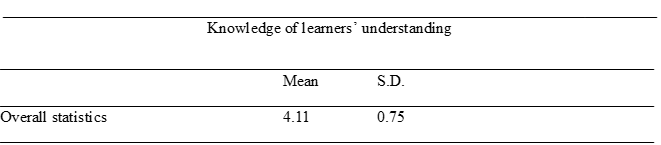
Table 4 presents data reflecting respondents’ perceptions of their knowledge regarding how students understand science concepts. The high overall mean score of 4.11 (SD = 0.75) suggests that the majority of respondents felt confident in their ability to support learners' understanding of scientific ideas. This positive self-assessment implies that teachers believe they possess the necessary pedagogical insight to anticipate, identify, and respond to the needs and learning patterns of young children in science education.
The consistency in responses, as indicated by the relatively low standard deviation, points to a shared understanding among participants of the factors that influence young learners' grasp of science. This may be attributed to their training in early childhood education, which emphasizes learner-centered approaches and the developmental characteristics of young children. Respondents generally agreed that facilitating student understanding in science requires attentiveness to several key instructional strategies.
Magnusson et al. (1999) emphasise that instructional strategies for teaching science concepts involve methods tailored to certain science classes and topics intended for activities and representations. Table 5 highlights the findings on the knowledge of instructional strategies employed by respondents in the classroom for teaching science.
Knowledge of instructional strategies | ||
Mean | S.D. | |
Overall statistics | 4.05 | 0.90 |
The overall mean score of 4.05 (SD = 0.90), as shown in Table 4, indicates that respondents generally perceived themselves as having a strong understanding of instructional strategies for teaching science concepts in Grade R. This suggests that most teachers reported regularly using effective teaching methods to facilitate science learning among young children. These methods likely include hands-on activities, guided discovery, storytelling, visual aids, and the integration of everyday experiences— approaches that are developmentally appropriate for early childhood learners.
The relatively low standard deviation of 0.90 indicates a fair degree of consistency in responses, implying that there is a common level of confidence and shared practice among the teachers surveyed. This uniformity may reflect exposure to similar training programs or shared professional development experiences, particularly in early childhood education, where best practices often emphasize active, experiential learning.
Table 6 below presents the overall statistics on respondents’ perceptions regarding their knowledge of assessment strategies for teaching science. This knowledge involves understanding various methods to evaluate students’ learning effectively. It also encompasses the ability to design tasks that measure students’ grasp of science concepts.
Knowledge of assessment strategies | ||
Mean | S.D. | |
Overall statistics | 3.37 | 1.01 |
The overall mean score of 3.37 (SD = 1.01), as shown in Table 6, reflects a moderate level of teacher engagement with assessment strategies in the context of teaching science to Grade R learners. This score suggests that while some teachers feel reasonably confident in their use of assessment techniques, others may be less familiar or comfortable with implementing them consistently and effectively.
The relatively high standard deviation of 1.01 further emphasizes the variability in how assessment strategies are understood and applied among respondents. This spread in responses indicates that, within the sample, there is no uniform approach to assessing science learning. Some teachers may regularly use formative assessments such as observation checklists, questioning techniques, and performance-based tasks to gauge learners’ understanding. Others, however, may rely on less frequent or less structured methods, or may not fully recognize the value of assessment as a tool for informing instruction.
Table 7 presents the overall statistics on respondents’ orientation toward science teaching. The focus was on respondents’ beliefs, attitudes, and approaches to delivering science content effectively. This orientation reflects the extent to which respondents prioritised inquiry-based learning, hands-on activities, and fostering critical thinking among students.

The overall mean score of 3.78 (SD = 0.91) in Table 7 above indicates a moderately positive orientation toward teaching. This suggests that teachers generally adopt effective practices but may show variability in their approaches or confidence levels. The standard deviation reflects a range of teaching orientations, which could be influenced by differences in experience, training, or contextual factors. Strengthening professional development opportunities and promoting reflective teaching practices may help achieve a more consistent and positive orientation across teachers.
Table 8 illustrates the Spearman correlation coefficients and associated p-values between questionnaire domain averages. The data reveal that respondents’ self-perceptions of their knowledge of the science curriculum (KSC), knowledge of student understanding (KSU), and knowledge of instructional strategies (KIS) do not jointly impact their knowledge of assessment strategies (KAS). The findings reveal a weak but statistically significant correlation between KSC and teacher orientation toward teaching (TO) (r = 0.28577, p = 0.0039). However, the correlations between KSC and KAS (r = 0.12680, p = 0.2087) and between KSU and KAS or TO (p = 0.1075, p = 0.2196, respectively) are weak. KIS shows a weak correlation with KAS (r = 0.19902, p = 0.0471) but a moderate, significant correlation with TO (r = 0.42819, p < 0.0001).
Table 8: Spearman correlation coefficients and associated p-values between questionnaire domain averages (N = 100)
KSC | KSU | KIS | KAS | TO | |
KSC | 1.00000 | 0.36341 (0.0002) | 0.44647 (˂.0001) | 0.12680 (0.2087) | 0.28577 (0.0039) |
KSU | 0.36341 (0.0002) | 1.00000 | 0.12299 (0.2228) | 0.16194 (0.1075) | 0.12384 (0.2196) |
KIS | 0.44647 (˂.0001) | 0.12299 (0.2228) | 1.00000 | 0.19902 (0.0471) | 0.42819 (˂.0001) |
KAS | 0.12680 (0.2087) | 0.16194 (0.1075) | 0.19902 (0.0471) | 1.00000 | 0.40038 (˂.0001) |
TO | 0.28577 (0.0039) | 0.12384 (0.2196) | 0.42819 (˂.0001) | 0.40038 (˂.0001) | 1.00000 |
*Significant at p < 0.05
These findings suggest that respondents’ self-perceptions of their knowledge in key domains—namely knowledge of the science curriculum (KSC), knowledge of student understanding (KSU), and knowledge of instructional strategies (KIS), may not significantly influence their knowledge of assessment strategies (KAS). The observed weak correlations between KAS and the other domains indicate a potential disconnect in how respondents translate their curricular understanding and pedagogical expertise into effective assessment practices. This disjunction may reflect a limited conceptual integration of assessment as an essential component of the teaching and learning process. In practice, a comprehensive pedagogical approach requires that curriculum content, student learning needs, instructional methods, and assessment be closely aligned. The weak relationships identified here could suggest that many respondents view assessment as a separate or less central component of their teaching, rather than as a continuous and integrated process that informs instruction and supports learner development.
Moreover, the weak correlations may also point to gaps in professional preparation or ongoing support related specifically to assessment literacy in early childhood science education. While teachers may feel confident in planning lessons or engaging students with appropriate content, they may lack the tools, training, or confidence to assess learning outcomes effectively, especially in ways that are developmentally appropriate for Grade R learners.
Furthermore, the moderate correlation between knowledge of instructional strategies (KIS) and teaching orientation (TO) highlights the importance of aligning teaching methods with broader educational philosophies and beliefs about learning. This relationship suggests that teachers who possess a clear pedagogical orientation, such as constructivist, inquiry-based, or child-centered approaches, are more likely to choose instructional strategies that reflect those values. This alignment may contribute to more coherent and effective teaching practices, particularly in early science education, where young learners benefit from hands-on, exploratory, and play-based approaches.
This study explored how teachers in Grade R perceived their knowledge base for facilitating concepts of science. It was evident from the data that respondents believed they had the appropriate knowledge for teaching science concepts. In other words, respondents believed that they knew how to teach science concepts. These results corroborate those of previous researchers who studied teachers’ perceptions about their knowledge base, particularly PCK (Gul et al., 2021; Jita & Tsakeni, 2022). Nisperuza et al. (2019) indicated that teachers perceived knowing how learners think, including educational and assessment strategies. Similar to the results in this study, they highlighted that teachers had differing views about their orientation toward teaching science concepts, which could be because of their engagement in facilitating science concepts.
It was discovered that most respondents were quite confident about their knowledge of the curriculum used to teach science concepts in terms of its significance and breadth and depth. In this regard, the respondents believed that they understood the fundamental science concepts and could adapt the activities to the type of learners they were teaching and the complexity of the concepts. Given the stronger correlation between this curricular knowledge sub-component and PCK, it seems understandable that respondents firmly felt that they were knowledgeable about it. This finding is in accord with that of Barendsen and Henze (2017), who found that pre- and in-service teachers were positive about their PCK. It can be implied that teachers believe they are knowledgeable about science concepts because they have experience teaching them.
According to the survey results, most respondents expressed satisfaction with their knowledge foundation for teaching science concepts. Respondents expressed confidence in their content knowledge and their ability to teach. However, there was a conspicuous absence of correlation between the sub- components of curricular knowledge. For example, although respondents were confident in their knowledge of scientific content, they found it difficult to align this knowledge with curriculum goals and methods of student assessment practices.
This study provides important insights into early childhood teachers’ perceptions of their knowledge base for teaching science concepts. While respondents generally expressed confidence in their content knowledge and ability to facilitate science learning, the absence of meaningful correlations between key PCK domains suggests potential gaps in how these knowledge components interact in practice. This misalignment raises concerns about whether teachers’ understanding of science concepts is sufficiently integrated with their curricular knowledge, instructional decision-making, and assessment strategies.
The findings further point to a fragmented knowledge base in which teachers may view content knowledge, curriculum requirements, pedagogy, and assessment as separate entities rather than
interconnected aspects of effective science teaching. Such fragmentation can compromise the coherence of science instruction, potentially limiting learners’ opportunities to develop deep conceptual understanding through developmentally appropriate, inquiry-based approaches. The lack of integration across PCK domains also signals the possibility that teachers rely on routine or generic instructional methods rather than pedagogies specifically tailored to early science learning.
Educational establishments ought to provide professional development programmes to improve teachers’ understanding of PCK constructs. This can assist teachers in aligning their subject-matter expertise with valuable and practical instructional strategies. On the other hand, educational institutions such as schools and district educational departments ought to encourage collaboration among teachers to build a more comprehensive understanding of science teaching. Effective classroom practices can result from sharing ideas and tactics facilitated by professional learning communities.
This study is limited to the self-reported data, which may not accurately reflect teachers’ actual knowledge base or classroom practices. As a result, the findings did capture the extent to which teachers perceived knowledge translates into effective instructional strategies, curriculum alignment, or assessment practices. In addition, the sample consisted of teachers within a specific context, which may limit the generalisability of the findings. Factors such as training background, resource availability, and school environment may have influenced teachers’ perceptions. This constrained understanding means that the results may not fully represent Grade R teachers in other regions or contexts. Moreover, while respondents reported confidence in certain sub-components of curricular knowledge, the study revealed weak or absent correlations between these elements. The survey design did not explore the underlying reasons for these inconsistencies, making it difficult to determine whether they stem from conceptual misunderstandings, gaps in training, or the structure of the curriculum itself. Furthermore, future studies should investigate teachers’ actual PCK through classroom observations and lesson plan analysis. This would provide a more precise understanding of their instructional practices and areas where they still need further improvement and support.
The author declares that she has no financial or personal relationship(s) that may have inappropriately influenced her in writing this article.
Alghamdi, A. A. (2023). Exploring early childhood teachers’ beliefs about STEAM education in Saudi Arabia. Early Childhood Education Journal, 51(2), 247–256. https://doi.org/10.1007/s10643-021- 01303-0
Barendsen, K., & Henze, I. (2017). Relating teacher PCK and teacher practice using classroom observation. Research in Science Education, 49, 1141–1175. https://doi.org/10.1007/s11165-017- 9637-z.
Bayram‐Jacobs, D., Henze, I., Evagorou, M., Shwartz, Y., Aschim, E., Alcaraz‐Dominguez, S., Barajas, M., & Dagan, E. (2019). Understanding science teaching: Models, learning and assessment. Journal of Science Teacher Education, 30(2), 1207–1233. https://doi.org/10.1002/tea.21550
Braun, V., & Clarke, V. (2006). Using thematic analysis in psychology. Qualitative Research in Psychology, 3(2), 77–101. https://doi.org/10.1191/1478088706qp063oa
Catalano, A., Asselta, L., & Durkin, A. (2019). Exploring the relationship between science content knowledge and science teaching self-efficacy among elementary teachers. IAFOR Journal of Education, 7(1), 57–70. https://files.eric.ed.gov/fulltext/EJ1217961.pdf
Cohen, L., Morrison, L., & Manion, L. K. (2018). Research methods in education (8th ed.). Routledge.
DeJarnette, N. (2018). Implementing STEAM in the early childhood classroom. Early Childhood Education Journal, 46(4), 379–389. https://eric.ed.gov/?id=EJ1190735
Fraser, S. P. (2016). Pedagogical content knowledge (PCK): Exploring its usefulness for science lecturers in higher education. Research in Science Education, 46, 141–161. https://doi.org/10.1007/s11165-014-9459-1
Gul, N., Ullah, I., & Bibi, N. (2021). Perception of working and prospective teachers about the application of their professional knowledge at secondary level. The Dialogue, 16(1), 39–50. https://www.researchgate.net/publication/350609578
Hair, J., Black, W., Babin, B., Anderson, R., & Tatham, R. (2006). Multivariate data analysis (6th edition). Prentice Hall.
Hlaela, N., & Jita, L. C. (2024). Examining physics teachers’ domain-specific pedagogical content knowledge components in Lesotho secondary schools. Journal of Baltic Science Education, 23(2), 240– 259. https://doi.org/10.33225/jbse/24.23.240
Jita, L. C., & Tsakeni, M. (2022). Science teachers’ perceptions of their knowledge base for teaching force concepts. Journal of Baltic Science Education, 21(4), 651–662. https://eric.ed.gov/?id=EJ1363780
Jurado de Los Santos, P., Moreno-Guerrero, A. J., Marín-Marín, J. A., & Soler Costa, R. (2020). The term equity in education: A literature review with scientific mapping in Web of Science. International Journal of Environmental Research and Public Health, 17(10), Article 3526. https://doi.org/10.3390/ijerph17103526
Kennedy, T. J., & Sundberg, C. W. (2020). 21st century skills. In B. Akpan, & T. J. Kennedy (Eds.), Science education in theory and practice: An introductory guide to learning theory (pp. 479–496). Springer.
Kovalchuck, V., Kubikova, K., Alieka, H., Pysmenna, O., & Filatenko, T. (2024). Forms and methods of professional development for biology teachers. Edelweiss Applied Science and Technology, 8(4), 507–521. https://ideas.repec.org/a/ajp/edwast/v8y2024i4p507-521id1126.html#
Larimore, R. A. (2020). Preschool science education: A vision for the future. Early Childhood Education Journal, 48(6), 703–714. https://doi.org/10.1007/s10643-020-01033-9
Larkin, K., & Lowrie, T. (2023). Teaching approaches for STEM integration in pre- and primary school: A systematic qualitative literature review. International Journal of Science and Mathematics Education, 21(Suppl 1), 11–39. https://doi.org/10.1007/s10763-023-10362-1
Magnusson, S., Krajcik, J., & Borko, H. (1999). Nature, sources, and development of pedagogical content knowledge for science teaching. In J. Gess-Newsome, & N. G. Lederman (Eds.), Examining pedagogical content knowledge (pp. 95–132). Springer.
Mazibe, E. N., Coetzee, C., & Gaigher, E. (2018). A comparison between reported and enacted pedagogical content knowledge (PCK) about graphs of motion. Research in Science Education, 50(3), 941–964. https://doi.org/10.1007/s11165-018-9718-7
Ministry of Education and Training (Information concealed). (2021). National Policy for Integrated Early Childhood Care and Development. Ministry of Education and Training.
Moomaw, S. 2024. Teaching STEM in the early years: Activities for integrating science, technology, engineering, and mathematics. Redleaf Press.
Murphy, C., Smith, G., & Broderick, N. (2021). A starting point: Provide children opportunities to engage with scientific inquiry and nature of science. Research in Science Education, 51(6), 1759–1793. https://doi.org/10.1007/s11165-019-9825-0
Nhase, Z., Okeke, C. I., & Ugwuanyi, C. S. (2021). Using an inquiry-based approach to enhance Grade 3 learners’ basic science concepts development. Cypriot Journal of Educational Sciences, 16(3), 1065– 1072. https://doi.org/10.18844/cjes.v16i3.5825
Nisperuza, E. F., Salgado, A. G., & Garcia, L. M. (2019). Science teachers’ perceptions of their pedagogical content knowledge (PCK) [Congress]. CISETC 2019 International Congress on Educational and Technology in Sciences, Arequipa, Peru. http://ceur-ws.org/Vol-2555/paper26.pdf
Park, H., Byun, S.-Y., Sim, J., Han, H.-S., & Bae, S. Y. (2016). Teachers’ perceptions and practices of STEAM education in South Korea. Eurasia Journal of Mathematics, Science & Technology Education, 12(7), 1739–1753. http://doi.org/10.12973/eurasia.2016.1531a
Prasetyo, Z. K., Syawaludin, A., & Desstya, A. (2024). Integration indigenous science in Merdeka Curriculum to strengthen scientific literacy and environmental care in elementary schools: Need analysis. Edelweiss Applied Science and Technology, 8(5), 1062–1070. https://doi.org/10.55214/25768484.v8i5.1806
Rahman, M. (2018). Exploring teachers’ practices of classroom assessment in secondary science classes in Bangladesh. Journal of Education and Learning, 7(4), 274–283. https://doi.org/10.5539/jel.v7n4p274.
Raviv, A., & Galili, I. (2024). Preschool teachers’ attitudes towards the implementation of science and technology studies in preschool. Early Childhood Education Journal, 52(3), 575–585. https://doi.org/10.1007/s10643-023-01461-3
Rice, A. H., & Kitchel, T. (2017). Teachers’ beliefs about the purpose of agricultural education and its influence on their pedagogical content knowledge. Journal of Agricultural Education, 58(2), 198–213. https://doi.org/10.5032/jae.2017.02198
Reimers, F. M. (2024). The sustainable development goals and education, achievements and opportunities. International Journal of Educational Development, 104, 102965.https://doi.org/10.1016/j.ijedudev.2023.102965
Şen, A., Demirdöğen, B., & Öztekin, C. (2022). The role of PCK in shaping teaching practices: Insights from science teachers. International Journal of Science Education, 44(3). https://doi.org/10.1007/s11165-023-10124-7
Shulman, L. S. (1986). Those who understand: Knowledge growth in teaching. Educational Researcher, 15(2), 4–14. https://doi.org/10.3102/0013189X015002004
Shulman, L. S. (1987). Knowledge and teaching: Foundations of the new reform. Harvard Educational Review, 57(1), 1–23. https://doi.org/10.17763/HAER.57.1.J463W79R56455411
Tondeur, J., van Braak, J., Ertmer, P. A., & Ottenbreit-Leftwich, A. (2017). Understanding the relationship between teachers’ pedagogical beliefs and technology use in education: A systematic review
of qualitative evidence. Educational Technology Research and Development, 65(3), 555–575. https://www.academia.edu/28595855/
Yiğit‐Gençten, V., Gultekin, M., & Aydemir, F. (2024). Exploring the hidden canvas: Conceptualisations of nature in early years curricula and standard documents in Turkey. The Curriculum Journal, 35(3), 447–469. https://doi.org/10.1002/curj.248
Yoshida, M., & Sølberg, J. (2024). Science Teachers’ Beliefs on Science Teaching and Learning for Implementing in STEM Education. Science Education International, 35(3), 192-197.