PROMETEICA - Revista de Filosofia y Ciencias. 2025, v. 32
Artículos
https://doi.org/10.34024/prometeica.2025.32.19799
KNOWLEDGE MANAGEMENT AND ORGANIZATIONAL PERFORMANCE
ANALYSIS IN THE CHILEAN EDUCATIONAL CONTEXT
GESTIÓN DEL CONOCIMIENTO Y RENDIMIENTO ORGANIZATIVO
Un análisis en el contexto educativo chileno
RELAÇÃO ENTRE GESTÃO DO CONHECIMENTO E DESEMPENHO ORGANIZACIONAL
Uma análise no contexto educativo chileno
(Universidad del Bío-Bío, Chile)
(Universidad Austral de Chile, Chile)
Recibido: 06/12/2024
Aprobado: 25/07/2025
ABSTRACT
This study analyzes the relationship between the dimensions of knowledge management creation, sharing, and application and the organizational performance of primary and secondary education institutions. Using a quantitative and exploratory approach, surveys were administered to teachers and administrators with experience in educational management in institutions located in southern Chile. The analysis was conducted through Partial Least Squares Structural Equation Modeling (PLS-SEM). The results show that knowledge creation, sharing, and application have a positive and significant effect on organizational performance. These findings invite not only a reflection on institutional efficiency, but also on the role of knowledge in schools as a common good oriented toward human development. From a philosophical perspective, the study emphasizes the need to promote a knowledge management approach that integrates technical capacity with ethics and educational transformation.
Keywords: knowledge. knowledge management. performance. education in Chile.
RESUMEN
Este trabajo analiza la relación entre las dimensiones de la gestión del conocimiento creación, compartición y aplicación y el desempeño organizativo de instituciones de educación primaria y secundaria. A partir de un enfoque cuantitativo y exploratorio, se aplicaron encuestas a docentes y directivos con experiencia en gestión educacional, pertenecientes a establecimientos ubicados en el sur de Chile. El análisis se realizó mediante el modelo de ecuaciones estructurales por mínimos cuadrados parciales (PLS-SEM). Los resultados revelan que la creación, compartición y aplicación del conocimiento inciden de manera positiva y significativa en el desempeño organizativo. Estos hallazgos permiten reflexionar no solo sobre la eficiencia institucional, sino también sobre el sentido del conocimiento en la escuela como un bien común orientado al desarrollo humano. Desde una mirada filosófica, se destaca la importancia de promover una gestión del conocimiento que articule la dimensión técnica con la ética y la transformación educativa.
Palabras clave: conocimiento. gestión del conocimiento. rendimiento. educación en Chile.
RESUMO
Este trabalho analisa a relação entre as dimensões da gestão do conhecimento criação, compartilhamento e aplicação e o desempenho organizacional de instituições de ensino fundamental e médio. Com uma abordagem quantitativa e exploratória, foram aplicados questionários a professores e gestores com experiência em gestão educacional, pertencentes a escolas localizadas no sul do Chile. A análise foi realizada por meio do modelo de equações estruturais de mínimos quadrados parciais (PLS-SEM). Os resultados indicam que a criação, o compartilhamento e a aplicação do conhecimento impactam positivamente e de forma significativa o desempenho organizacional. Esses achados convidam não apenas à reflexão sobre a eficiência institucional, mas também sobre o papel do conhecimento na escola como bem comum voltado ao desenvolvimento humano. Numa perspectiva filosófica, destaca-se a importância de promover uma gestão do conhecimento que articule a dimensão técnica com a ética e a transformação educacional.
Palavras-chave: conhecimento. gestão do conhecimento. desempenho. educação no Chile.
Today, knowledge management is a business management discipline that has aroused the interest of professionals and academics alike, leading to the development of multiple research projects (Guzmán & Barros, 2020). Indeed, organizations with a higher level of knowledge can coordinate and combine their traditional resources in new and different ways (Pedraja-Rejas et al., 2010). This entails managing more knowledge to create organizational value (Mendoza-Arvizo and Solís-Rodríguez, 2022; Ali et al., 2024). According to Pallarés (2014), the knowledge management process contemplates a set of stages: creation, acquisition, dissemination, and use to increase organizational learning, value, and performance (Kamara et al., 2002). Performance largely depends on an organization's ability to assume the challenges imposed by the business environment (Bertolli et al., 2017). It constitutes a support tool for managers to evaluate the degree of effectiveness and efficiency in the use of resources (Chong, 2008), where its measurement is vital for designing strategic actions that improve business competitiveness (Borodako et al., 2021).
Research conducted internationally in developed countries has confirmed the positive association between knowledge management and organizational performance (Sarkindaji et al., 2014; Rehman & Abdul Rehman, 2015; Jyoti and Rani, 2017). However, there is a particular shortage of such studies in developing countries (Obeidat et al., 2016). However, its role has been recognized in different organizational contexts, such as higher education. Universities, within the field of training and research, generate and disseminate knowledge for the benefit of society, being responsible for the quality of human
capital training (Cricelli et al., 2018). Meanwhile, for management, the problems associated with management roles are reflected in institutional performance, having to pay attention to the requirements and demands of the current educational context (Salazar-Rebaza et al., 2022), where trying to manage institutions without knowledge management initiatives can undermine their operation, which could have an impact on the quality of education (Raj, 2010).
Studies conducted in Chilean institutions related to knowledge have revealed, through exploratory analyses, that knowledge management within universities primarily focuses on the generation and application of knowledge. This approach is positively perceived across the dimensions of knowledge creation, exchange, and application, and its relationship with organizational factors (Rodríguez-Ponce et al., 2016; Araya-Guzmán et al., 2018; Rodríguez-Ponce et al., 2022). Most findings highlight a direct interaction between knowledge management and the performance of higher education institutions.
In contrast, knowledge management practices in primary and secondary education have received significantly less attention (Thambi and O'Toole, 2012; Cheng, 2014). This gap is notable, given that these institutions also require robust knowledge processing and generation practices (Fernández-López et al., 2018). Such practices are critical for addressing persistent challenges related to improving productivity, competitiveness, and educational quality (Cilliers, 2021; Arjona-Granados et al., 2022). Consequently, the objective of this paper is to examine the relationship between knowledge management and organizational performance at the primary and secondary levels of education within the context of educational institutions in Chile. This will be achieved by conducting data analysis using partial least squares structural equation modeling (PLS-SEM).
Given the limited research on knowledge management in Chilean educational institutions, this study aims to enrich the current state of research and support the empirical evidence regarding knowledge management and its correlation with performance, particularly in these types of organizations. This study will serve as a valuable source of information for managers and administrators responsible for the management of educational institutions.
Although this study is based on quantitative methods to examine the relationship between knowledge management and organizational performance in educational institutions, it also acknowledges the importance of reflecting on the role and purpose of knowledge in education. From this broader perspective, the research considers how knowledge management practices can contribute not only to institutional efficiency but also to the construction of meaningful educational processes. This dimension is further developed in the theoretical framework, allowing for a comprehensive understanding of knowledge as both a strategic and transformative resource within the school environment.
The article is structured as follows: First, a theoretical framework related to knowledge management and organizational performance is provided to support the proposed hypotheses. Secondly, the methodology used is presented, which includes sampling, data collection, and processing. Finally, the results, conclusions, and limitations are discussed.
Knowledge has been the object of study for many researchers, and several of them agree that it is intrinsic to people and its generation occurs as part of the interaction between them (Núñez and Alfonso, 2023). It has been defined as the set of cognitions and skills whereby individuals usually solve problems, understanding theory and practice, everyday rules, and instructions for action (Mejía and Colín, 2013). It refers to the ability to act, process, and interpret information to generate more knowledge or solve a particular problem (Rubier, 2019). It constitutes a strategic resource that combines many ideas and information and is integrated into the organization through routines, documents, systems, and organizational culture (Fernández-López et al., 2018).
According to the classical theory by Nonaka and Takeuchi (1995), knowledge originates in individuals and becomes valuable to the organization through processes of socialization and transformation.
Properly managed, knowledge can provide a competitive advantage (Alharafsheh & Ratib, 2023), although implementing effective knowledge management remains a significant challenge in today's knowledge-based society (Rodríguez-Ponce et al., 2022).
Dzenopoljac et al. (2018) consider knowledge management the systemic management of all activities and processes behind generating, coding, storing, transferring, and using knowledge for the organization (Khoa and Huynh, 2024). De Freitas (2023) defines it as the formulation and application of a strategy that combines tacit and explicit knowledge in the organization’s processes to identify, capture, encode, store, retrieve, share, and use existing knowledge, facilitating the process to make correct decisions. Quiñonez and Rivera (2021) point out that it is a process whereby the organization generates, shares, distributes, and manages information among its stakeholders to progress in its process of wealth creation and value aggregation. Finally, Lin (2015) says that the orientation of knowledge management is a multidimensional construct with organizational memory, sharing, absorption and receptivity of knowledge. From these considerations, it can be determined that knowledge management is a process that comprises several stages in which, regardless of their differences, all definitions agree that to manage knowledge, it is necessary to acquire or at least create, sharing or share and apply knowledge (Ibarra-Cisneros et al., 2023), where its application entails acquiring a series of advantages for the entire organization, generating innovations or improvements in products or services (Zhao and Lavin, 2012).
Knowledge creation is the initial step of the knowledge processing cycle (Kaba and Ramaiah, 2020). It is considered a social interaction process where individuals sharing knowledge, leading to a change of mental models by incorporating new and different elements into the existing body of knowledge (González-Illescas and Zaragoza-Sáez, 2023). Knowledge creation implies creating new ideas, synthesizing different previously undiscovered disciplines, and establishing new processes (Olubiyi et al., 2019). Individuals within an organization create new knowledge through intuitive connections of existing ideas or interaction with other individuals (Rodríguez-Ponce and Pedraja-Rejas, 2016). This exchange facilitates the flow of knowledge and improves the organization’s performance and sustainability. In contrast, an organization with a culture that promotes the customs of sharing knowledge, beliefs, and ideologies encourages an effective flow of information and knowledge from the holder to the recipient (Abbasi et al., 2020). In addition, it ensures the availability of knowledge for future users, emphasizing the transfer of techniques, experiences, specialized knowledge, and intellectual capital that can provide positive organizational performance (Valaei et al., 2017). According to Quarchioni and Paternostro (2020), applying knowledge is the ability to apply previously learned knowledge in novel and unique ways or to demonstrate the correct application of a concept or idea in a different environment. For Rodríguez-Ponce and Pedraja-Rejas (2016), applying knowledge implies converting knowledge into a valuable result for the organization, generating products, services, and ideas that lead to better strategic decision-making.
Beyond its instrumental function, knowledge management also carries an epistemological and formative dimension, which is particularly relevant in educational contexts. Although it was originally conceived in business environments as a strategy for competitiveness (Nonaka & Takeuchi, 1995), it has evolved into a multidisciplinary process that integrates knowledge, technologies, organizational learning, and social transformation (Balza, 2011; Pérez-Montorio, 2016). In the educational sphere, managing knowledge implies building spaces for dialogue, collaboration, and collective learning, where knowledge is validated and applied with a social purpose.
This perspective aligns with the thought of Paulo Freire (1970), who understood education as a political and liberating act, in which knowledge is constructed collectively and not imposed as a commodity. As Reina (2020) and Escorcia & Barros (2020) argue, knowledge should be regarded as a common good, oriented toward human development, social justice, and the transformation of environments. From this standpoint, knowledge management becomes an epistemic and pedagogical process that bridges science and philosophy: the former through empirical and organizational analysis, and the latter through critical reflection on the use, purpose, and ethics of knowledge in educational institutions.
Organizational performance is derived from a comparison of results or the actual product achieved and the initial projection, providing a criterion for measuring how an organization achieves objectives, both effectively and efficiently, through the use of resources and the satisfaction of customer needs (Ahmad et al., 2017). Performance has been defined as the actual consequences of the company's financial and non-financial results (Huynh, 2022). However, in recent years, non-financial and/or subjective variables have been added because they allow capturing information from the business environment that financial measures cannot (Alves and Lourenço, 2022). Organizational performance largely depends on an organization's ability to take on the challenges imposed by the business environment (Bertolli et al., 2017). For this reason, it is a priority to measure it to obtain practical, relevant, and reliable information that allows managers to design strategic actions to improve their efficiency and competitiveness (Barradas et al., 2021).
Barra and Gómez (2013) point out that achieving improvements in performance is a recurring concern in all types of organizations. They analyze certain variables that can lead to a significant increase in institutional value while aiming to reduce the gaps between what was planned and what was actually achieved. In general, organizational performance is a tool that helps managers assess the effectiveness and efficiency of resource use, supporting the achievement of strategic objectives (Chong, 2008). However, in educational contexts, it is important to recognize that performance should not be reduced to operational or productivity metrics alone, but should also encompass formative, social, and ethical dimensions intrinsic to educational work (Fullan, 2007). Similarly, the concept of competitiveness, originally from the business domain, must be critically reinterpreted: not as a logic of rivalry among schools, but as an institution’s capacity to respond to contextual challenges with quality, equity, and pedagogical purpose. Within this framework, knowledge management can play a fundamental role in positively influencing organizational performance, provided it is developed, managed, and integrated in ways that are consistent with the educational mission (Núñez & Alfonso, 2023).
Knowledge management is a dynamic strategy that enhances institutional performance by fostering shared knowledge among employees, promoting creativity, efficiency, and punctuality in their performance (Lerner et al., 2001; Butt et al., 2018). Additionally, it supports comprehensive quality management by considering knowledgeable workers as strategic assets, ensuring continuous organizational improvement (Nisula and Kianto, 2015; Hasani and Sheikhesmaeili, 2016; Ahmad et al., 2017).
Knowledge management acquires prominence in educational institutions due to their drive to improve institutional performance (Iqbal et al., 2019). The success of knowledge management in educational institutions can improve decision-making, academic and administrative services, and reduce time and costs (Kidwell et al., 2000). In addition, the prestige of an institution is the result of the excellent use of knowledge management. Therefore, the contribution of all academics and administrators is essential to achieving the objectives of educational institutions, regardless of their status, profile, or employment situation (Ibarra-Cisneros et al., 2023). Knowledge-related resources improve organizational performance by creating, sharing, and applying knowledge, influencing learning, decision-making, productivity, and profitability (Martelo-Landroguez & Cepeda-Carrión, 2016).
Several studies have analyzed the impact of knowledge management processes on organizational performance in education. For example, Ahmad et al. (2017) and Sahibzada et al. (2020) established a positive and causal relationship between knowledge management processes and the performance of Higher Education Institutions. Escorcia and Barros (2020) recognize the positive perception of academics about knowledge management and organizational performance in universities. Ibarra- Cisneros et al. (2020) explore whether Intellectual Capital, through its dimensions and knowledge management, influences the performance of universities, as does Iqbal et al. (2019), who evidence their
influence according to the perception of the academic and administrative staff of public sector universities in Pakistan. Meanwhile, Araya-Guzmán et al. (2018) explore the impact of knowledge management on the performance of Higher Education Institutions, highlighting that the internal generation of knowledge, easy access, and collaboration between people to share their knowledge among working members is of great relevance.
These approaches make it possible to visualize that the creation, sharing, and application of knowledge benefit decision-making and the performance of educational institutions. In particular, knowledge creation should be placed at the forefront of knowledge initiatives in an organization since generating new knowledge will ensure a constant source of competitive advantage (Migdadi, 2022). For Liao and Wu (2009), the effective adoption of knowledge-creation practices positively influences performance, creating new knowledge within the organization. Chu (2016) points out how knowledge creation is essential in the educational environment, as it updates internal processes and guarantees the institution's sustainability. Knowledge sharing combines dispersed knowledge to enhance innovation and creativity and achieve higher performance (Gao et al., 2008). In this regard, Ali et al. (2019) demonstrate that knowledge exchange practices positively influence organizational performance through cost reduction, organizational growth, and intangible benefits. Adhikari (2010) analyzes the need to change the mindset within organizations to ensure that people, processes, systems, and technologies are suitable for sharing knowledge in educational institutions. Lin (2015) suggests that companies that effectively share knowledge among employees are more likely to achieve business performance.
Studies on applying knowledge focus on verifying its impact on developing and applying improvements or innovations (Chen et al., 2009). The application of knowledge is evidenced in educational management, where Becerra-Fernández and Stevenson (2001) suggest that, from a strategic point of view, all areas of an organization need knowledge to maximize their results. These considerations allow us to assume a positive relationship between the dimensions of the knowledge management process (creating, sharing, and applying knowledge) and organizational performance at primary and secondary education levels.
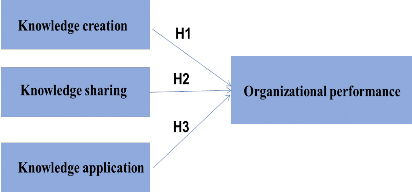
Based on the literature reviewed, the following hypotheses and research model (Figure 1) are proposed:
H1: Knowledge creation positively impacts organizational performance at primary and secondary education levels.
H2: Knowledge sharing positively impacts organizational performance at primary and secondary education levels.
H3: Knowledge application positively impacts organizational performance at primary and secondary education levels.
Figure 1: Conceptual model.
This study is exploratory in nature. The data was collected through a questionnaire administered on the Google platform through a link sent by email to primary and secondary education institutions located in the south of Chile. The sample includes teaching and administrative staff with educational management knowledge and/or experience.
The measurement instrument consists of 30 already made research questions, including knowledge creation (KC) with 5, knowledge sharing (KS) with 4 and knowledge application (KA) with 8, following the proposal of Chin-Loy and Mujtaba (2011); and organizational performance (OP) considering the scale of Cardona and Calderón (2006) with 13 questions. Demographic information was also included. A five-point Likert scale was used, from "1," meaning "strongly disagree,” to "5," meaning "strongly agree." Of the questionnaires sent, 303 were correctly answered. Table 1 shows a summary of the respondents' profiles.
Regarding the context of the participating schools, the sample consists mostly of urban institutions; however, no formal classification was made concerning their geographical location or the socioeconomic context of the school communities. Additionally, it was not identified whether the institutions belonged to Indigenous communities or other specific cultural contexts. This limitation presents an opportunity for future research to explore the social, institutional, and cultural backgrounds surrounding the work of staff in these schools—elements that are essential for adequately understanding the organizational and educational reality of such environments.
This study employs the partial least squares (PLS) method, a technique widely used in various social science disciplines, including information management systems (Ringle et al., 2012). In general, structural equation models (SEM) serve as tests of hypothesized data models. Within the SEM framework, latent factors represent unobserved conceptual variables derived from observed indicators in the dataset (Vizioli, 2024). PLS was selected for several reasons: (a) the study is exploratory, (b) the sample size is relatively small, and (c) the analysis prioritizes the predictive relationships specified in the proposed hypotheses (Richter et al., 2016; Hair et al., 2019). Furthermore, PLS-SEM has been extensively employed in empirical knowledge management research (Valaei et al., 2017; Wang et al., 2016; Shujahat et al., 2019).
303 surveys were received, of which 70% were from women and 30% from men. Most of those surveyed (32.7%) were between 30 and 39 years old. As for the educational level at which they work, the majority teach at a primary level (39.9%), followed by the secondary level (36.0%), and a smaller group (24.1%) teach at mixed levels. In addition, there was favorable acceptance by public institutions, which occupied the highest percentage (73.6%), followed by subsidized institutions (21.8%) and, to a lesser extent, private institutions (4.6%). The results are summarized in Table 1.
Table 1: Demographic variables of the Participants
Demographic variable | Frequency | Percentage |
Gender | ||
Female | 212 | 70 |
Male | 91 | 30 |
Age (years) | ||
<30 | 67 | 22.1 |
30-39 | 99 | 32.7 |
40-50 | 65 | 21.5 |
>50 | 72 | 23.8 |
Years of Experience | ||
1-5 | 122 | 40.3 |
6-10 | 85 | 28.1 |
>10 | 96 | 31.6 |
Education Level | ||
Primary | 121 | 39.9 |
Secondary | 109 | 36.0 |
Mixed | 73 | 24.1 |
Type of Education | ||
Public | 223 | 73.6 |
Subsidized | 66 | 21.8 |
Private | 14 | 4.6 |
To evaluate the reflective measurement model (Hair et al., 2019), the following criteria were applied:
(1) indicator loadings, which should exceed 0.707 to indicate that the construct explains more than 50% of the variance of the indicator and thus confirms acceptable item reliability; (2) composite reliability (CR), which should be above 0.70; (3) convergent validity, assessed through the average variance extracted (AVE), which should exceed 0.50; and (4) discriminant validity.
To evaluate the structural model, the standard evaluation criteria were taken into account: the determination coefficient of the endogenous construct (R2), the effect sizes of the exogenous measurement model (f2), the predictive relevance of the model using cross-validation redundancy (Q2), and the statistical significance and relevance of the path coefficients, (Hair et al., 2011; Hair et al., 2019), responding to each of the hypotheses raised in the model.
Evaluation of the measurement model
Table 2 presents the factorial loads (λ) analyzed that are above the suggested value of 0.70. Two items were eliminated due to loadings less than 0.70, related to the institution's mechanisms to create and acquire knowledge from external sources (KC1) and the existence of libraries, centers and forums to disseminate knowledge (KE3). The composite reliability (rho_a) and the average extracted variance (AVE) of all constructs were higher than the suggested values of 0.70 and 0.50, respectively (Hair et al., 2019). Therefore, the convergent validity and reliability of the items are confirmed.
Table 2: Item loads, reliability, variance, and alpha coefficient.
λ | rho_a | AVE | |
Knowledge creation KC2 | 0.775 | 0.817 | 0.643 |
KC3 | 0.754 | ||
KC4 | 0.86 |
KC5 | 0.815 | |
Knowledge sharing | 0.822 | 0.733 |
KS1 | 0.856 | |
KS2 | 0.888 | |
KS4 | 0.823 | |
Knowledge application | 0.955 | 0.638 |
KA1 | 0.729 | |
KA2 | 0.795 | |
KA3 | 0.791 | |
KA4 | 0.859 | |
KA5 | 0.806 | |
KA6 | 0.825 | |
KA7 | 0.843 | |
KA8 | 0.854 | |
Organizational performance | 0.955 | 0.638 |
OP1 | 0.818 | |
OP2 | 0.822 | |
OP3 | 0.775 | |
OP4 | 0.733 | |
OP5 | 0.719 | |
OP6 | 0.771 | |
OP7 | 0.794 | |
OP8 | 0.803 | |
OP9 | 0.847 | |
OP10 | 0.858 | |
OP11 | 0.869 | |
OP12 | 0.738 | |
OP13 | 0.82 |
The criterion of Fornell and Larker (1981) and cross-loading have traditionally been used to evaluate the discriminant validity (Hamid et al., 2017). This work considered the heterotrait-monotrait relationship (HTMT) of the proposed correlations, as it is the most reliable criterion for detecting discriminant validity problems (Hair et al., 2019). In this context, an HTMT < 0.85 is considered, where the results of all values are below the most conservative threshold, complying with the existence of discriminant validity between constructs. Table 3 shows the result.
Table 3: Discriminant Validity
Construct | Knowledge application | Knowledge creation | Organizational performance |
Knowledge application | |||
Knowledge creation | 0.699 | ||
Knowledge sharing | 0.731 | 0.69 | |
Organizational performance | 0.757 | 0.768 | 0.726 |
Evaluation of the Structural Model
The evaluation of the measurement model was satisfactory, and the next step was to evaluate the structural model.
First, the collinearity should be examined to make sure that it does not bias the results by the variation inflation factors (VIF), where the idea is that the VIF values are close to 3 and lower (Hair et al., 2017). Figure 4 shows that there are no collinearity problems.
Table 4. Variance inflation factor (VIF)
Organizational performance (VIF) | |
Knowledge application | 2.008 |
Knowledge creation | 1.73 |
knowledge sharing | 1.836 |
Table 5 shows the effect sizes (f2). The f2 is used to determine the size of the effect of each component on the structural model. The formula removes a specific construct from the model and analyzes the results (Hair et al., 2014). As indicated, the effect sizes of the constructs were examined using the criteria proposed by Cohen (1988). In this case, the exogenous construct knowledge sharing helps to explain, to a lesser extent, the variability of the endogenous construct organizational performance.
Table 5: Effect size
Organizational performance | Effect size | |
Knowledge application | 0.213 | moderate effect |
Knowledge creation | 0.164 | moderate effect |
knowledge sharing | 0.069 | weak effect |
The cross-validation redundancy determines the structural model's predictive value. For predictive relevance to be effective, this quality assessment criterion requires that the cross-validated redundancy value (Q2) be an integer, positive, and greater than 0 (Chin, 1998). Using the blindfolding approach, Table 6 indicates that the studied model is practical in forecasting, as it presents a high predictive value according to the quality parameters.
The mean absolute error (MAE) and the root mean square error (RMSE) were determined for the PLSpredict-based evaluation of the model's predictive power. The MAE measures the average
magnitude of the errors in a set of predictions without considering their direction (by excess or by default). The RMSE is the square root of the mean of the quadratic differences between the predictions and the actual observations (Hair et al., 2019).
Table 6: Summary of prediction of manifest variables
Q²predict | PLS-SEM_ RMSE | PLS-SEM_ MAE | LM_RMSE | LM_MAE | |
OP1 | 0.405 | 0.752 | 0.591 | 0.761 | 0.586 |
OP2 | 0.38 | 0.739 | 0.566 | 0.739 | 0.561 |
OP3 | 0.286 | 0.847 | 0.674 | 0.835 | 0.64 |
OP4 | 0.277 | 0.817 | 0.637 | 0.793 | 0.601 |
OP5 | 0.334 | 0.794 | 0.612 | 0.832 | 0.623 |
OP6 | 0.355 | 0.794 | 0.623 | 0.807 | 0.63 |
OP7 | 0.47 | 0.813 | 0.65 | 0.821 | 0.646 |
OP8 | 0.475 | 0.751 | 0.585 | 0.781 | 0.61 |
OP9 | 0.405 | 0.752 | 0.591 | 0.761 | 0.586 |
OP10 | 0.493 | 0.745 | 0.606 | 0.74 | 0.593 |
OP11 | 0.496 | 0.754 | 0.602 | 0.758 | 0.595 |
OP12 | 0.339 | 0.781 | 0.589 | 0.797 | 0.601 |
OP13 | 0.418 | 0.815 | 0.616 | 0.809 | 0.619 |
It is necessary to compare the RMSE (or MAE) values with a naive benchmark. The recommended naive reference value (produced by the PLS-predict method) is the linear regression model (LM) that generates predictions for the manifest variables, executing a linear regression of each of the dependent constructs on the indicators of the exogenous latent variables in the PLS path (Danks and Ray, 2018). By comparing the values of RMSE (or MAE) with the LM values, it was possible to determine that the minority of the indicators in the PLS-SEM analysis show higher prediction errors compared to the naive LM reference, indicating an average predictive power, according to the guidelines proposed by Shmueli et al. (2019).
Once the model's predictive power was verified, the statistical significance and relevance of the trajectory coefficients were evaluated, applying the bootstrap method (5,000 subsamples, BCa bootstrap method, two-tailed test, 5% significance level). Table 7 shows the results obtained.
Table 7: Significance and statistical relevance of the path coefficients.
Hypothesis | Relationships | Total effects | t-value | Confidence intervals (95%) | Conclusion |
H1 | KC→OP | 0.320 | 6.793*** | [0.227; 0.411] | Accepted |
H2 | KS→OP | 0.213 | 4.099*** | [0.113; 0.313] | Accepted |
H3 | KA→OP | 0.393 | 7.068*** | [0.283; 0.502] | Accepted |
OP | R2: 0,640 R2 ajustado: 0,636 |
***: p<0.001
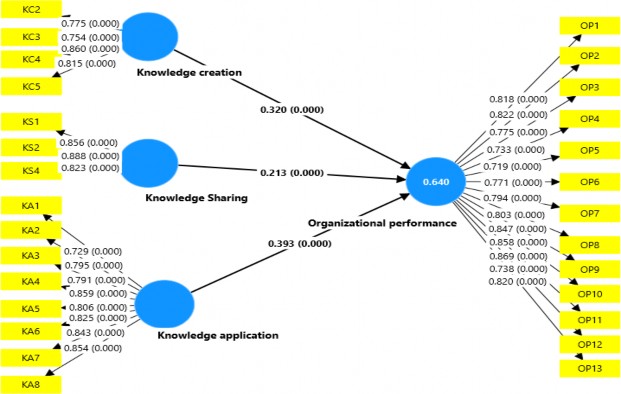
The coefficient of determination (R2) indicates the model's explanatory capacity within the sample (Rigdon, 2012). An R2 greater than 0.200 means the model's endogenous variables have good explanatory power (Benítez et al., 2018). The results of the coefficient of determination of the Organizational performance (OP) construct reveal a value of 0.640, considered significant.
Table 7 confirms the 3 proposed hypotheses, indicating that knowledge creation, sharing, and application significantly influence organizational performance. Considering the analysis, Figure 2 shows the structural model's result.
Figure 2: Structural model
This study examined the relationship between knowledge management and organizational performance at the primary and secondary education levels of educational establishments in southern Chile. It showed a positive and significant effect between the creation, sharing, and application of knowledge and organizational performance, which led to the acceptance of the three proposed hypotheses. The results coincide with those of Cordeiro et al. (2022), who identify the influence of knowledge management processes on the performance of primary education in private and confessional organizations in Brazil.
Knowledge creation positively impacts organizational performance at the primary and secondary (H1) education levels, which is in line with what Abubakar et al. (2019) have pointed out. By analyzing the decision-making styles, relationships, and informal practices of people involved in knowledge creation in schools, they establish that knowledge creation processes strongly influence organizational performance.
Knowledge sharing positively impacts primary and secondary (H2) organizational performance. This result coincides with what Asad et al. (2021) proposed, which indicates that knowledge sharing, like the rest of the dimensions of knowledge management, is vital in generating positive results in educational organizations. In addition, the results obtained are also consistent with the approaches of Wang and Wang (2012), who, in a more general context, establish that knowledge sharing practices improve the operational (and financial) performance of organizations. For Lin (2015), the fact of sharing knowledge within an organization has a positive impact on its performance. Regarding knowledge sharing in the study institutions, the respondents suggest that there are working sessions and conferences to show and disseminate knowledge, facilitating access to the needs of employees. In this regard, Pham et al. (2023) recommend the development of practice communities, seminars, brainstorming sessions, workshops, and conferences to facilitate communication and the acquisition of new knowledge, competencies, and skills; initiatives that could also be implemented in primary and secondary institutions in Chile.
The application of knowledge positively impacts organizational performance at the primary and secondary education levels (H3). This is consistent with the approaches of Kim et al. (2021), who discovered that knowledge application impacts the primary educational environment by significantly increasing the knowledge capacity of employees and adopting new practices. According to Sahibzada et al. (2020), the constant application of new knowledge is fundamental in educational institutions to improve student satisfaction, curriculum development, quality, and responsiveness to environmental challenges. These aspects may relate to or have an impact on the performance of the organization.
From a more general perspective, the results are compatible with the studies of Ahmad et al. (2017) and Pham et al. (2023), who express, in the context of universities of Pakistan and Vietnam, respectively, that the acquisition, sharing and application of knowledge improves organizational performance. In this sense, knowledge management contributes positively and significantly to organizational performance (Padilla and Martínez, 2018), increasing and supporting daily routine practices (Rawashdeh et al., 2021). In this context, principals play a fundamental role, as they perceive knowledge management and its environment, using information to create new knowledge that allows training academics and administrators (Đonlagić and Mešanović, 2022). In addition, there is a need to continuously train and educate the administrative staff of organizations on the importance of knowledge management through group work and training programs (Abuaddous et al., 2018), where, precisely, primary and secondary education institutions have dynamic and knowledge-intensive characteristics, with principals being responsible for creating, exchanging, and using knowledge to develop and maintain new services (Iqbal et al., 2019).
It is important to note that, although some of the concepts used in this study such as organizational performance or competitiveness originate from traditional business-oriented approaches, their application to the school context is carried out from a critical perspective, adapted to the specific characteristics of the educational sector (Ball, 2003; Apple, 2006). In this case, competitiveness is not understood as a logic of rivalry between institutions, but rather as the ability of schools to improve their pedagogical, administrative, and management processes for the benefit of their educational communities. This perspective recognizes that the ultimate goal of education is not technical efficiency in itself, but human development, social justice, and cultural transformation (Fullan, 2007), in line with the thinking of Paulo Freire (1970), who conceived education as a political and liberating act, oriented toward building a culture of peace rather than reproducing technocratic or market-driven models.
Although the present study adopts a quantitative approach focused on organizational and knowledge management variables, it also acknowledges that a more comprehensive analysis of the school environment requires the inclusion of pedagogical, cultural, and community factors that influence institutional performance. This methodological limitation opens the possibility for future research using mixed-method or qualitative designs that incorporate the voices of educational actors, pedagogical practices, and the social realities that shape school contexts in Chile (Stake, 1995; Creswell & Plano Clark, 2017).
Moreover, while the structural model provides relevant information about the predictive relationships between knowledge management and organizational performance, it is important to interpret these results in light of the specific characteristics of educational settings. Beyond statistical relationships, factors such as institutional culture, situated practices, and the subjectivities of school actors affect how knowledge is created, shared, and applied (Leithwood et al., 2008). Therefore, this model should not be viewed as a closed system but rather as part of a broader reflection on the organizational dynamics of schools and the lived experiences of their staff.
The study confirmed the significant and positive impact of knowledge management on organizational performance in primary and secondary schools. Understanding the role of knowledge and its management encompassing the creation, sharing, and application of knowledge is essential for achieving better results.
The findings highlight the critical importance of effectively utilizing and making existing knowledge accessible to improve outcomes. Although knowledge management research in Chile's primary and secondary education is still in its early stages, advancing studies in this area is crucial to understanding its impact on school dynamics and effectiveness.
From a managerial perspective, this study provides valuable insights into how the creation, sharing, and application of knowledge can enhance the performance of schools. Specifically, it identifies mechanisms for generating new knowledge from existing resources, leveraging lessons learned to improve subsequent activities, and fostering processes for the exchange of ideas and knowledge among individuals and groups. Furthermore, strategies such as rewarding employees for innovative ideas, ensuring knowledge is easily accessible, delivering timely reports with relevant information to stakeholders, and organizing meetings or activities for knowledge sharing are key practices. These actions, combined with rapid adaptation to environmental changes and the capacity to adjust goals and objectives accordingly, contribute significantly to improved performance.
Finally, it is recommended that principals of primary and secondary schools define and implement policies and mechanisms to promote knowledge management. Additionally, it is suggested that the sociocultural specificities of each institution be considered when applying these practices, recognizing that the educational context profoundly influences the processes of knowledge creation, sharing, and application. Incorporating these factors will enable a more comprehensive understanding of organizational performance from a perspective that integrates the technical with the ethical and the human.
Among the main limitations of this study is the absence of variables related to the socioeconomic and cultural context of the educational institutions analyzed. Although the applied questionnaire did not include specific items addressing these aspects, this omission is acknowledged as a relevant limitation. Most of the participating institutions are located in urban areas of southern Chile, many of them in municipalities with high vulnerability indicators. However, no distinctions were made between rural schools, urban-peripheral schools, or those situated in Indigenous or intercultural contexts.
Future research is encouraged to include variables related to the socioeconomic environment, cultural affiliation, and the type of educational community (rural, urban, or Indigenous), as these elements may significantly influence knowledge management processes and institutional performance. Likewise, the use of qualitative or mixed-method approaches would be appropriate to capture the subjective experiences of school actors and enrich the understanding of the phenomena under study. Such research would contribute to building broader and more context-sensitive interpretive frameworks, aligned with the complexity of the Chilean educational system.
This research was funded with support provided by Exempt Decree RA No. 352/4759/2023, under the Institutional Contribution Project for State Universities and the Performance Agreement of the Faculty of Business Sciences, through the “Strengthening Graduate Faculty through Research Assistants” initiative of the University of Bío-Bío, Concepción, Chile.
Abuaddous, H. Y., Al Sokkar, A. A. M., & Abualodous, B. I. (2018). The impact of knowledge management on organizational performance. International Journal of Advanced Computer Science and Applications, 9(4), 204–208. https://doi.org/10.14569/IJACSA.2018.090432
Abubakar, A. M., Elrehail, H., Alatailat, M. A., & Elçi, A. (2019). Knowledge management, decision- making style and organizational performance. Journal of Innovation & Knowledge, 4(2), 104–114. https://doi.org/10.1016/j.jik. 2017.07.003
Adhikari, D. R. (2010). Knowledge management in academic institutions. International Journal of Educational Management, 24(3), 188-206. https://doi.org/10.1108/09513541011020918
Ahmad, N., Lodhi, M. S., Zaman, K., & Naseem, I. (2017). Knowledge Management: a Gateway for Organizational Performance. Journal of the Knowledge Economy, 8(3), 859–876. https://doi.org/10.1007/s13132-015-0282-3
Alharafsheh, M. & Ratib, A.A. (2023). The Impact of Business Strategy on Competitive Advantage and Performance of Small & Medium Enterprises in Jordan. International Journal of Professional Business Review, 8(6), 1-22. https://doi.org/10.26668/businessreview/2023.v8i6.1534
Ali, M., Lei, S., Ali, M., & Wang, L. (2019). Knowledge Sharing Practices and Organizational Performance: The Role of Cost Reduction, Organizational Growth and Intangible Benefits. Journal of Knowledge Management, 23(1), 1-19.
Ali, N., Mustaffa, M. M., Alkawsi, G., & Capretz, L. F. (2024). If you build it, will they come? Exploring the success factors of knowledge management systems in the Malaysian public sector. Heliyon, 10(6). https://doi.org/10.1016/j.heliyon.2024.e27093
Alves, I., & Lourenço, S. (2022). The use of non-financial performance measures for managerial compensation: evidence from SMEs. Journal of Management Control 33(4), 1-37. https://doi.org/10.1007/s00187-022-00337-8
Apple, M. W. (2006). Educating the "right" way: Markets, standards, God, and inequality (2nd ed.). Routledge.
Araneda-Guirriman, C., Rodríguez-Ponce, E., & Pedraja-Rejas, L. et. al. (2017). La gestión del conocimiento en instituciones de educación superior del norte de chile. Revista de Pedagogía, 38 (0798– 9792), 13–30. https://doi.org/10.4067/s0718-33052022000200266
Araya-Guzmán, S., Bravo, C. H., Ramírez-Correa, P., & Salazar, A. B. (2019). Exploring the relationship between knowledge management and organizational performance in university institutions of higher education. RISTI - Revista Iberica de Sistemas e Tecnologias de Informacao, (17), 947–959.
Arjona-Granados, M. del P., López Lira-Arjona, A. y Maldonado-Mesta E. A. (2022). Los sistemas Los sistemas de gestión de la calidad y la calidad educativa en instituciones públicas de Educación Superior de México. Retos Revista de Ciencias de la Administración y Economía, 12(24), 268-283. https://doi.org/10.17163/ret.n24.2022.05
Asad, M.M., Rind, A.A. & Abdulmuhsin, A.A. (2021). The effect of knowledge management in educational settings: a study of education management organizations (EMOs) schools of Pakistan. International Journal of Organizational Analysis, 30(5), 1156-1171. https://doi.org/10.1108/IJOA-12- 2020-2521
Ball, S. J. (2003). The teacher's soul and the terrors of performativity. Journal of Education Policy, 18(2), 215–228. https://doi.org/10.1080/0268093022000043065
Balza, A. (2011). Gestión del conocimiento, tecnologías de la información y aprendizaje organizacional. Un desafío para la sociedad local-global. Acción Pedagógica,20(1).
Barra, C., & Gómez, J. (2013). Performance measurement and management in contemporary organizations: A review of the literature and a research agenda. Journal of Business Research, 66(10), 1489-1502. https://doi.org/10.1108/13683041011027418
Barradas, M. D. R., Rodríguez, J., & Maya, I. (2021). Desempeño organizacional. Una revisión teórica de sus dimensiones y forma de medición. RECAI Revista de Estudios En Contaduría, Administración e Informática, 21. https://doi.org/10.36677/recai.v10i28.15678
Becerra-Fernández, I., & Stevenson, D. (2001). Knowledge management: challenges, solutions and technologies. Upper Saddle River, NJ: Prentice Hall.
Benítez, J., Henseler, J., Castillo, A., & Schuberth, F. (2018). How to perform and report an impactful analysis using partial least squares: Guidelines for confirmatory and exploratory in research. Information & Management, 57(2), 231-257. https://doi.org/10.1016/j.im.2019.05.003
Bertolli, M., Roark, G., Urrutia, S. & Chiodi, F. (2017). Revisión de modelos de madurez en la medición del desempeño. INGE CUC, 13(1), 70-83. http://dx.doi.org/10.17981/ingecuc.13.1.2017.07
Borodako, K., Berbeka, J., & Rudnicki, M. (2021). Performance and innovation orientation measurement framework of business services research. Innovation Orientation in Business Services. https://doi.org/10.4337/9781839109553.00015
Cardona, J. & Calderón, G. (2006). El impacto del aprendizaje en el rendimiento de las organizaciones.
Cuadernos de Administración Bogotá, 19(32), 11-43.
Chen, C. J., Huang, J. W., & Hsiao, Y. C. (2010). Knowledge management and innovativeness: The role of organizational climate and structure. International Journal of Manpower, 31(8),848-870. https://doi.org/10.1108/01437721011088548
Cheng, E. C. K. (2014). Knowledge management for school education. Springer
Chin, W., & Newsted, P. (1998). The partial least squares approach to structural equation modeling. Modern methods for business research. In Statistical Strategies for Small Sample Research (Issue January 1998, 295–336).
Chin-Loy, C., & Mujtaba, B. (2011). The Influence Of Organizational Culture on The Success of Knowledge Management Practices With North American Companies. International Business & Economics Research Journal, 6(3). https://doi.org/10.19030/iber.v6i3.3350
Chong, H. (2008). Measuring Performance of Small-and-Medium Sized Enterprises: the Grounded theory Approach. Journal of Business & Public Affairs, 10, 1-11.
Chu, S. K. W. (2016). Knowledge Creation: The Central Link between Library Services and Learning.
Journal of Academic Librarianship, 42(3), 226-235. https://doi.org/10.1016/j.acalib.2016.01.005
Cilliers, J. (2021). Boosting educational. In book: The Future of Africa. https://doi.org/10.1007/978-3- 030-46590-2_6
Cohen, J. (1988). Statistical Power Analysis for the Behavioral Sciences. Hillsdale, NJ: Lawrence Erlbaum Associates
Cordeiro, M. de M., Oliveira, M., & Sanchez-Segura, M. I. (2022). The influence of the knowledge management processes on results in basic education schools. Journal of Knowledge Management, 26(10), 2699–2717. https://doi.org/10.1108/JKM-07-2021-0579
Creswell, J. W., & Plano Clark, V. L. (2017). Designing and conducting mixed methods research (3rd ed.). SAGE Publications.
Cricelli, L., Grimaldi, M., & Ghiron, N. L. (2018). The impact of knowledge management on the quality of university education: an empirical investigation. Total Quality Management & Business Excellence, 29(11), 1327-1345. https://doi.org/10.1080/14783363.2018.1427503
Danks, N. & Ray, S. (2018). Predictions from partial least squares models, in Ali, F., Rasoolimanesh, S.
M. & Cobanoglu, C. (Eds), Applying Partial Least Squares in Tourism and Hospitality Research, Emerald, Bingley, 35-52.
De Freitas, V. (2023). Nivel de madurez en Sistemas de Gestión del Conocimiento en Instituciones de Educación Superior: Un Estudio de Caso desde un Enfoque Holístico. GECONTEC: Revista Internacional de Gestión del conocimiento y La Tecnología, 5(1), 83–102. https://doi.org/10.5281/zenodo.7506797
Đonlagić, S., & Mešanović, M. (2022). Knowledge Management Implications To the Financial Performance: a Survey Analysis. Management (Croatia), 27(2), 247–260. https://doi.org/10.30924/mjcmi.27.2.13
Dzenopoljac, V., Alasadi, R., Zaim, H. & Bontis, N. (2018). Impacto de los procesos de gestión del conocimiento en el desempeño empresarial: evidencia de Kuwait. Gestión de conocimientos y procesos, 25(1), 77–87. https://doi.org/10.1002/kpm.1562
Escorcia, J., & Barros, D. 2020. Gestión del conocimiento en Instituciones de Educación Superior: Caracterización desde una reflexión teórica. Revista de Ciencias Sociales, 26(3). https://doi.org/10.31876/rcs.v26i3.33235
Escorcia, J., & Barros, D. (2020). Gestión del conocimiento en Instituciones de Educación Superior: Caracterización desde una reflexión teórica. Revista de Ciencias Sociales, 26(3). https://doi.org/10.31876/rcs.v26i3.33235
Fernández-López, S., Rodeiro-Pazos, D., Calvo, N., & Rodríguez-Gulías, M. J. (2018). The effect of strategic knowledge management on the universities’ performance: an empirical approach. Journal of Knowledge Management, 22(3), 567–586. https://doi.org/10.1108/jkm-08-2017-0376
Fornell, C. & Larcker, D. (1981). Evaluación de modelos de ecuaciones estructurales con variables no observables y error de medida. Revista de Investigación de Mercados, 18(1), 39–50. https://doi.org/10.1177/002224378101800104
Freire, P. (1970). Pedagogía del oprimido. Siglo XXI Editores.
Fullan, M. (2007). The new meaning of educational change (4th ed.). Teachers College Press.
Gao, F., Li, M., & Clarke, S. (2008). Knowledge, management, and knowledge management in business operations. Journal of Knowledge Management, 12(2), 3–17. https://doi.org/10.1108/13673270810859479
González-Illescas, M., & Zaragoza-Sáez, P. (2023). Influence of knowledge management infrastructure on knowledge creation processes. A study in the primary sector. Heliyon, 9(9). https://doi.org/10.1016/j.heliyon.2023.e19536
Guzmán E., & Barros, D., 2020. Gestión del conocimiento en Instituciones de Educación Superior: Caracterización desde una reflexión teórica. Revista de Ciencias Sociales, 26(3). https://doi.org/10.31876/rcs.v26i3.33235
Hair, J. F., Ringle, C. M., & Sarstedt, M. (2011). PLS-SEM: indeed a Silver Bullet. Journal of Marketing Theory & Practice, 19(2), 139–152. https://doi.org/10.2753/MTP1069-6679190202
Hair, J. F., Risher, J. J., Sarstedt, M., & Ringle, C. M. (2019). When to use and how to report the results of PLS-SEM. European Business Review, 31(1), 2–24. https://doi.org/10.1108/EBR-11-2018-0203
Hair, J., Sarstedt, M., Hopkins, L. & Kuppelwieser, V. (2014). Modelado de ecuaciones estructurales de mínimos cuadrados parciales (PLS-SEM): una herramienta emergente en la investigación empresarial. Revista empresarial europea, 26 (2), 106-121. https://doi.org/10.1108/EBR-10-2013-0128
Hair, J.F., Hult, G.T.M., Ringle, C.M. & Sarstedt, M. (2017). A Primer on Partial Least Squares Structural Equation Modeling (PLS-SEM). Sage, Thousand Oaks, CA.
Hamid, M. R., Sami, W., & Mohmad Sidek, M. H. (2017). Discriminant Validity Assessment: Use of Fornell & Larcker criterion versus HTMT Criterion. Journal of Physics: Conference Series 890. https://doi.org/10.1088/1742-6596/890/1/012163
Hasani, K., & Sheikhesmaeili, S. (2016). Knowledge Management and Employee Empowerment: A Study of Higher Education Institutions. Kybernetes, 45(2), 337–55. https://doi.org/10.1108/k-04-2014- 0077
Huynh, Q. L. (2022). The Impact of Knowledge Management on Organizational Performance by considering Structure and Culture in Vietnam. Journal of Asian Finance, Economics and Business, 9(10), 97–104. https://doi.org/10.13106/jafeb.2022.vol9.no10.0097
Ibarra-Cisneros, M. A., Reyna, J. B. V., & Hernández-Perlines, F. (2023). Interaction between knowledge management, intellectual capital and innovation in higher education institutions. Education and Information Technologies. https://doi.org/10.1007/s10639-022-11563-x
Iqbal, A., F. Latif, F. Marimon, U. F. Sahibzada, & S. Hussain. (2019). From Knowledge Management to Organizational Performance: Modeling the Mediating Role of Innovation and Intellectual Capital in Higher Education. Journal of Enterprise Information Management 32(1), 36–59. https://doi.org/10.1108/jeim-04-2018-0083
Jyoti, J., & Rani, A. (2017). High performance work system and organizational performance: Role of knowledge management. Personnel Review,46(8), 1770–1795. https://doi.org/10.1108/pr-10-2015-0262
Kaba, A., & Ramaiah, C.K. (2020). Measuring knowledge acquisition and knowledge creation: a review of the literatura. Library Philosophy and Practice (e-journal). 4723.
Kamara, J. M., Anumba, C. J., & Carrillo, P. M. (2002). Knowledge management in the architecture, engineering and construction industry. Construction Innovation, 2(1), 53-67. https://doi.org/10.1108/14714170210814685
Khoa, B. T., & Huynh, T. T. (2024). Knowledge-intensive teamwork development through social media adoption after the COVID-19 pandemic in higher education institutions. Heliyon, 10(4). https://doi.org/10.1016/j.heliyon.2024.e26210
Kidwell, J. J., Vander, K., & Johnson, S. L. (2000). Applying corporate knowledge management practices in higher education. Educause Quarterly, 23(4), 28–33.
Kim, T.H., Choi, B., Lee, J.N. & Sambamurthy, V. (2021), Portfolio effects of knowledge management strategies on firm performance: complementarity or substitutability? Information & Management, 58(4). http://dx.doi.org/10.1016/j.im.2021.103468
Kucharska, W. & Erickson, S. (2023). Tacit knowledge acquisition & sharing, and its influence on innovations: A Polish/US cross-country study. International Journal of Information Management, 71(2), 1-24. http://dx.doi.org/10.1016/j.ijinfomgt.2023.102647
Leithwood, K., Harris, A., & Hopkins, D. (2008). Seven strong claims about successful school leadership. School Leadership & Management, 28(1), 27–42. https://doi.org/10.1080/13632430701800060
Liao, S., & Wu, C. (2009). The relationship among knowledge management, organizational learning, and organizational performance. International Journal of Business and Management, 4(4), 64–76. http://dx.doi.org/10.5539/ijbm.v4n4p64.
Lin, H. (2015). Linking knowledge management orientation to balanced scorecard outcomes. Journal of KnowledgeManagement, 19(6), 1224-1249. http://dx.doi.org/10.1108/JKM-04-2015-0132
Martelo-Landroguez, S., & Cepeda-Carrión, G. (2016). How Knowledge Management Processes can Create and Capture Value for Firms? Knowledge Management Research Practice, 14(4), 423–33. http://dx.doi.org/10.1057/kmrp.2015.26
Mejía, M. I., & Colín, M. (2013). Gestión del conocimiento y su importancia en las organizaciones.
Revista Trilogía, 9, 25-35. https://doi.org/10.22430/21457778.379
Mendivel Geronimo, C. A., Moreno Menéndez, F. M., Lujan Minaya, J. C., & Toledo Ríos, R. H. (2022). Implicaciones epistémicas en la gestión del conocimiento, la sociedad digital y la universidad en el siglo XXI. Revista de Filosofía, 39(Edición Especial Nº2), 19–27. https://doi.org/10.5281/zenodo.7297028
Mendoza-Arvizo U., and Solís-Rodríguez, F. Th. (2022). Quality, knowledge, and innovation of manufacturing processes in Ciudad Juárez, Mexico. Retos Revista de Ciencias de la Administración y Economía, 12(23), 83-109. https://doi.org/10.17163/ret.n23.2022.05
Migdadi, M. M. (2022). Knowledge management processes, innovation capability and organizational performance. International Journal of Productivity and Performance Management, 71(1), 182–210. https://doi.org/10.1108/IJPPM-04-2020-0154
Nisula, A.-M., & A. Kianto. (2016). The Role of Knowledge Management Practices in Supporting Employee Capacity for Improvisation. The International Journal of Human Resource Management, 27(17). http://dx.doi.org/10.1080/09585192.2015.1088885
Nonaka, I., & H. Takeuchi. (1995). The Knowledge-Creating Company: How Japanese Companies Create the Dynamics of Innovation. Oxford: Oxford University Press.
Núñez, G., & Alfonso, I. M. (2023). Modelos de Gestión del Conocimiento en las Instituciones de Educación Superior: una revisión de literatura. GECONTEC: Revista Internacional de Gestión del Conocimiento y la Tecnología, 11(1), 1–16. https://doi.org/10.5281/zenodo.7501571
Obeidat, B. Y., M. M. Al-Suradi, R. Masa’deh, E. & Tarhini, A. (2016). The Impact of Knowledge Management on Innovation: An Empirical Study on Jordanian Consultancy Firms. Management Research Review, 39(10), 1214–38. https://doi.org/10.1108/mrr-09-2015-0214
Olubiyi, T. O., Egwakhe, J., Akinlabi, B. H. (2019). Knowledge Management and Family Business Continuity: The Moderating Effect of Length of Time in Existence. Oman Chapter of Arabian Journal of Business and Management Review, 8(2), 35–42. https://doi.org/10.12816/0053208
Padilla, P., & Martínez, M. (2018). Gestión del conocimiento y su influencia sobre el desempeño organizacional en las empresas de Aguascalientes. Investigación y Ciencia de la Universidad Autónoma de Aguascalientes (75), 55–65. http://dx.doi.org/10.33064/iycuaa2018751770
Pallarés, M. (2014). Los medios de comunicación y tecnológicos como ejes de canalización y gestión del conocimiento. Educar, 50(1), 207-229. https://doi.org/10.5565/rev/educar.204
Pedraja-Rejas, L., Rodríguez-Ponce, E., & Rodríguez-Ponce, J. (2010). Gestión del conocimiento, eficacia organizacional en pequeñas y medianas empresas. Revista Venezolana de Gerencia, 14(48), 495-506. https://doi.org/10.31876/revista.v14i48.10546
Pérez-Montorio, M. (2016). Gestión del conocimiento: Orígenes y evolución. El profesional de la Información, 25(4).
https://doi.org/10.3145/epi.2016.jul.02
Pham, H. H., Nguyen, T. T. H., Nguyen, V. T., Nguyen, V. M., The Cong, P., Vu, M. C., Do, T. N., Kim, M. H., & Tran, N. M. (2023). The impacts of knowledge management enablers and knowledge management processes on university performance in Vietnam. Knowledge Management Research and Practice, 21(3), 512–524. https://doi.org/10.1080/14778238.2022.2105758
Quarchioni, S. Paternostro, S., & Trovarelli, F. (2022). Knowledge management in higher education: a literature review and further research avenues. Knowledge Management Research and Practice, 20(2), 304–319. https://doi.org/10.1080/14778238.2020.1730717
Quiñonez, C. & Rivera, W. F. (2021). Modelo de gestión del conocimiento para centros de productividad e innovación. Telos: Revista de Estudios Interdisciplinarios en Ciencias Sociales, 23(2), 347-366. https://doi.org/10.36390/telos232.09
Raj Adhikari, D. (2010). Knowledge management in academic institutions. International Journal of Educational Management, 24(2), 94–104. https://doi.org/10.1108/09513541011020918
Rawashdeh, A. M., Almasarweh, M. S., Alhyasat-Al-Balqa, E. B., & Rawashdeh, O. M. (2021). The relationsip between the quality knowledge management and organizational performance via the mediating role of organizational learning. International Journal for Quality Research, 15(2), 373–386. https://doi.org/10.24874/IJQR15.02-01
Rehman, W. U., & Abdul Rehman, C. (2015). Linking intellectual capital and knowledge management with organizational performance: A meta-review analysis. Kuwait Chapter of Arabian Journal of Business and Management Review, 5(2), 63-73.
Reina, L. (2020). El aprendizaje significativo y la evaluación de los aprendizajes. Revista de Investigación Educativa. 14(23).
Reina, L. (2020). El aprendizaje significativo y la evaluación de los aprendizajes. Revista de Investigación Educativa, 14(23).
Richter, N.F., Cepeda Carri!on, G., Roldán, J.L. & Ringle, C.M. (2016). European management research using partial least squares structural equation modeling (PLS-SEM): editorial. European Management Journal, 34(6), 589-597. http://dx.doi.org/10.1016/j.emj.2014.12.001
Rigdon, E.E. (2012). Rethinking partial least squares path modeling: in praise of simple methods. Long Range Planning, 45(5), 341-358. https://doi.org/10.1016/j.lrp.2012.09.010
Ringle, C.M., Sarstedt, M. & Straub, D.W. (2012). A critical look at the use of PLS-SEM in MIS quarterly. MIS Quarterly, 36(1). https://doi.org/10.2307/41410402
Rodríguez-Ponce, E. R., & Pedraja Rejas, L. M. (2016). Percepciones sobre la gestión del conocimiento de directivos universitarios de cuatro universidades chilenas. Formación Universitaria 9, 41-52. https://doi.org/10.4067/s0718-50062016000400006
Rodríguez-Ponce, E., Pedraja-Rejas, L., Muñoz-Fritis, C., & Araneda-Guirriman, C. (2022). Gestión del conocimiento y cultura organizacional en instituciones de educación superior chilenas. Ingeniare. Revista Chilena de Ingeniería, 30(2), 266–278. https://doi.org/10.4067/s0718-33052022000200266
Rubier, D. (2019). La incidencia de la gestión del conocimiento en el éxito de las organizaciones.
COODES, 7(3), 392–405.
Sahibzada, U. F., Cai, J., Latif, K. F & Sahibzada, H. F. (2020). Knowledge Management processes, knowledge worker satisfaction and organizational performance: Symmetric and asymmetrical analysis. Aslib Journal of Enterprise Information Management 72(1),112–29. https://doi.org/10.1108/AJIM-10- 2019-0276
Sahibzada, U.F., Jianfeng, C., Latif, K. F., Shafait, Z. & Sahibzada, H. F. (2020). Interpreting the impact of knowledge management processes on organizational performance in Chinese higher education: mediating role of knowledge worker productivity. Studies in Higher Education. https://doi.org/10.1080/03075079.2020.1793930
Salazar-Rebaza, C., Zegarra-Alva, M. &Cordova-Buiza, F. (2022). Management and leadership in university education: Approaches andperspectives. Problems and Perspectives in Management, 20(3), 130-141. https://doi.org/10.21511/ppm.20(3).2022.11
Sarkindaji, B., Hashim, N., & Abdullateef, A. (2014). Knowledge management and organizational performance of mobile service firms in Nigeria: A proposed framework. Information and Knowledge Management, 4(11), 88-95.
Shmueli, G., Sarstedt, M., Hair, J.F., Cheah, J.-H., Ting, H., Vaithilingam, S. & Ringle, C.M. (2019). Predictive model assessment in PLS-SEM: guidelines for using PLSpredict. European Journal of Marketing, 53(11), 2322–2347. https://doi.org/10.1108/ejm-02-2019-0189
Shujahat, M., Sousa, M. J., Hussain, S., Nawaz, F., Wang, M., y Umer, M. (2019). Translating the impact of knowledge management processes into knowledge-based innovation: The neglected and mediating role of knowledge-worker productivity. Journal of Business Research, 94, 442-450. https://doi.org/10.1016/j.jbusres.2017.11.001
Stake, R. E. (1995). The art of case study research. SAGE Publications.
Thambi, M., & O’Toole, P. (2012). Applying a knowledge management taxonomy to secondary schools.
School Leadership & Management, 32(1), 91–102. https://doi.org/10.1080/13632434.2011.642350
Valaei, N., Nikhashemi, S. R., & Javan, N. (2017). Organizational factors and process capabilities in a KM strategy: Toward a unified theory. Journal of Management Development, 36(4), 560-580. https://doi.org/10.1108/JMD-04-2016-0057
Vizioli, N. A. (2024). The so-called theoretical crisis of psychology and the alternatives proposed to circumvent it. Prometeica - Revista De Filosofía Y Ciencias, 30, 161-175. https://doi.org/10.34024/prometeica.2024.30.16057
Wang, Z. P. N. Sharma, & J. Cao. (2016). From Knowledge Sharing to Firm Performance: A Predictive Model Comparison. Journal of Business Research 69(10), 4650–4658. https://doi.org/10.1016/j.jbusres.2016.03.055
Wang, Z., & Wang, N. (2012). Knowledge sharing, innovation and firm performance. Expert Systems with Applications, 39(10), 8899–8908. https://doi.org/10. 1016/j.eswa.2012.02.017
Zhao, Y & Lavin, M. (2012). An empirical study of knowledge transfer in working relationships with suppliers in new product development. International Journal of Innovation Management, 16(2), 1-26. https://doi.org/10.1142/S1363919612003782