https://doi.org/10.34024/prometeica.2024.31.16413
COLLAGING ILLUSTRATED MATHEMATICAL WORD PROBLEMS
AGENTIAL CUTS IN ENTANGLED MATHEMATICAL KNOWLEDGE PRODUCTION
COLAGEM DE PROBLEMAS MATEMÁTICOS ILUSTRADOS
Cortes agenciais emaranhado na produção de conhecimento matemático
COLLAGE DE PROBLEMAS MATEMÁTICOS ILUSTRADOS
Cortes agenciales enredados en la producción de conocimiento matemático
Laura Caligari
(Stockholm University, Sweden)
laura.caligari-moreira@su.se
Eva Norén
(Stockholm University, Sweden)
eva.noren@su.se
Paola Valero
(Stockholm University, Sweden)
paola.valero@su.se
Recibido: 08/03/2024
Aprobado: 07/11/2024
RESUMO
Em um contexto educacional matemático, os problemas matemáticos com palavras são uma prática estabelecida com o objetivo de se conectar à vida cotidiana dos alunos. Com base nas perspectivas neomateriais e nos métodos de pesquisa baseados em arte, exploramos a colagem como uma forma de nos envolvermos criticamente com problemas matemáticos ilustrados. Desafiamos a visão da produção de conhecimento matemático como um processo objetivo, neutro em termos de valor e sem corpo, realizando cortes agenciais com problemas matemáticos ilustrados de dois livros didáticos de matemática suecos. As perspectivas e os métodos mobilizam sensibilidades que promovem novos pontos de vista. Assim, contribuindo para ampliar a gama de métodos e paradigmas de pesquisa qualitativa que estudam problemas matemáticos com palavras.
Palavras-chave: educação matemática. problemas matemáticos ilustrados. perspectivas neomateriais. colagem como engajamento crítico.
ABSTRACT
In a mathematical educational context, mathematical word problems are an established practice with the aim to connect to students’ everyday life. Drawing on Neo-material perspectives and art-based research methods we explore collage as a way to critically engage with illustrated mathematical word problems. We challenge the view of mathematical
knowledge production as an objective, value-neutral and disembodied process by performing agential cuts with(in) illustrated mathematical word problems from two Swedish mathematical textbooks. The perspectives and methods mobilize sensibilities that advance new points of views. Hence, contributing to broaden the range of qualitative research methods and paradigms studying mathematical word problems.
.
Keywords: mathematical education. illustrated mathematical word problems. neo-material perspectives. collage as critical engagement.
RESUMEN
En un contexto educativo matemático, los problemas de palabra son una práctica establecida y con el objetivo de conectar con la vida cotidiana de los estudiantes. Basándonos en perspectivas de nuevos materialismos y métodos de investigación basados en el arte, exploramos el collage como una forma de participar críticamente con problemas de palabras matemáticos ilustrados. Cuestionamos la visión de la producción de conocimiento matemático como un proceso objetivo, de valor neutral e incorpóreo, mediante el uso de cortes agenciales con(en) problemas de palabras matemáticos ilustrados de dos libros matemáticos de Suecia. Las perspectivas y métodos movilizan sensibilidades para ver nuevos puntos de vista. Por lo tanto, contribuye a ampliar la gama de métodos y paradigmas de investigación cualitativa que estudian los problemas de palabras matemáticos.
Palabras clave: educación matemática. problemas matemáticos ilustrados. perspectivas neomateriales. el collage como compromiso crítico.
Problematizing what illustrated word problems do
Illustrated mathematical word problems (from now on IMWP) in textbooks are an important component of mathematics teaching and learning. Accordingly, students spend a great deal of time working with tasks in textbooks during classroom sessions (Brehmer et al., 2016) and are also supposed to interpret both texts and illustrations mathematically. Given their prominence in practice, IMWP have been researched in various ways, diverse theoretical frameworks have been used, and different aspects have been in focus. Dewolf et al. (2015) conclude that most of the word problems in textbooks have illustrations, however, their function and nature vary. They call for a variety of theoretical and analytical approaches to be used to study the significance of IMWP to uncover, not only their contribution to the pedagogical process of solving problems, but also to better understand how IMWP play a “role re- enforcing or role-breaking function from a gender, or ethnic or disability perspective” (p. 40). Namely they call for an analysis that can point to how IMWP are connected to categories of differentiation in culture since working with them is a social praxis “where social and cultural forms of knowing are constituted” (Caligari et al, 2021, p. 179). So, IMWP “do something” to and with the multiple agencies involved, particularly when it comes to who and how different students become included as valued learners.
Contemporary mathematical textbooks have made visible changes in relation to word problems and their accompanying illustrations. Bright (2017, p. 4) describes how the textbooks use illustrations to now include different ethnicities, representative names, images of persons with disabilities, men and women in roles that differ from those traditionally assigned, and so on. But, as Bright also highlights, this form of representation offers a superficial treatment that does not challenge the status quo, because cultural reproduction rests on perspectives that are portrayed and presented as “normal”. That is, not taking into account power relations in the processes of knowledge production, but as representations that reify an idea of what “is” and “ought to be”. So, as she also stresses, mathematical word problems transmit and reproduce norms, values, and beliefs about mathematics and who is capable of engaging with it. Those
norms can stay unseen and unchallenged because they belong to culturally unwritten or implicit practices, transmitted to formal educational content and social interactions in schools. This means that the practices become so natural and familiar that they are not recognized as problematic.
Other studies have explored the embeddedness of culture in mathematics textbooks, and have provided some problematization. Fan et al. (2018) explores how cultural influences manifests in two versions of the same mathematics textbook series in China and England. They show how adaptations between the Chinese and the English series use particular forms of behavior, customs, artefacts, flora and fauna, geography, identities and history that are particular to a Chinese or an English culture. With theoretical tools from Foucault and interested in the subjectification that mathematics textbooks effect on children, Souza and da Silva (2018) show how the use of toys in word problems and illustrations in Brazilian primary mathematics textbooks reproduce gendered subjectivities. The articulation between the problems and a recurring gendered association between types of toys and activities portrays a constrained behavior of girls both in mathematics and in what are seen to be adequate female activities. Doğan and Haser (2014) addresses a different point based on their analysis of Turkish mathematics textbooks. They make visible how textbook problems bring forward an ideology where mathematical abilities and skills are associated with the benefit of private corporations instead of public welfare, and privilege a nationalist identity narrative associated with knowing mathematics. The effect is that children think of mathematics as a tool to engage in neoliberal economic exchanges and to ignore ethnic minorities and non-Muslim groups living in Turkey. Thus, textbooks produce and reproduce certain socio-economic, and ethnic differentiations with mathematics.
These studies, in different ways, make evident that both the texts and the illustrations in word problems carry with them particular cultural elements that portray what is viewed as normal. Even if these studies show that IMWP “do something” or have an agency, previous analysis may not be so precise in exploring the relationship between the illustrations, the mathematical contents in the texts and, above all, the production of social and cultural forms of knowing mathematics as children and teachers engage with them all together. To tap into this particular aspect of IMWP, we propose adopting theoretical/methodological tools from neo-materialist philosophers such as D. Haraway and K. Barad. Tools allowing us to cut IMWP together/apart to explore the relationships between human and nonhuman elements entangled in the processes of producing social and cultural forms of knowing, present in IMWP. Moving into the terrain of visual art and analysis, collage offers an alternative way to approach the problematization and study of IMWP. Seeing IMWP’ agency as embodied
We use Haraway’s (1988) understanding of situated and embodied knowledges to highlight that the research process is an entanglement of theory, method and analysis. This entanglement requires a positioning that involves carefully taking into account power relations in the processes of knowledge production. Special attention is given to whose knowledge mobilizes meaning, as such meaning can involve translations of race, gender, rhetorical privilege and so on, into the re/production of knowledge. These translations always originate from somebody’s point of view. After all, notions of vision, viewpoints, eyes, and seeing have dominated many philosophical explanations of how knowledge is created. Haraway (1988) claims that viewing has been separated from the sensing body, an act she calls “the god trick” (p. 581), a gaze from nowhere that sees everything. So, to contrast that view, Haraway proposes vision as a metaphor for knowing; a vision that is embodied, partial, and accountable for what one sees, and how one organizes what one sees. And thus, this vision differs from scientific and technological ideologies of objectivity connected to a disembodied gaze from “nowhere”, which distances the knowing subject (i.e., the researcher) from the world of objects (i.e., reality). Because in a disembodied objectivity “[it] —the world— must, in short, be objectified as a thing, not as an agent; it must matter the self-formation of the only social being in the production of knowledge, the human knower “(p. 592).
Thus, embodied vision invites us to stay observant to objects, their agency, what is missing, excluded and thereby reinforces what is present —in our case, that which is articulated as knowledge, meanings,
or images of school/everyday life-mathematics in IMWP. As Haraway, we seek “a doctrine and practice of objectivity that privileges contestation, deconstruction, passionate construction, webbed connections, and hope for transformation of systems of knowledge and ways of seeing” (p. 584).
With Haraway’s concepts, situated and embodied knowledges and vision, guiding our exploration of IMWP, we will perform agential cuts (Barad, 2007, p.175), as an analytical move that creates a temporal stabilization and separation within a phenomenon, in our case IMWP. Barad (2007) describes agential cuts as doings, rather than beings. A way of viewing simultaneously, cuts together/apart, because it is not possible to do cuts that separate the subject and object —i.e., the IMWP from its intended mathematical knowledge production, or the researcher from the researched object, or their inherent power relations— since they are inseparably entangled. Instead, they become visible through their relationship, their intra-action (p.333), their constant doings. So, intra-action differs from interaction, since an interaction consists of separate parts and casual contact, however intra-actions are a constant moving entanglement including all matter (Barad, 2007). Accordingly, the agencies involved can consist of both human and nonhuman elements, actively shaping and limiting the bodies they meet. Barad’s agential cuts and Haraway’s situated knowledges are closely related, as the philosophers have influenced each other (Ceder, 2018, p. 66).
Using the concepts —situated and embodied knowledges, vision, agential cuts— enables us to see the power relations in the processes of knowledge production connected to IMWP. We critically engage with the IMWP by doing a collage, challenging the view of mathematical knowledge production as an objective, value-neutral and disembodied process.
Collaging through agential cuts in IMWP
We put in operation our notions in the activity of collaging IMWP present in textbooks. Given that we recognize the expressive properties of visual objects, collage is a technique where one chooses previously produced images, cuts them out and glues them onto a surface. A collage is usually two- dimensional —flat, having width and length but often lacking a three-dimensional depth— and the chosen images can be combined and placed in different ways. Scotty and Chilton (2017) argues that collaging is a deconstruction and reconstruction of visual objects that may challenge the idea of reality and objectivity by giving the objects multiple additional meanings. Furthermore, Butler-Kisber and Poldma (2010) suggests that collage as a form of inquiry allows new insights to emerge through visual processes, and contributes to new insights and understandings of research data. It has been used to detect the unknown, as well as critically question the already known (Scotti & Chilton, 2017, p. 360). Hence, is collaging an adequate approach to assist our exploration of IMWP, and generate new associations and meanings.
Concretely, we suggest collaging as an approach to deepen the analyze of illustrations and texts in mathematical word problems present in textbooks. With collaging, it becomes possible to make different agential cuts in the illustrations to visualize different intra-actions that are being materialized and positioned. Hence, cutting together/apart makes the relationships of object and subject visible, as well as the agencies intra-action. So, collaging through agential cuts can help to challenge naturalized ideas that tend to be assigned IMWP. Accordingly, collaging can be seen as an artistic technique, a relational method of inquiry, and also a concrete performance that allows to entangle theory, method and analysis. Considering the power relations in knowledge productions, collaging allows to materialize situated and embodied knowledges.
In what follows, we describe the process we engaged in while collaging by performing agential cuts, as a way to study IMWP and its mathematical knowledge production. Our intention is to bring forward
what may be a way of performing an investigation that mobilizes the theoretical tools and concerns expressed above.
The selection of IMWP
In Sweden, it is common for a teacher or principal to choose mathematics textbooks directly from the publisher, furthermore there is no government agency that reviews teaching/learning materials (Fridolin et al., 2021). So, when selecting IMWP, our choice was based on personal experiences. We chose a book (from now on B1) that we have seen different teachers, and their students, work with. We also chose the revised version of the book (B2), which had included revisions of wording in problems and changes in illustrations. The revisions touched on what Bright (2017) addressed, i.e. representation of gender, ethnicity and more. To be clear, not all IMWP in B2 had been modified, some had been removed and new ones had also been added. But we specifically choose those that had been changed, as a way to explore the changes in the relationships between human and nonhuman elements entangled in the processes of mathematical knowledge production present in IMWP. Thus, we selected IMWP from a Swedish mathematics book for fourth graders —B1 published in 2011 and the revised B2 published in 2019. We found six IMWP that matched our criteria, that is, “being comparable in B1 and B2, with slightly graphical changes”. We took copies of the illustrations, and translated the word problems into English, for our upcoming collage. Due to the limitations of pages for this paper, we will only show two of the IMWP as illustrative examples (see Table 1).
IMWP in B1 | IMWP in B2 |
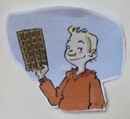
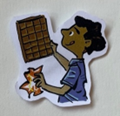
Chocolate bar (in chapter about multiplication) | Chocolate bar (in chapter about multiplication) |
How many pieces does the chocolate bar have? Think of several different ways to calculate it. Which way do you think is easiest? | How many pieces does the chocolate bar have? Think of several different ways to calculate it. Which way do you think is easiest? |
| 
|
Hur många bitar har chokladkakan? Tänk ut flera olika sätt att räkna ut det. Vilket sätt tycker du är enklast? | Hur många bitar har chokladkakan? Tänk ut flera olika sätt att räkna ut det. Vilket sätt tycker du är enklast? |
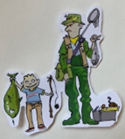
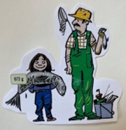
Fishing (in chapter about subtraction)
Martin got a fish that weighed 672 grams. Dad's fish weighed 319 grams less. How much did it weigh?
Martin fick en fisk som vägde 672 gram. Pappas fisk vägde 319 gram mindre. Hur mycket vägde den? | Fishing (in chapter about subtraction)
Dad's fish weighs 619 g (grams) less than Maria's. How much does dad's fish weigh?
Pappas fisk väger 619 g (gram) mindre än Marias. Hur mycket väger pappas fisk? |
Table 1: Examples of the selected IMWP (Undvall et al., 2011; 2019)
We focused on objects —word and illustration— in the IMWP to bring forth the relationship with mathematical knowledge production. With Haraway’s suggestion in mind, about objectification and deconstruction as a means of transforming existing systems of knowledge and ways of seeing (1988, p. 584), we began by looking closely at the IMWP. We placed the objects next to each other, and looked through details, as well as paid attention to specific changes, and similarities. Afterwards, we made agential cuts, which we present through two illustrative examples. During the work on the collage, additional images were also used, the choice of images will be explained at each agential cut. The selected images were free, no attribution required, and changes could be made as needed (https://pixabay.com/sv/).
Agential cut I
Here we will exemplify an agential cut done in the IMWP with the chocolate bar (See Table 1). The act of deconstructing the IMWP, started as mentioned before, by looking closely at the words and illustrations. We could see that the chocolate bar had a central role in the IMWP. So, we used the word
—Chocolate bar— as a keyword to search for additional images that resembled the illustrated one, but also contrasted it. This process assisted us to bring forward new connections to human and nonhuman elements entangled with the chocolate bar, along with mathematical knowledge production. So, cutting together/apart the chocolate bar, and its intended mathematical knowledge production, made their intra- actions visible.
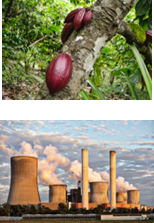
The additional images to the collage showed that the characteristics of a chocolate bar can vary, as well as how it is presented (see Table 2, Images). Thus, it became evident that the chocolate bar when used for a specific mathematical knowledge production is shaped and limited with special characteristics, such as countable pieces, organized in columns and rows. It is a disposition which makes it possible to count in different ways, as requested in words (see Table 2, Wordings). This array is constructed to make visible that multiplication is a quick way to calculate how many pieces the chocolate bar has, which is also the type of knowledge that the IMWP mobilizes since it is included in the chapter of multiplication. At the same time, the IMWP shapes and limits the human-body to recognize mathematics as a cognitive tool —by stressing the word think (see Table 2, Wordings). And also presenting the aspect that there are easy ways to do mathematics, which implies there are also difficult ones. It also becomes visible that the chocolate bar is being decontextualized. That is, it is moved from a concrete and tangible context to an abstract one.
Wordings | Images | Images |
How many pieces does the chocolate bar have?
Think of several ways to calculate it.
Which way do you think is easiest? | Keyword: Chocolate bar
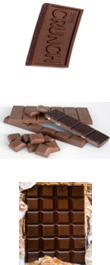
| Keyword: Chocolate, industry
|
Table 2: Example of chocolate bar related keyword, images and wordings
Furthermore, the keyword chocolate bar also generated images of cocoa fruits. Then, by juxtaposing the images of chocolate bar and cocoa tree, new associations where made. We could see that the existence of the chocolate bar was bound to the chocolate-industry (see Table 2). This way of objectifying by deconstructing, viewing the objects further meanings, and seeing chained connections, showed us that the chocolate bar –used as an object in the production of mathematical knowledge– was also reflecting a logic of capitalist colonialism. A logic where nature is for disposal, “[n]ature is only the raw material of culture, appropriated, preserved, enslaved, exalted, or otherwise made flexible for disposal by culture in the logic of capitalist colonialism.” (Haraway, 1988, p. 592).
Agential cut II
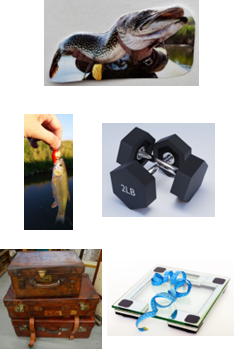
In the second agential cut we focused our view on the human and nonhuman intra-action, and its relationship with mathematical knowledge production in the IMWP “Fishing” (See Table 1). We concentrated on looking for agencies involved, that consisted of both human and nonhuman elements, actively shaping and limiting the bodies they met. First, we looked at the written words, of the IMWP. Words such as “Martin got a fish that weighed”, and “Dad’s fish weighed less than Maria’s”, showed us the need to cut together/apart human-body, fish-body and weight-body, from the IMWP. We looked at the illustrations to see where these three bodies met. Then, a literal cut –with scissors– was made on the illustrations. This made it visible that only one hand/hands and fish were needed for the collage, as the weight was connected to the fish-body. Next, we searched for images that resembled the situation in the IMWP, but also contrasted it (see Table 3). Cutting together/apart the different elements, such as the fish and the hand in the IMWP, made their intra-action visible, with its intended mathematical knowledge production.
It looked like the weight of the fish had an effect on the body that held it. As when the fish was described as heavy, the person appeared to have a firmer grip on it, or even used two hands. While lighter weight could be held with just two fingers. So, while weight seemed to be the main agent, we could also see that the shape, and texture of the fish, as well as the size, mobility and strength of the hands influenced how the human and nonhuman also had agency and met in the production of knowledge about weight. Whereas the production of mathematical knowledge of weight appeared as a further connection, namely to the concept of unit. And therein we could also see a cultural relation, because the unit in the IMWP
was described as “g (grams)”, as in another context the same weight could have been described as oz (ounce), lb (pound), or other ways. A thought that emerged with help of the picture of the dumbbells (see Table 3).
Agential cut II, also showed that the human-body’s gender or ethnicity were not relevant in this intra- action. However, the body’s ability to lift something and sense weight seemed of greater importance for the knowledge production of weight. The IMWP dealt with the idea of measurement, by comparing the weight of two similar objects, two fishes. A comparison that supported the idea of measure as a way of organizing and understanding the world.
Wordings | Illustration | Images |
/Martin got a fish/
/Dad's fish weighed/
/Dad's fish weighs less than Maria's/
How much did it weigh?
How much does dad's fish weigh?
weighed 672 grams weighs 619 g (grams) | 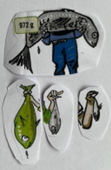
| Keyword: Fishing, weight
|
Table 3: Example of wordings, illustrations, keywords and images
However, if the human body only used vision in the intra-action with weight shown in the IMWP, and misinterpreted or associated weight to the fish length instead, it could be misleading. Which was a thought the image of the measuring tape generated (see Table 3 Images), and the suitcases prompted the idea of things that could be big, but light weighted, and vice versa. For instance, the weight of a suitcase could also be in relation to what is inside it, which is unseen, not only its size. As if, the small suitcase contained stones, and the large one contained cotton balls.
The agential cuts showed that although the mathematical knowledge intention with the IMWP was to enhance the knowledge of subtraction —since it was included in the chapter on subtraction— it was done through the comparison of already established fish weights. In that way, embodied knowledge of weight, as well as a mathematical cultural dimension of weight were entangled with a calculation activity.
Discussion and conclusion
We apply Haraway’s vision (1988) as a way to critically engage with IMWP. By doing a collage and using Barad’s agential cuts (2007), on two different IMWP, we can see that different objects agencies
effortlessly entangle in the process of social and cultural forms of mathematical knowledge production. For instance, in agential cut I, a chocolate bar is included in the IMWP. The agential cuts, shows that a chocolate bar has several chained relationships, that focuses on doings, rather than beings. For start, a chocolate bar “taste good” and is appreciated by children, so it is not surprising that it is included in an IMWP. It “produce positive associations” for many children. However, when seeing it as an object for mathematical knowledge production one must open up for new perspectives of a chocolate bar. And what becomes visible first, when collaging the cocoa tree, entangled with the chocolate bar, is a link to the chocolate industry. So, the chocolate bar “can do” things connected to both nature and industry. Which opens up for the possibility that a chocolate bar “represents” something, as for example, capitalist colonialism, where nature is for disposal (Haraway, 1988, 592), or “remind of” socio-economic issue for those who harvest the cacao beans. Additionally, the other chocolate bar-images, on our collage, show that there are many different kinds of chocolate bars, with different shapes and characteristics. So, a chocolate bar “transforms” easily. In our illustrative example we can see that it gets transformed for a mathematical purpose. Namely, “show an array of columns and rows” to use for a mathematical calculation. It moves from a concrete and tangible context to an abstract one. So, looking close at the IMWP nonhuman objects intra-action, shows that a mathematical knowledge production is not an objective process. Because they are based on a purpose, and a staged situation. It also shows that an IMWP is not disembodied, it has agency. Consequently, an illustration in itself cannot “be” neither a representative figuration, decoration, or cultural artefact. Because “being” is much more problematic and contingent (Haraway, 1988, p.585), unforeseen.
In agential cut II, it becomes visible that the changes done in relation to gender and ethnicity in the books (see Table 3), are really not relevant in the processes of mathematical knowledge production. Because the agential cut focusses the intra-actions of hand-holding-weighing-object. What, however seems important is the body’s ability to experience and sense, for example weight. However, the illustrations as a whole refer to fishing, and when searching for representative images for the collage, one can clearly see that fishing is a gendered cultural activity. Because, most of the pictures that show people fishing, show white men and boys. A pattern that the IMWP in B1 reproduces, and B2 slightly restrains from. Bright (2017) talks about the difficulty of IMWP challenging the status quo with superficial treatments, as long as cultural reproduction rests on perspectives that are portrayed and presented as “normal”. Our proposed method offers an opportunity to view the unseen/normalised cultural ideas that continues to be reproduced. Those that deal with specific ways of thinking, organizing and translating the world. Ideas that are not value neutral, since they privilege particular ways of reading and interpreting the world.
While crafting the collage, one is challenged to stay really observant. The illustrations, words and different images, makes one think extra about ethics. Ethical thoughts tied to both humans and nonhumans, and concerns questions about the images seen in the collage. For instance, we do not show pictures where human faces are visible, even if its authorized. This means we have to cut out faces from the images, and for that we need to perform a literal cropping of the images of humans. Doing it feels different and unsettling, compared to the similar action done to the drawn illustration, even knowing that both are printed, illustrations. It becomes visible how “the god trick” (Haraway, 1988, p 581), the viewing separated from a sensing body, is rooted without one even being aware that the seed has been planted. What is more, as a result of the cropped image, and perhaps the awakening sensibilities, the dead fish-body becomes more visible, and also the awareness of that the fish probably died around the time the picture was taken. Suddenly we started question ourselves: Are we contributing to objectifying the fish, to gain knowledge? Even if we know that we do not value some bodies more or less than others, this belief was questioned while collaging. And it opens up for the predicament that nonhumans, nature and some humans are raw materials that are processed for cultural forms of mathematical knowledge production. It reminds us of something Haraway has written, namely “[v]ision is always a question of the power to see-and perhaps of the violence implicit in our visualizing practices. With whose blood were my eyes crafted?” (p. 585).
We acknowledge the need of varied and analytical approaches, as also Dewolf et al. (2015) asks for. Because there is a need to explore different roles, agencies, entanglements and connections within the
IMWP, and the “world outside”. For this reason, we propose the method that has been put forward in this paper. A method that highlights the entanglements that occurs all the time with(in) the world. And, allows a closer exploration of the relationship between the illustrations, the mathematical content in the texts and, above all, the production of knowledge as children and teachers engage with them all together, in the larger entanglement that constitutes human and nonhuman life.
Acknowledgment
This paper reports on research conducted within the graduate school Relevancing mathematics and science education (RelMaS), funded by the Swedish National Research Council. Special acknowledgment to Johan Unenge for letting us use his illustrations in this text.
References
Barad, Karen. 2007. Meeting the Universe Halfway: Quantum Physics and the Entanglement of Matter and Meaning. Duke University Press.
Barone, T., & Eisner, E. W. (2011). Arts Based Research. SAGE.
Brehmer, D., Ryve, A., & Van Steenbrugge, H. (2016). Problem solving in Swedish mathematics textbooks for upper secondary school. Scandinavian Journal of Educational Research, 60(6), 577–593. https://doi.org/10.1080/00313831.2015.1066427
Bright, A. (2017). Education for Whom? Word Problems as Carriers of Cultural Values. Taboo: The Journal of Culture and Education, 15(1). https://doi.org/10.31390/taboo.15.1.04
Butler-Kisber, L., & Poldma, T. (2010). The Power of Visual Approaches in Qualitative Inquiry: The Use of Collage Making and Concept Mapping in Experiential Research. Journal of Research Practice,
6(2). https://www.proquest.com/docview/2230994166/abstract/6DDF3E438FFD41C2PQ/1
Caligari, L., Norén, E., & Valero, P. (2021). Multilingual Students Working with Illustrated Mathematical Word Problems as Social Praxis. In A. A. Essien & A. Msimanga (Eds.), Multilingual Education Yearbook 2021: Policy and Practice in STEM Multilingual Contexts (pp. 175–194). Springer International Publishing. https://doi.org/10.1007/978-3-030-72009-4_10
Ceder, S. (2018). Towards a Posthuman Theory of Educational Relationality (1st ed.). Routledge. https://doi.org/10.4324/9781351044196
Dewolf, T., Van Dooren, W., & Verschaffel, L. (2015). Mathematics word problems illustrated: An analysis of Flemish mathematics textbooks. Mediterranean Journal for Research in Mathematics Education, 14, 17-42.
Doğan, O., & Haser, Ç. (2014). Neoliberal and nationalist discourses in Turkish elementary mathematics
education. ZDM, 46(7), 1013–1023. https://doi.org/10.1007/s11858-014-0605-z
Fan, L., Xiong, B., Zhao, D., & Niu, W. (2018). How is cultural influence manifested in the formation of mathematics textbooks? A comparative case study of resource book series between Shanghai and England. ZDM, 50(5), 787–799. https://doi.org/10.1007/s11858-018-0976-7
Fridolin, G., Medin, A., & Mejer, T. (2021). Läromedelsutredningen – böckernas betydelse och elevernas tillgång till kunskap, SOU 2021:70.
Haraway, D. J. (1988). Situated Knowledges: The Science Question in Feminism and the Privilege of Partial Perspective. Feminist Studies, 14(3), 26.
Moser, F., & Hannover, B. (2014). How gender fair are German schoolbooks in the twenty-first century? An analysis of language and illustrations in schoolbooks for mathematics and German. European Journal of Psychology of Education, 29(3), 387–407. https://doi.org/10.1007/s10212-013-0204-3
Scotti, V., & Chilton, G. (2017). Collage as Arts-Based Research. In P. Leavy (Ed.), Handbook of Arts- Based Research. Guilford Publications. http://ebookcentral.proquest.com/lib/sub/detail.action?docID=4979052
Undvall, L., Melin, C., Johnson, K., Welén, C., & Dahlin, K. (2019). Matematik Alfa Grundbok. Liber. Undvall, L., Melin, C., & Ollén, Jenny. (2011). Matematikboken Alfa [Grundbok]. Liber.